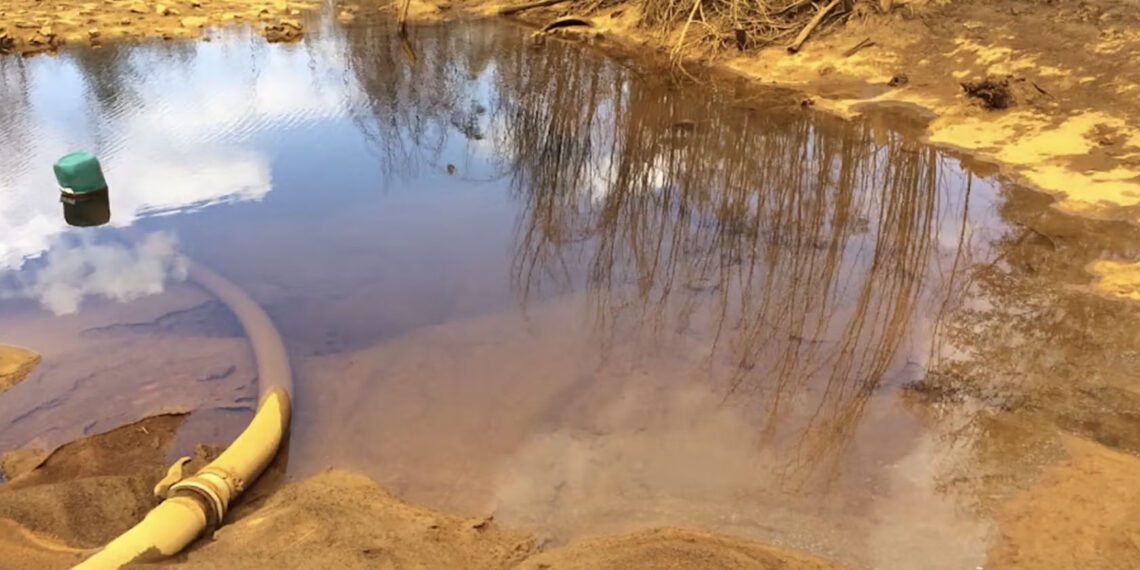
For 140 years, gold mines in Johannesburg, South Africa have been leaking wastewater contaminated with heavy metals. The acid mine drainage from Johannesburg’s estimated 278 abandoned mines and 200 mine dumps includes uranium (a radioactive metal), toxic arsenic, copper, cobalt, nickel, lead and zinc. Acid mine drainage can pollute land and water sources up to 20 kilometres away from a mine unless it is remediated by mining companies. The contamination cascades through food webs and poisons river water, plants and animals.
Before 1994 in South Africa, African communities were forcibly relocated to places near mine dumps in Soweto, south-west of Johannesburg. Today, Soweto is home to 1.9 million people who are exposed to acid mine drainage.
Fellow environmental scientists Salerwe Mosebi, Khayalethu Ntushelo and I researched how acid mine drainage affects urban agriculture in Soweto. Residents of the area rely on their small vegetable gardens to supplement their income and help meet their nutritional needs.
Our research found that acid mine drainage has contaminated the streams, irrigation water sources and subsequently, the soil on the land adjacent to the Klip River, which flows south and west of Soweto.
In very mild doses, exposure to the heavy metals in acid mine drainage can cause dehydration and abdominal pain. In cases of serious exposure, birth defects, brain damage, cancer and miscarriages can result.
Related stories
Mining companies are supposed to keep money aside to rehabilitate the environment after they close, and can only close down once government has granted a closure certificate. But this did not always happen in the past.
The authorities, both government and mining companies, should appreciate the seriousness of the situation so that they can do something about it. Strategies could include chemical treatment of the water and construction of wetlands along the rivers. Wetland plants can soak up large quantities of contaminants, such as heavy metals.
What we found
We took samples from river sediment, river water, borehole water, and cultivated and uncultivated soil in vegetable gardens all along the Klip River. We also took samples of spinach leaves in the gardens.
We ran a variety of tests using different approaches, to see whether microbes or microscopic organisms, which can be bacteria, viruses or fungi, had been adversely affected by acid mine drainage.
The results showed extreme toxicity near the mine dumps at abandoned mines (the source of acid mine drainage). People living closest to these sites were the most affected.
Bacteria are the most robust and hardy forms of life yet the sites we tested were found to be unlivable for all life. Microbes were unable to survive the levels of contamination.
Our findings provide compelling evidence that acid mine drainage is indeed detrimental to the microbial community. It could be disrupting the delicate microbial networks that are so important for a healthy environment.
How does this pollution affect Soweto residents?
Soweto residents are affected by the mine dumps, toxic dust and the polluted land and rivers. I grew up in Tladi, Soweto, very close to the Klip River. My friends and I used to play in the river, and cross it on makeshift and precarious stone bridges to get to church and shops on the other side. We were oblivious to the danger of acid mine drainage at the time.
Today artisanal miners, locally known “zama-zamas” (meaning “we try! we try!”) are re-mining the dumps. They are extremely exposed to the heavy metals because they handle the acid mine drainage, often without any protective clothing.
In the last 20 years, government has offered some incentives to mining companies to pump away the acid mine drainage so that it is not continuously leaking into Soweto’s rivers and streams.
However, our study found that this is simply not enough. The residents to the north of Soweto’s Dobsonville, Diepkloof and Meadowlands neighbourhoods live almost on top of mine dumps and they are most affected.
Our research found that soil from uncultivated fields in Soweto was more toxic than soil from the cultivated fields. This is because crops in the cultivated fields are irrigated with more healthy borehole water, which originates underground. It is possible that this borehole water dilutes the metal concentrations and reduces contamination in cultivated soil.
This means that farmers will need to irrigate with tap or borehole water, rather than river water. This is costly and less convenient for small farmers living along the river.
People who live along the Klip River are also at risk of being exposed to heavy metals. We also found that the rest of Soweto’s residents are very vulnerable to heavy metal dust that is blown around during strong winds.
We hope the government will take steps to safeguard people in Soweto affected by acid mine drainage. This will help ease the burden on an already strained public health sector now and in the future.
The abandoned mines should be lawfully decommissioned. People living very close to the mine dumps must be relocated, and a rehabilitation programme must be implemented to sustain urban agriculture.
- This article is republished from The Conversation under a Creative Commons license. Lesego Khomo is a senior lecturer of department of environmental science, University of South Africa.
ALSO READ: Axed agricultural practitioners demand jobs back
Sign up for Mzansi Today: Your daily take on the news and happenings from the agriculture value chain.