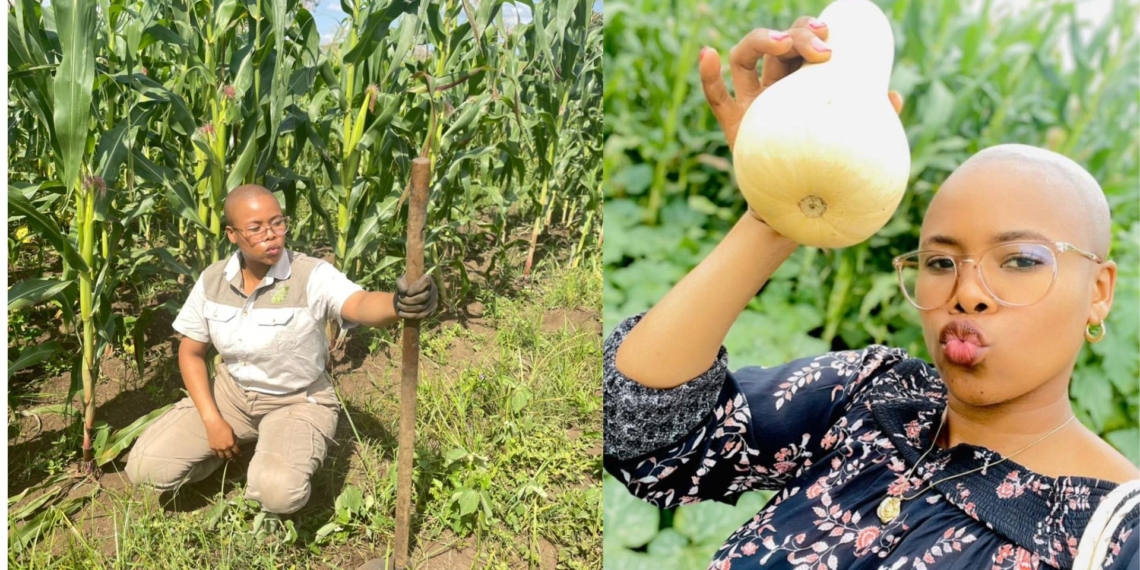
Nonjabulo Mzobe studied maritime studies with hopes of becoming a navigating officer on a commercial ship. But life had other plans. With unemployment rising and memories of her family’s land calling her back, Mzobe returned home and chose farming.
Growing up in Bhamsehla, Chibini in Ndwedwe, north of Durban, she moved between village life and townships. That experience shaped how she sees the world and gave her a sense of balance.
In 2024, she registered Nonrican Agri-Farm, focusing on crop production and slowly building a future rooted in the soil.
Unemployment leads to opportunities
Since childhood, she always dreamed of a life connected to cruises, ships, and everything about boat and ship transportation.
Mzobe studied maritime at the SA Maritime College from 2014 to 2017 and then did an internship at the Sharks Board from 2018 to 2019, facilitated by the Moses Kotane Institute. However, after her internship, she realised that opportunities were not as easy or abundant as she had imagined.
“I struggled with unemployment from 2020 until I decided to start a business. Sitting at home in Umlazi, I thought of selling clothes.”
In early 2025, Mzobe started her clothing line business and moved from Umlazi to Ndwedwe for a fresh start, a new environment, and new people.
“I took a loan of about R2 000 for my first stock. It was a risk because I wasn’t sure whether I could make sales; I just knew that I had to start somewhere.”
She explains that she never felt left out, as the local community welcomed and supported her business. “I used social media and went door to door, trying to build my brand and a loyal customer base.”
She registered an agricultural business before moving into practical farming.
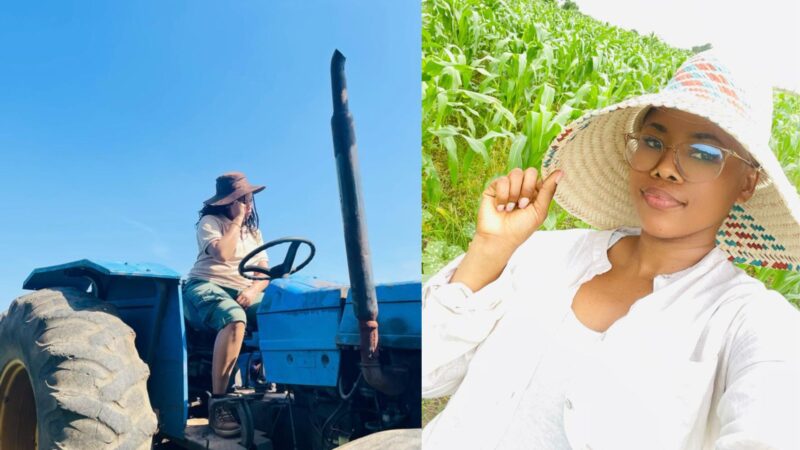
Mzobe noticed that the once green and colourful garden her grandparents had tended was now overgrown and lifeless.
“With my profit [from selling clothes], I started employing people to cut the trees from April to September,” she adds. “It took longer than I anticipated because the plot was too bushy and uneven.” Afterwards, she had to push more for profit to hire a tractor to level her land.
Related stories
- Gogo’s helper: Mothudi grows healthy crops and community
- Limpopo farmer finds peace, purpose in the harvest
- Three little pigs pull ex-prisoner from the depths of despair
- Visionary farmer takes agritourism to KZN village
All the perseverance, the waiting, and the courage to start were strengthened by the support of her mother, Nokuthula, who has been her pillar of strength and a forceful woman who pushes against all odds.
“My mom showed me from an early age that someone has to start somewhere and that there is nothing a woman cannot do when she pushes hard. I carried that lesson with me as I grew older.”
Seeds of a new start
The first crops were planted on 10 November 2025, after attending an agricultural summit in Ballito.
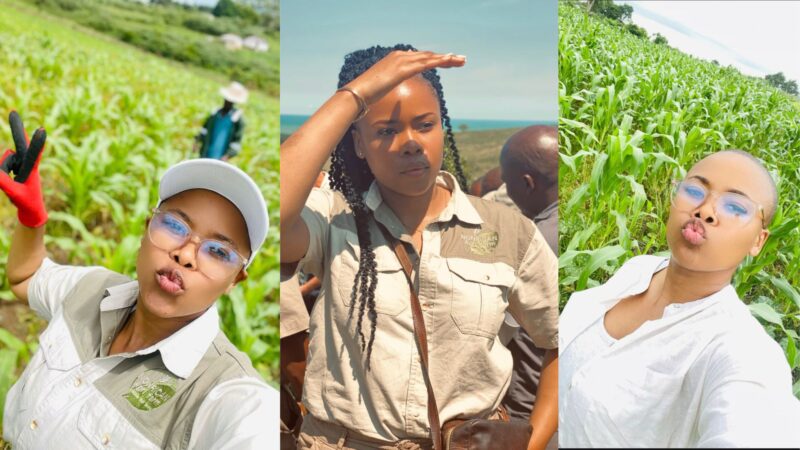
“I spoke to agricultural experts about which crops I can start with, as an inexperienced farmer with no formal background. They said I can start with maize, potatoes, and beans. I added pumpkins and butternuts.”
She practices intercropping, something she learned at one of the agri workshops she attended. Half of 2025, she spent on the road, selling her harvest, gathering information, and meeting other farmers.
“Another thing that kept me motivated was that I had employed people to work on my garden. I had to go out and sell so I could make a profit,” she explains.

Currently, Mzobe has an agricultural advisor, Xolani Madlala, under the agricultural municipality of Ndwedwe. She adds that Sambulo Sithole, another advisor at Ilembe Enterprise, also supports her.
Learning the tricks of the trade
Towards the end of the year, Mzobe heard about the Africa Co-operative Action Trust (ACAT) in Howick, Pietermaritzburg, from a teacher she knew locally.
She applied and joined a year-long course this January. So far, she says, the programme has exposed her to leadership development, agricultural programmes, community volunteer training, and lessons on “making God the centre of our lives and finding ways to improve our communities and fight poverty.”
Her business, Nonrican Agri-Farm, plans to expand into livestock. She has identified a gap in the market for chickens, both live and slaughtered, to supply local restaurants and community members. She also sees opportunities in the goat and pig markets, which she hopes to add in the future to grow her business.
“For now, it is just the beginning, but my goal is to become a commercial farmer producing safe, quality products for people in this country,” Mzobe says.
She adds that it is also important to her to create job opportunities and equip the youth with skills that can help them become independent one day.
READ NEXT: Simphiwe’s KZN rural roots grow into retail farming business