Tuesday, April 14, 2026
SUBSCRIBE
21 GLOBAL MEDIA AWARDS
Food For Mzansi
  • News
  • Changemakers
  • Lifestyle
  • Farmer’s Inside Track
  • Food for Thought
No Result
View All Result
  • News
  • Changemakers
  • Lifestyle
  • Farmer’s Inside Track
  • Food for Thought
No Result
View All Result
Food For Mzansi
No Result
View All Result
in Inspiration

Breaking new ground: Msibi trades marketing for mixed farming

When the pandemic disrupted her marketing studies, Nomasonto Msibi didn't just pivot; she planted. By merging traditional family knowledge with a formal agricultural diploma, the founder of Friendly Farms has built a growing mixed-farming enterprise in the Vaal

by Vateka Halile
13th February 2026
Nomasonto Msibi is an assistant teacher in the mornings who spends her after-hours farming, committed to growing her business and making a meaningful difference in her community. Photos: Supplied/Food For Mzansi

Nomasonto Msibi is an assistant teacher in the mornings who spends her after-hours farming, committed to growing her business and making a meaningful difference in her community. Photos: Supplied/Food For Mzansi

Share on FacebookShare on TwitterShare on WhatsApp

Nomasonto Msibi from Vaal in Gauteng has always known what she wanted and pursued it. When the Covid 19 pandemic hit, it shifted her perspective and showed her that life is not always shaped by what you studied for, but by the opportunities you respond to. 

That shift led her into mixed farming, a path she has fully committed to. As the founder of Friendly Farms, she is focused on building a sustainable business with a long-term vision.

Msibi studied marketing and sales management at the Sedibeng TVET college from 2018 to 2019, believing at the time that it was what she needed. When the Covid 19 pandemic hit, that thinking shifted as the priority became putting food on the table. 

She initially tried crop production but struggled while relying only on traditional methods. “I started doing more research on agriculture, and that is when I decided to drop out at NQF Level 6 in marketing and pursue agriculture,” she says.

A change in mindset

In 2022, she applied to the Potchefstroom College of Agriculture and completed a diploma in agriculture, specialising in mixed farming. 

She now farms on two hectares, producing poultry, sheep, spinach, tomatoes, pumpkin, squash, cabbage and other cash crops.

Msibi says formal training helped strengthen the traditional knowledge she already had. “I no longer focus on planting only two crops for local sales. I now understand how to broaden my market and produce according to market standards.”

Farming was always part of her life, often serving as a safety net during periods of unemployment, as she grew up in a farming household.
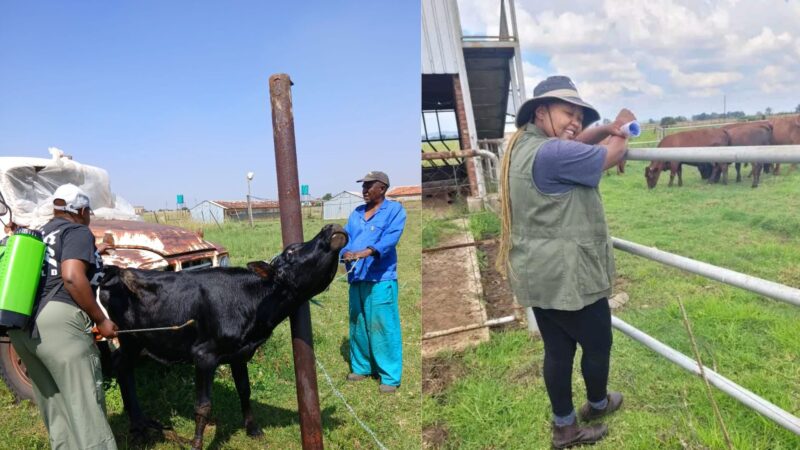
Nomasonto Msibi carries out manual tick control on her cattle at home as part of her daily livestock maintenance routine. Photos: Supplied/Food For Mzansi

She shares that although she used to attend auctions with her father, she never considered farming as a business.

“To me, auctions were just about selling an animal to get money for survival. Obtaining my diploma at the Potchefstroom College of Agriculture helped shift my mindset.” 


Related stories
  • Brewing heritage: Amahle swaps chef whites for farming boots
  • Skepe is living proof that perseverance pays off
  • Always have a backup plan, says Pretoria poultry farmer
  • Marketing tips for poultry agribusinesses

From self-funded to NYDA grant

Msibi runs her business on her family’s farmland and says she has always been self-funded, as that was the only option available to her. In 2023, the National Youth Development Agency (NYDA) visited the Potchefstroom College of Agriculture to offer business training on campus.

“I attended and completed the training. After that, we were given an opportunity to apply for funding from the institution. Luckily, I had already registered my business and was already operating.” 

It paid off, and she received R50 000 in funding from the NYDA. “The grant helped me buy stock and assisted with applying for UIF for my employees,” she tells Food For Mzani.

For Msibi, the funding came at a critical time, as she was sometimes struggling to make consistent profits. “My business grew, and I was able to produce up to 500 chickens per cycle for our local abattoir.” 

She explains that she purchased 2 000 broiler chicks and feed, as well as a chicken plucker for slaughtering. The remaining funds were used to buy medication such as vaccines and stress-relief packs for the chicks. 
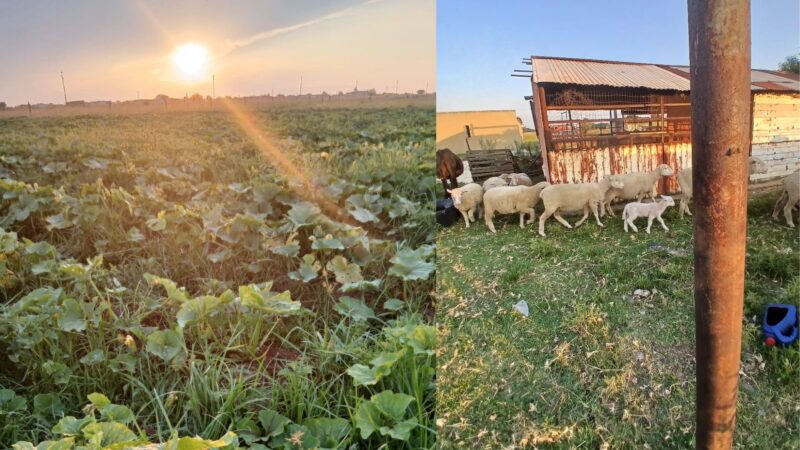
Nomasonto Msibi says changing climatic conditions sometimes lead to losses in her garden, much like disease outbreaks can affect livestock. Photos: Supplied/Food For Mzansi

Broiler chickens are her main focus due to their efficiency in meat production. She says the structures were already in place, with five poultry houses that can accommodate up to 2 500 birds. 

Her market includes the local community, flea markets, door-to-door deliveries and direct bulk sales to customers. “What works for me is being a reliable supplier, especially in an industry with a lot of competition. Maintaining quality is our priority,” she says.

“People rely on us for fresh meat, vegetables and the basic service of food security.”

Building towards larger markets

Msibi says that with the support of her parents, the farm continues to operate in her absence. This year, she started volunteering at a school of agriculture at Tshepong Secondary School in the Vaal, under the Sedibeng District.

“I am at the school from 7 am to 3 pm, and the afternoons are dedicated to my business.” 

In addition to poultry and crops, Msibi keeps livestock. She has nine Merino sheep aged between two and three years, five that are 10 months old, and three newborn lambs, bringing the total to 17. She also owns three Jersey-Angus cross bulls.

“I chose these breeds because of the meat quality, strong genetics and wool,” she says. “We are able to sell sheep in three ways: meat, wool and pelts, which allows for better profitability.”

She adds that she is looking to expand her herd but faces challenges in meeting growing demand. “People want to buy in larger numbers, and many trust my produce, but at the moment I cannot maintain the quantities the market requires.”

Msibi also completed practical training with one of the largest mutton producers in the Free State, Lee Meat, between Deneysville and Oranjeville.

“The practicals focused on lamb feedlot production. I have an opportunity to supply them, but only if I can sustain the volume of lambs they require on a weekly basis,” she says.

As Msibi keeps learning and Friendly Farms expands its reach, she remains a beacon for young entrepreneurs, demonstrating that agriculture is not just about survival; it is a sophisticated, scalable business.

READ NEXT: Mchunu’s fertile vision turns cow dung into farming gold

Sign-up for the latest agricultural news delivered straight to your inbox every day with Mzansi Today!

Vateka Halile

Vateka Halile grew up in rural areas of Cofimvaba in the Eastern Cape. She was raised in a traditional family setting and found writing to be a source of comfort and escape. Vateka participated in an online citizen journalism course through Food For Mzansi, and her passion for health and medicine-related stories was born. Her dedication to community work and love for social justice and solidarity spaces is evident in her quality time with the community when she isn't working.

Tags: GautengInspire meMixed farmingWomen in Agriculture

Related Posts

100 ha of hope: Aphiwe revives family farming legacy in Engcobo

100 ha of hope: Aphiwe revives family farming legacy in Engcobo

13th April 2026
Poultry and potatoes power Fort Hare graduate’s farming vision

Poultry and potatoes power Fort Hare graduate’s farming vision

10th April 2026

Big dreams on his ‘Tiny Farm’: Setjhaba’s 300-hectare success

Jobless to boss: Sihle Petela grows jobs and crops in Mthatha

Sabelani Co-op gives Bongani Nkosi purpose and a future

Dignity in the vineyards: How DONUTS wine changed SA farms

Agrolimo Farms: Tebogo turns schoolyards into Soweto’s pantry

Bongeka’s backyard business grows from 100 to 3000 broilers

Rooibos cosmetics offer growth path for agripreneurs
Lifestyle

Rooibos cosmetics offer growth path for agripreneurs

by Vateka Halile
11th April 2026

Rooibos isn’t just for tea anymore. South African agripreneurs are tapping into its antioxidant power to create skincare products with...

Read moreDetails

Rainbow expert shares blueprint for poultry farming success

11th April 2026
Poultry and potatoes power Fort Hare graduate’s farming vision

Poultry and potatoes power Fort Hare graduate’s farming vision

10th April 2026
The business of farming: How to make your farm bankable

The business of farming: How to make your farm bankable

10th April 2026
Western Cape pledges R22m for drought-hit livestock farmers

Western Cape pledges R22m for drought-hit livestock farmers

10th April 2026

This week’s agri events: 13 – 17 April

Four lessons from Colombia to fix South Africa’s land reform

How climate-friendly farming is paying off for rural EC communities

Every drop counts: Managing precision irrigation for export citrus

Agri leaders urge farmers to think beyond production

Join Food For Mzansi's WhatsApp channel for the latest updates!

JOIN NOW!
Next Post
Harvesting love: How farming couples balance business & romance

Harvesting love: How farming couples balance business & romance

THE NEW FACE OF SOUTH AFRICAN AGRICULTURE

With 21 global awards in the first six years of its existence, Food For Mzansi is much more than an agriculture publication. It is a movement, unashamedly saluting the unsung heroes of South African agriculture. We believe in the power of agriculture to promote nation building and social cohesion by telling stories that are often overlooked by broader society.

AgriTrends: SA farmers adapt as global shocks reshape agriculture

Every drop counts: Managing precision irrigation for export citrus

Four lessons from Colombia to fix South Africa’s land reform

Sugar industry hopeful as phase 2 of master plan launches

100 ha of hope: Aphiwe revives family farming legacy in Engcobo

Didiza calls for radical shift in youth land access and finance

  • Awards & Global Impact
  • Our Story
  • Contact Us
  • Cookie Policy
  • Privacy Policy
  • Copyright

Contact us
Office: +27 21 879 1824
News: info@foodformzansi.co.za
Advertising: sales@foodformzansi.co.za

Contact us
Office: +27 21 879 1824
News: info@foodformzansi.co.za
Advertising: sales@foodformzansi.co.za

  • Awards & Global Impact
  • Our Story
  • Contact Us
  • Cookie Policy
  • Privacy Policy
  • Copyright
No Result
View All Result
  • News
  • Changemakers
  • Lifestyle
  • Farmer’s Inside Track
  • Food for Thought

Copyright © 2024 Food for Mzansi

This website uses cookies. By continuing to use this website you are giving consent to cookies being used. Visit our Privacy and Cookie Policy.