Wednesday, October 21, 2026
SUBSCRIBE
22 GLOBAL MEDIA AWARDS
Food For Mzansi
  • News
  • Changemakers
  • Lifestyle
  • Farmer’s Inside Track
  • Food for Thought
No Result
View All Result
  • News
  • Changemakers
  • Lifestyle
  • Farmer’s Inside Track
  • Food for Thought
No Result
View All Result
Food For Mzansi
No Result
View All Result
in Farmer's Inside Track

How to put the cherry on top of your production

Besides being labour and capital-intensive, cherries are tricky little customers when it comes to rainfall and temperature. But these sweet, handpicked fruits have plenty to offer if managed correctly

by Octavia Avesca Spandiel
29th November 2022
How to put the cherry on top of your production

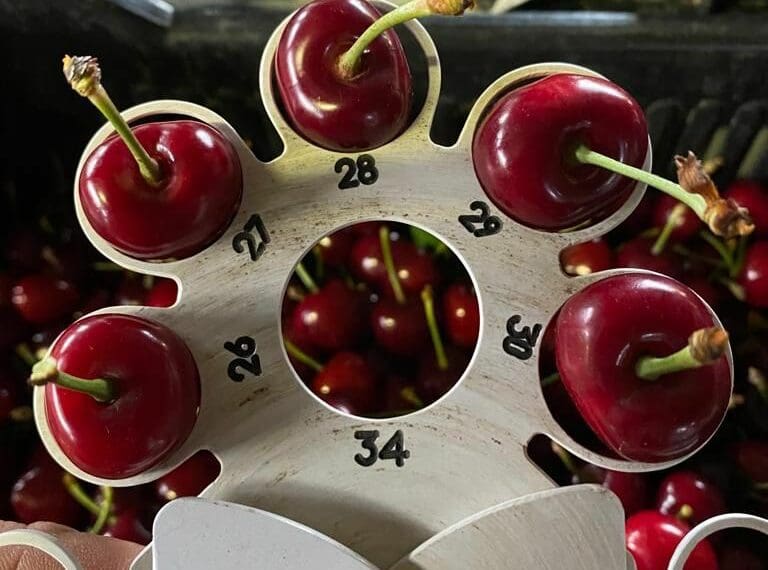
Cherries do not require a lot of water for production, and too much rain will spoil the fruit. Photo: Supplied/Food For Mzansi

Share on FacebookShare on TwitterShare on WhatsApp

The cherry fruit is known for its highly capital and labour-intensive production, but cashing in on the profit is well worth the wait for Mzansi farmers.

The beautiful, sweet cherry fruit faces a variety of challenges, such as extreme winter temperatures and the summer rain can also ruin the fruit. But with all the odds against it, there is still hope for a profitable business when it comes down to the adequate management of cherries.

Where to start?

The first thing that is important to do, is to test your soil. This is to see if anything can grow on the land that you want to farm on, says Fanie Grobbelaar, farm executive manager at Welgelegen Cherry Estate.

“Do your research, understand the climate conditions, and always have a plan B for your land,” says Grobbelaar.

Originally, cherries are bought as seedlings and this should take about 30 days to produce seeds. But if you want to farm commercially, then it is best to buy them as trees because cherries take years to bear 100% fruit, he explains.

“Even though you get your cherries as seedlings, it is best to buy them as trees and it is important to ask from where you purchase if they are self or cross-pollinated.”

“It takes about seven years to bear 100% fruit and about six years for you to get a return on your investment,” says Grobbelaar.

He says that farming with cherries is quite capital-intensive and it is a very sensitive tree. He creates the analogy that cherry trees should be treated like  women. “Handle with care and a lot of love.”

Climate and irrigation requirements

Climate is a very important aspect of cherry growth. Cherries are predominantly produced in the Western Cape, Ceres to be exact, as well as the Eastern Free State and Mpumalanga.

Interestingly enough, the Eastern Free State was a great source of cherry production prior to the  Western Cape, says Grobbelaar. But the Eastern Free State, for example, gets summer rain. This is during the season that cherries ripen and can result in cherries busting through their skin making it inedible, which means it can’t be sold.

“Cherries prefer to be grown in cool spring and mild summer conditions and cold winters, preferably seven degrees and below. They do need a long winter and go into dormancy. It’s like they are sleeping and the more they sleep, the better fruit they give you in summer.”

The Western Cape’s climate is much better for cherry production because it does not receive an excess amount of water.

“What makes the Western Cape climate better is the winter rainfall because cherries have a tendency to burst if they get too much water,“ he says.

Cherries do not require a lot of water for production. “From flowering in September until harvesting, they require about 25mm a week.”

Grobbelaar explains that every farmer’s worst nightmare in cherry farming played out this year. The Eastern Free State region received too much rainfall, about 300mm, bursting the cherries’ skin open.

Different kinds of pests and diseases

There are various kinds of pests and diseases such as brown rot, black knot, cherry leaf spot and cytospora canker. To protect your cherry trees from pests and diseases, Grobbelaar advises using nets.

He adds that farmers need to protect the cherry trees against the elements such as hail, as well as birds and mainly theft.

“It’s a tough thing because the law does not protect farmers against theft because there’s no way to prove that the cherries belong to you. Farmers should form the habit of walking through the land to detect if anything is happening,” says Grobbelaar.

Marketing landscape

For the past couple of years, the cherry market has fluctuated in Mzansi, as Grobbelaar explains “it is up one year and down the next.” 

Essentially, there are a lot of factors to consider. ”It’s all due to Covid-19, the UK with inflations, and of course the markets being down with the Ukraine and Russian war,” he adds.

“In South Africa, there has been a steady decline of reproduction of cherry trees but an increase of apples, oranges, and naartjie.”

Grobbelaar has also noticed a decline in cherry farming in South Africa due to it being capital and labour-intensive, which is understandable, he says.

“It is very intensive and there is only a certain period to harvest. Harvesting time is between August and February and your peak season for growth is between October and November,” says Grobbelaar.

ALSO READ: A guide to growing canola

Sign up for Farmer’s Inside Track: Join our exclusive platform for new entrants into farming and agri-business, with newsletters and and podcasts.  
Octavia Avesca Spandiel

Raised by a close-knit family who loves her deeply, Octavia believes in the philosophy of ‘I am because you are'. This former news and content editor for radio is now living her best life in the agricultural sector as a commercial journalist at Food For Mzansi. Her soft spot for poetry and passion for life, writing and traveling inspires her to write compelling stories. Apart from being an excellent writer, Octavia has an educational background in youth work and loves working with people. 

Tags: cherry farmingFruit industry
This week’s agri events: 19 – 23 October
News

This week’s agri events: 19 – 23 October

by Tiisetso Manoko
19th October 2026

There is a lot happening in the final months of 2026! Get all the information on the Villiersdorp Show, livestock...

Read moreDetails

Stop the rot: Four steps to slash post-harvest losses

18th October 2026
A standing ovation for agriculture’s incredible talent! The Agri’s Got Talent 2026 top three celebrate their achievements: winner Honey Katoo of Endulini Fruit in Patensie, alongside runner-up Clareece Vlotman of Wolfpack in Wolseley and finalist Lwandile Nantsi of Laastedrift in Ceres. Photo: Supplied/Food For Mzansi

Patensie claims Agri’s Got Talent crown for second year running

17th October 2026
The panellists at FNB Business’s “Farming together” discussion at the Royal Show explored how market access, mentorship, financial discipline and strong commercial relationships can help farmers build sustainable businesses. Featured from the left are Bertram July (FNB’s distribution sales lead), commercial farmer Shakes Shabalala; Sandy Gumede (co-founder of Zulu Girl Wines), and Janis Robson (FNB’s head of development and SME business development). Photo: Food For Mzansi

FNB puts relationships at the heart of commercial farming

17th October 2026
Agri Skills Transfer students gain hands-on experience at the institution’s Cullinan Farm Training Centre, where agricultural theory meets the realities of commercial production. Photo: Supplied/Food For Mzansi

Build your future in agriculture with Agri Skills Transfer

17th October 2026

Patensie claims Agri’s Got Talent crown for second year running

Mpumalanga agripreneur bottles family wisdom one chilli at a time

This week’s agri events: 19 – 23 October

Reluctant farmer scales EC cabbage enterprise to supply Spar

CPAs urged to register for free governance support toolkits

Join Food For Mzansi's WhatsApp channel for the latest updates!

JOIN NOW!
Next Post

FIT Summit: 'Break stigmas, barriers in farming'

THE NEW FACE OF SOUTH AFRICAN AGRICULTURE

With 21 global awards in the first six years of its existence, Food For Mzansi is much more than an agriculture publication. It is a movement, unashamedly saluting the unsung heroes of South African agriculture. We believe in the power of agriculture to promote nation building and social cohesion by telling stories that are often overlooked by broader society.

CPAs urged to register for free governance support toolkits

Potatoes and tomatoes plunge while avocado prices soar

Becoming bankable: How to get your farm ready for finance

Fixing SA’s agricultural visa system to protect seasonal harvests

SA and Namibia reevaluate livestock trade after FMD outbreak

Agda conference to tackle finance, market access and agri growth

  • Awards & Global Impact
  • Our Story
  • Contact Us
  • Cookie Policy
  • Privacy Policy
  • Copyright

Contact us
Office: +27 21 879 1824
News: info@foodformzansi.co.za
Advertising: sales@foodformzansi.co.za

Contact us
Office: +27 21 879 1824
News: info@foodformzansi.co.za
Advertising: sales@foodformzansi.co.za

  • Awards & Global Impact
  • Our Story
  • Contact Us
  • Cookie Policy
  • Privacy Policy
  • Copyright

Chat Options

About this assistant

This feature generates automated answers summarised from Food For Mzansi articles. By using it, you are interacting with an AI system (provided by Google), not a human. AI can make mistakes. Please refer to the source articles for verification and citation purposes.

Our staff do not check or moderate Lerato’s answers in advance, but may review some later. Our journalists continue to write and edit all the articles Lerato uses as sources.

To estimate unique and returning web users, we store a random browser ID in this browser. WhatsApp users are counted by phone number. The same person using both channels may be counted twice.

I'm Lerato, your AI assistant!
No Result
View All Result
  • News
  • Changemakers
  • Lifestyle
  • Farmer’s Inside Track
  • Food for Thought

Copyright © 2026 Food for Mzansi