Families occupying land near Grabouw face an uncertain future as the department of public works and infrastructure (DPWI), which owns the land, is “still looking at all of its options”.
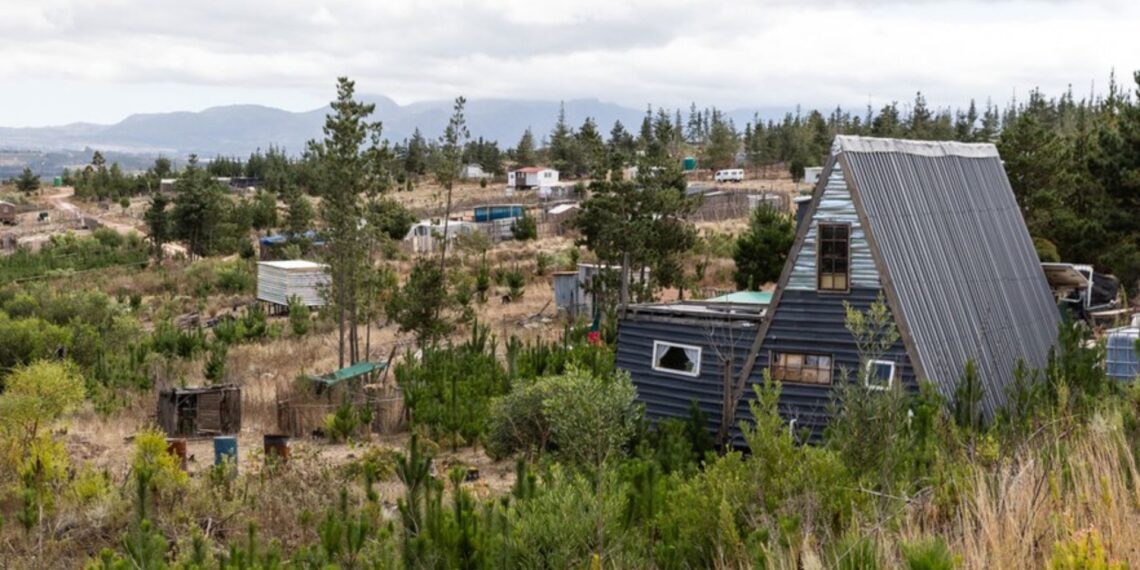
The area now known as Knoflokskraal was first occupied in 2020 by people who wanted to establish a self-sustaining Khoisan community in the Elgin Valley. The settlement has grown, with homes, livestock farms and vegetable gardens spread across 1 800 hectares.
Small-scale farmer Benjamin September says when he moved to Knoflokskraal from Grabouw, it was “just bush”.
“We are making something out of nothing,” he says. September says it was his dream to have a piece of land to farm.
“We didn’t come for housing. We came to farm… We will work the land, plant on it, and live from it. That was our reason. Not housing… Our main goal is to be self-sustaining,” September said.
He said vegetable gardens and livestock help the farmers beat the rising cost of living.
Related stories
- Balancing human rights and land reform: Can SA get it right?
- Land reform is justice, not just policy, says Ngcukaitobi

Julius Maree, chairman of the Knoflokskraal Emerging Farmers, has been living in Knoflokskraal for four years. Photo: Ashraf Hendricks
Knoflokskraal has been a thorn in the government’s side since its inception. Soon after the initial occupation, the DPWI started a legal process which resulted in a containment order. This means that no new people are allowed to move onto the land, and no one is allowed to expand their properties or to bring in building materials. But this has not prevented the growth of the settlement.
Initially, the land was earmarked for forestation by the department of forestry, fisheries and the environment (DFFE). The DFFE planned to evict the residents. But then-minister Barbara Creecy said in 2022 that management of the land would be handed back to Public Works.
In May 2023, Knoflokskraal residents picketed on the N2, demanding water and sanitation and the lifting of the containment order. Earlier this year, they staged three further protests on the N2 to demand better access to water.

Despite the court’s containment order, people have extended their homes and yards over the years. Photo: Ashraf Hendricks
The Theewaterskloof Municipality has said it does not have the funds to provide basic services like water and sanitation. Members of the community say they are prepared to pay for services if infrastructure is installed.
There is a water pump on the property, pumping water from the river. But September said the pump stopped running after Eskom cut the power due to the bill not being paid. The Theewaterskloof Municipality fills two 5 000-litre water tanks daily, but this is not enough, according to September.
“Our gardens and animals have suffered,” he said.
The municipality told GroundUp that, “We solely assist with the provision of water as a humanitarian act, but it isn’t our mandate. It can’t be done on a large scale as it is not provided for in our operational budget.”

Families living in Knoflokskraal do not have access to running water, electricity or sanitation. Photo: Ashraf Hendricks
GroundUp found residents gathered around a water tank, filling up five-litre bottles of water. Others were wheeling water up the road, which they fetched from the river.
Public works spokesperson Lennox Mabaso said the department “does not provide basic services such as water and electricity to people illegally occupying state property.”
Over the years, people have extended their homes and yard spaces. Houses are made of brick, wood, or corrugated metal sheets. The plots are large and surrounded by vegetation. Some residents have solar power, with inverters, and septic tanks.
Many businesses have opened, including a restaurant, nursery, gas refills, and wood and carpentry shops. There are market days on some weekends.
Some people told GroundUp they moved to Knoflokskraal to retire. A few structures stood locked and empty, because the owners lived elsewhere, GroundUp was told.

Mortimer Beckett (left) and Dawid de Wee, president of the Khoi Aboriginal Party. De Wee says they’ve tried to ask government for services, but nothing has happened. Photo: Ashraf Hendricks
Julius Maree, chairman of the Knoflokskraal Emerging Farmers, representing about 40 small-scale farmers, said farming the land is “not easy”. “It’s endurance. Some have given up. You must have the willpower,” said Maree.
He said Grabouw, which he left for Knoflokskraal, had become overpopulated and dangerous. When he saw the opportunity to farm at Knoflokskraal, he took it “with open arms”, Maree said. He plans to retire there one day.
Dawid de Wee, president of the Khoi Aboriginal Party, said residents have tried asking the national and provincial governments for services. “But nothing much has happened from the government’s side.”

Earlier in 2025, residents staged three protests on the N2 due to the lack of water in the community. Photo: Ashraf Hendricks
De Wee said crime rates were low. Residents were starting a neighbourhood watch with the Grabouw Community Police Forum (CPF).
Resident Mortimer Beckett said that the government referred to the people occupying Knoflokskraal as “land invaders”. But they are “land reclaimers”, he says. “This is our land. History says so.”
“For the time I’ve been here, the community has been successful with being self-sustaining,” said Beckett.
But the lack of sewerage and waste removal services would become “a big problem” and possibly a health crisis, he said.
“Our people can’t grow here, because they don’t have water. We can turn it into a paradise, but at the moment it’s a desert,” he said.
Mabaso said the department was “looking at all of its options”.
“No individual has the right to occupy state property illegally,” he said. He said DPWI continued to provide security at the property. “However, this has been inadequate to stop further occupations and is being re-looked at in terms of our broader view of the illegal occupations.”
Meanwhile, the containment order is still in place, he said.

Many residents of Knofloskraal farm livestock and vegetables to sustain themselves. Photo: Ashraf Hendricks
This story was first published on GroundUp.
READ NEXT: Zimbabwe begins payouts to former farm owners
Sign up for Mzansi Today: Your daily take on the news and happenings from the agriculture value chain