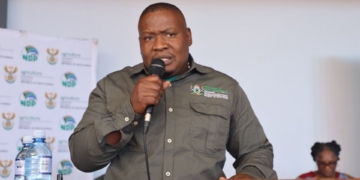
In his keynote address at the Mzansi Young Farmers Indaba on the final day, renowned legal scholar and author Adv. Tembeka Ngcukaitobi called on young people to stand united and speak in one voice regarding land access. He said that while they might feel pressure and resistance, they need to be resilient and leaders of today.
He said that the Expropriation Act is another paper tiger without addressing the demand side of land reform; it is only loud in its bark but ineffective.
“While the thrust of my talk today has tended to focus on the socio-economic benefits of land reform, it is necessary to recall that land reform is primarily a matter of justice,” he said.
Young leaders needed
Ngcukaitobi said young farmers of today must emulate the likes of Nelson Mandela, Oliver Tambo, Anton Lembede and Walter Sisulu in their fight to get land and work on it.
“Not only did they aspire to create a nationalist movement, their economic policy was founded on the simple, yet profound vision about the land: they wanted the re-division of land among farmers and peasants of all nationalities in proportion to their numbers,” he said.
He noted that the challenge for this generation of farmers is that they need to produce the next Lembede, Mandela, and Sisulu. “As young farmers, you have the challenge of leadership. Of finally taking us to the promised land.”
Speaking on the government’s ability to help with speeding up land access, he said two million hectares of land is in the hands of the government and not productive, which further delays new-era farmers from working the land.

Related stories
- Closing the divide: Why transformation must start with farmers
- Ramokgopa: Young farmers, rise and take your space in agriculture
“According to state policy, this land is used for allocation to black farmers, incubation, training and graduation of smallholder farmers and agricultural graduates. It is never clear who qualifies for which land and for assistance, thus opening channels for corruption and maladministration.
“Now, two million hectares of land is significant in a country with so much land shortage. For perspective, the total land surface in the Ingonyama Trust land is 2.8 million hectares. That accommodates 5.2 million people including large-scale commercial farms,” he said.
Just and equitable land reform
Ngcukaitobi said labour tenants are also another area of interest insofar as the land falling under the Labour Tenants Act may be expropriated subject to nil compensation.
“These are people who work, not for a wage, but for the right to reside. And when that is squared up against history, compensating landowners in labour tenancy cases is itself an odious thing. Arguably, they have been compensated enough through the (un)free labour,” he said.
According to Ngcukaitobi, transformation is non-negotiable, and the ruling party must accept that they have promised the people land and they have not done so.
“The mere fact that land is needed for land reform is not a general entitlement to take it on nil compensation basis. Nil compensation must also be just and equitable. Some factors are highlighted as possible indicators where nil compensation may be just and equitable.
“There has been some clever distortion of Trumpian proportions by the opponents of the act, arguing that land falling within these categories will be taken without compensation. There is no closed list, and each land parcel will be subject to the overall test of justice and equity.”
Responding on the importance of the country retaining its sovereignty, he said South Africa should not be bullied but diplomatically engage the United States to address the impasse.
“Living in South Africa, with the vestiges of colonialism and apartheid that still shape our imagination of the present and the future, we should have an acute sense of what needs to be corrected in society.
“There is much more. An impression seems to be entrenched that Section 12 is a land seizure provision. This is mischief. Plain old mischief. The state has no unqualified power to grant nil compensation. And each expropriation is itself an administrative act which is subject to judicial review. Only judges may make final decisions over expropriations,” he explained.
READ NEXT: MEC reflects on tough first months, bold plans for FS farming
Sign up for Mzansi Today: Your daily take on the news and happenings from the agriculture value chain.