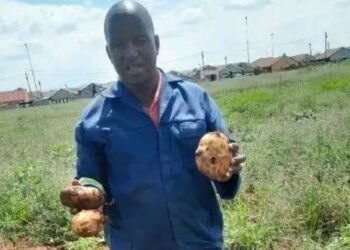
In the heart of the Vhembe municipal district of Limpopo, potato farmers Tshianeo Mathidi and his son carry on a family farming legacy nearly lost to history. Decades ago, during the harshest years of apartheid, the land his father cultivated was cruelly stripped away.
“My grandfather once owned land, but it was taken away. He spent his life waiting on land that was rightfully his,” Mathidi explains.
What used to be a family farm became a place where Mathidi’s father, Andries, had to come back. Not to take over or own it, but to work there like an employee.
“His highest position was the foreman of the farm. Foreman is the highest position that a black person could have during that time,” Mathidi shares.
Today, on 850 hectares of land and years later, Mathidi is the owner of Mamusha Boerdery and is working hard to reclaim their farming legacy.
Despite growing up around agriculture, Mathidi never saw himself as a future farmer. “I was never good at gardening,” he admits. “Even in school, my agri projects were never the best.” Instead, he excelled in maths and science, matriculated, and went on to study a BCom in accounting.
Agriculture found him again while working as a bookkeeper in the sector, and later, farm visits during his time at Eskom reignited his passion, prompting him to resign and farm full-time.
“I started with a few cattle in a village where a chief friend gave me space.”
Related stories
- Potato farming: Tips from a pro to beat climate challenges
- Cutworm infestation: Here’s how to protect your crops

Why potatoes are his golden ticket
Although Mathidi now produces potatoes and breeds Bonsmara cattle and goats, his journey began differently. He first owned a butchery and only later moved into livestock farming.
“I also had somebody lease me his irrigation scheme; I was planting butternut, spinach and cabbage.”
His operations steadily grew until he secured a government lease farm. “That’s where I am now, currently I’m more on potato and livestock and also cow candy, which I do after planting the potatoes,” Mathidi explains.
Mathidi turned to potatoes because, despite needing more water, they yield far higher profits than his other, less sustainable crops.
“I am in the area where it’s called the potato belt of South Africa. Everybody plants potatoes. The advantage is that you get technical help easily. The support system is easy when you plant potatoes in a potato-dominated area.”
Mathidi explains that he follows agricultural principles to guide his farming practices. For example, he manages a 34-hectare pivot and has 160 hectares of less fertile land.
To maintain soil health and prevent disease, he rotates his potato crops so that each field is only used for potatoes once every five years. Although his farm spans 850 hectares, not all of it is cultivated.

The secrets behind Mamusha Boerdery’s success
One of the most rewarding parts of Mathidi’s journey is seeing their family’s legacy being carried forward by his son, Tshilidzi.
“I’m now mainly handling the finances and administration. But when it comes to planting, harvesting, and marketing, that’s all his responsibility,” Mathidi explains.
Tshilidzi is fast gaining recognition in agriculture. As a LandCare winner, he’s represented Mzansi in China and Mozambique.
“Success isn’t about size, but about smart, timely decisions.””
Tshianeo Mathidi
At Mamusha Boerdery, Tshilidzi drives branding and marketing, with their washed potatoes sold nationally via platforms like the Joburg and Polokwane markets.
Mathidi keeps goats mainly for aesthetic pleasure. “I don’t eat them – I just enjoy watching them roam. It’s just for pleasing the eyes,” he remarks.
His cattle are mainly kept for commercial purposes, primarily for slaughter. Occasionally, small-scale farmers express interest in one of his bulls, and he provides them with one.

Smart and timely decisions
Mathidi is also an extraordinary leader and is one of the founding fathers of the African Farmers’ Association of South Africa (Afasa).
“We decided to form Afasa. I was instrumental in the initial formation of Afasa.”
Furthermore, he serves in multiple leadership roles, mainly as the Potato SA regional chairperson for Limpopo and deputy chairperson nationally, as well as a member of the research committee.
“Potato SA is the one that plays a big role. I now understand potatoes far better than before. I’ve served in many committees. Nationally and African-wise,” he shares.
At the heart of this service lies a strong spiritual conviction.
“I’ve learned that serving people is serving God. I find joy in seeing others succeed through my service.”
Tshianeo Mathidi
His commitment to both people and purpose has been tested many times on the farm. Mathidi has faced numerous farming challenges, from frost and waterlogging to diseases like late blight. Rather than discouraging him, these obstacles have shaped his philosophy and built his resilience.
His advice to fellow farmers is grounded in practical experience. “Firstly, plant at the right time. You must order the certified seeds in time because you don’t want to be too early and you don’t want to be too late.”
He also stresses the importance of adapting to current conditions, especially during water shortages. Rather than planting large areas, he advises scaling down to ensure effective irrigation and healthier crops. For Mathidi, success isn’t about size, but about smart, timely decisions.

READ NEXT: Aquaponics basics: Get your system thriving
Sign up for Mzansi Today: Your daily take on the news and happenings from the agriculture value chain.