Cutworms (Agrotis segetum) are a major headache for crop farmers, especially those growing potatoes. They are relentless feeders that can cause devastating damage. These pests are widespread across South Africa, and their lifecycle is closely tied to environmental factors, with weeds playing a key role in their development.
For crop farmers looking to protect their crops, understanding the behaviour of cutworms, keeping a close eye on their activity, and implementing smart control strategies are essential to reducing losses and ensuring healthy harvests. Entomologist Blessing Mphahlele, a PhD candidate at the University of Pretoria, shares insights and tips on how to effectively tackle this persistent pest.
Prevalence and life cycle of cutworms
Mphahlele notes that cutworms are found throughout South Africa: “Their life cycle begins when moths lay eggs during the winter months, primarily on weeds. They become abundant during the spring period – often when most farmers are starting their crop production activities,” he explains.
Once larvae mature, they burrow into the soil to pupate. “In its life cycle, as the larvae transition to the pupa stage, you’ll find that they tunnel down into the soil, and that’s where most of their preparation takes place. The preparation takes about two to three weeks depending on the conditions,” Mphahlele adds.
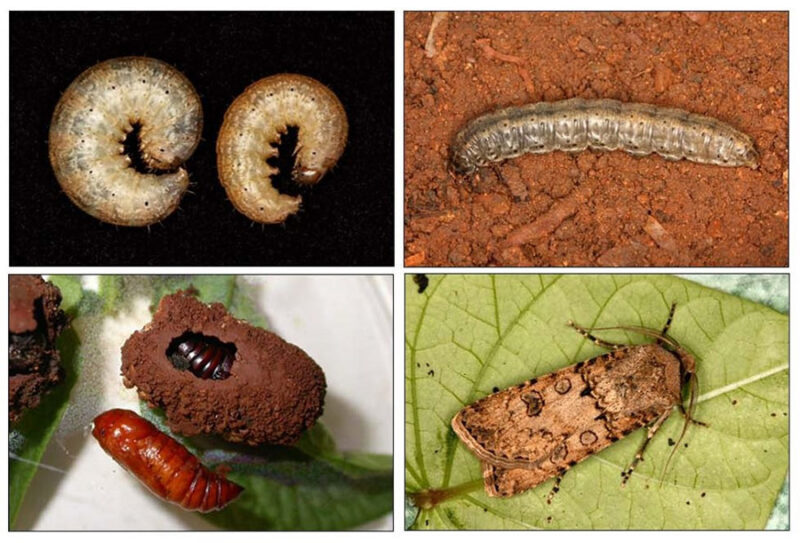
Signs of cutworm infestation
Farmers must be vigilant in scouting for early signs of cutworm presence. According to Mphahlele, the main signs are:
- Wilting
“The early indication is that you notice wilting and the loss of your seedlings here and there,” he says. Wilting can sometimes be mistaken for soil or nutrient deficiencies. However, as Mphahlele clarifies, “There’s wilting that comes from nutrient deficiencies, but then there’s also wilting from damage – the mechanical damage that can occur to the plant.” - Leaf damage
Farmers should look for small holes in the leaves when scouting their fields, as this can indicate the presence of young larvae, says Mphahlele.
Related stories
- Safe pesticide management: A guide for SA farmers
- Transporting crop protection: Avoid risks and stay compliant
Monitoring and scouting techniques
Monitoring for cutworm infestations is crucial, given that these pests are nocturnal. “The cutworm spends most of its time under the debris or drilled deep into the soil, meaning that during the day […] it is very rare for farmers to find it crawling between the plants,” Mphahlele notes.
To detect cutworms effectively, farmers should:
- Check under weeds and plant debris, as these pests often hide there.
- Examine seedlings for signs of wilting or severed stems.
- Look for small holes on leaves, which indicate the presence of early-stage larvae.
Mphahlele advises farmers to not only monitor their crops for signs of infestation but also check surrounding weeds. “If they have weeds in their field, they also need to look around those weeds, especially those with an extended surface.”

Effective control methods
- Field sanitation
One of the most effective methods for controlling cutworms is maintaining weed control and field cleanliness. “‘Cleanliness is next to godliness.’ So even in pest management, farmers should sanitise their fields – it’s the best way of controlling infestations,” Mphahlele recommends.
Farmers can take the following steps:
- Remove weeds and plant debris that serve as shelter and food for cutworm larvae.
- Prepare fields at least a month before planting to disrupt the cutworm lifecycle.
- Integrated pest management (IPM) strategies
IPM is a holistic approach that involves multiple strategies to control cutworms effectively. “Understand that IPM is a sequence of events, it’s not a one-time thing,” Mphahlele emphasises. It is a continuous practice that requires regular monitoring, preventive measures, and adaptive strategies to effectively manage pests while minimising environmental impact.
IPM approaches include:
- Cultural control: Adjust planting dates to reduce infestations. “If farmers find that there’s been an infestation in the field, part of the cultural methods is to prolong planting – manipulating the planting date.” Delaying planting for 30 to 40 days can disrupt the cutworm lifecycle by starving the larvae.
- Biological control: Encouraging natural predators that feed on cutworm eggs and larvae, such as nematodes, ground beetles, and soil fungi. “There are predators that feed on the eggs as well as the larvae,” Mphahlele says.
- Chemical control: This method should be considered only when other methods prove insufficient. However, Mphahlele warns that improper application of chemicals can reduce effectiveness: “We know very well that when applying insecticides under certain conditions, the insecticide tends to lose its effectiveness.”
To maximise the efficiency of insecticides, farmers should:
- Apply insecticides in the afternoon when cutworms begin to emerge. “If farmers spray insecticides in the afternoon, there’s a greater chance of the chemical coming into contact with the larvae that will be active at night.”
- Keep fields moist before application, as this enhances insecticide retention and prolongs its effect.
READ NEXT: Managing soil acidity to improve crop quality
Sign up for Farmer’s Inside Track: Join our exclusive platform for new entrants into farming and agri-business, with newsletters and podcasts.