Aldrin Lawrence (51) farms in the Mara area of the Vhembe district of Limpopo, in a little farming town, called Buysdorp, named for his ancestor, French Huguenot Coenraad De Buys.
Lawrence is descended from this legendary renegade of a founding father, who left the confines of what was then the Cape Colony in the early 19th century to roam the hinterland. The three sons he would later have with his Khoi or San mistress started what is now the Buysdorp community.
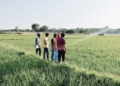
The De Buys inheritance sits on an 11 000-hectare land where his family has farmed since the Voortrekker migration of 1836.
Through an intricately developed system, the De Buys family has formed a trust through which descendants can lease land to venture into their own farming endeavours.

“You can apply for a piece of land to farm, build a house which the committee will approve and give to you. If you farm and you feel like that which you have been given is too small, then you apply again. They will come and evaluate and see if it is necessary and then you can apply for a farming plot,” he says.
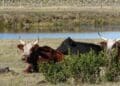
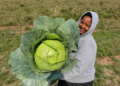
Lawrence has created his own 30-hectare mixed farming enterprise, producing livestock, broiler chickens and vegetable crops including potatoes and soybean.
With economic hardship, political turbulence and the worst recorded drought in the last 100 years, he says farming is an emotional rollercoaster. But with it comes the infinite “possibility of hope.”
“One moment it’s up with hope, then down with worry and stress. We can’t give up,” he declares.
“The secret to getting out of the dark depression is to stop looking down at the ground and rather look up. Look people in their eyes, look at problems head on. ‘Look up to the hills, that is where your help comes from!’ Psalm 121. That is where my strength comes from.”
‘We can’t give up, the possibility of hope makes it impossible to give up.’
On his farm he produces broiler chickens that he supplies to the local Spar and butcheries in Louis Trichardt. His produce is also sold at markets in Pretoria, Johannesburg and the Free State. “Our markets are largely dependent on where we can get a better offer for our produce,” he says.
Farming is generational
The De Buys ancestor, Coenraad, was known as a notorious Cape colonial frontiersman, with enormous self-confidence. He is also said to have allegedly fathered 315 children.
With farmlands spanning 11 000 hectares in the foothills of the Soutpansberg, the town of Buysdorp was named for the De Buys patriarch.
Here dwells a community of a few thousand of his descendants who have managed to develop structures and autonomous procedures of local government for the preservation of their lineage.
‘Something can always go wrong you must decide there and then whether you are going to crumble in defeat or stand up and do it again.’
Theirs is a complex history of interaction and intermarriage with surrounding tribes of Pedi and Tswana people, which manifests in their own indigenous identity tied to their land.
Lawrence explains that it all begins with the first ancestor – Elizabeth.
In history books, not much is said about the mysterious woman, who is speculated to be of Khoi, San, or Xhosa descent, who fled the Cape colony with a then married Coenraad, Lawrence clarifies.

“She moved here with him, after he left his wife and children in the Cape, they later had three children of their own.”
The three sons of Elizabeth and Coenraad would become his first successors on the De Buys lands, paving the way for Buysdorp.
“Those three brothers also married local black women and they started families – when the Voortrekkers came, they were the first to greet them. They assisted them with their translation skills as they were able to speak the local languages.
“They helped them communicate with all the chiefs in the area, they were useful guides. Eventually they got sick and tired of moving up and down and then they went to Pretoria to Paul Kruger to actually ask for a land of their own. Paul Kruger gave them this farm,” he explains.
Farming is not ‘pap en vleis’
There are many challenges that affect a small-scale farmer, Lawrence says. For farming you must have a passion, you must not think about the money.
“I always see people, if they think about taking the career they always estimate how much they will be paid for it. But in farming you really have to have a love and feeling for it.”
‘When you deal with nature, you always have to be on your knees.’
As a small-scale producer his challenge is often the quantities he is able to produce. These, he says, are often not enough to meet the demands of his clientele.
“I sometimes cannot fill a whole truck. Logistical challenges are also many,” he says.
“With markets also, if you don’t have a relationship with market agents and if you are not a regular supplier of any produce the market agents don’t know you, so when you send your things to the market then they’ll just sell it at whatever cost,” he says.
It is imperative to form bonds across the production value chain.

“It’s your brand, you have to know people, even your consumers that buy from the market. They need assurance when they buy your product, they should know that you always sell top quality produce.”
Passion and love for the industry always come first. “You can plant, and something could go wrong, and you don’t get an income from the yield. You must decide there and then whether you are going to crumble in defeat or stand up and do it again.”
Fundamentally, farming is an act of biology, Lawrence. “The essence of agriculture begins with the conversion of solar energy through photosynthesis,” he says.
But at its root Lawrence believes a deeper meaning lies. It is a much more spiritually charged endeavour than what science posits.
“When you deal with nature, you always have to be on your knees,” he laughs and then adds, “to pray. You do not have control. In the field, that is where you realize that you are totally dependent on God.”