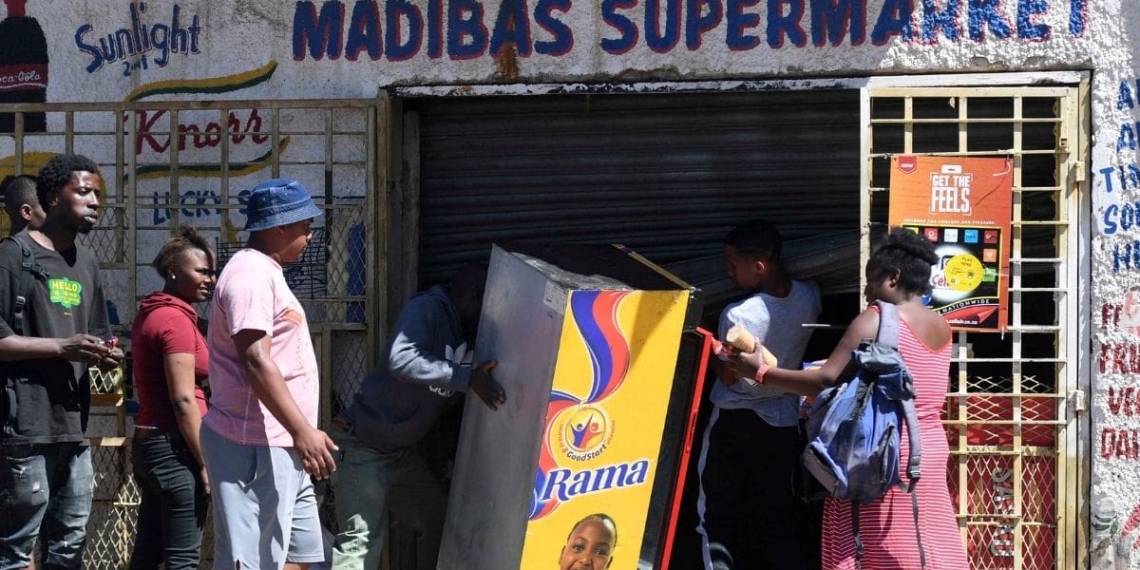
Experts warn hunger and starvation on a national scale are on the cards for South Africa if the looting of shops, stoning of cars, blocking of roads, and burning of trucks continues unabated.
Both KwaZulu-Natal and Gauteng are reeling from several days and nights of “brazen vigilante attacks” with government acknowledging that it was beginning to spread to other provinces.
This, as many South Africans witnessed on live television and online video streams how properties were vandalised and destroyed.
Also, trucks carrying agricultural produce, sugarcane fields and other crops were tortured with some farmers also reporting incidents of livestock theft.

Last night, during an emergency address to the nation, President Cyril Ramaphosa said these events have rarely seen before in the history of the country’s democracy.
“The victims of the violence that is unfolding now – the workers, the truck drivers, the business owners, the parents and families of those who have lost their lives – have done nothing wrong,” said Ramaphosa.
“Although these may be opportunistic acts of looting driven by hardship and poverty, the poor and marginalised bear the ultimate brunt of the destruction.”
A state of emergency
In a strong-worded statement issued last night, Agri SA called on government to declare a national state of emergency. This, as the Rand tumbled against major currencies with markets rattled by the violent protests and looting.
In South Africa, the last national state of emergency was declared by apartheid president PW Botha on 20 July 1985 by PW Botha in a desperate attempt to exert complete control over black people following an upsurge of violent and non-violent resistance to apartheid.
Twenty-six years later, Agri SA executive director Christo van der Rheede said a national declaration of a state of emergency must also go hand in hand with the deployment of security personnel in all affected areas.
“In addition, we also call on the presidency to ensure that our logistical infrastructure such as our roads, harbours and airports continue to function in order for food to be delivered,” said Van der Rheede.
Food access and price hikes
Meanwhile, Dr Naudé Malan, senior lecturer in development studies at the University of Johannesburg and founder of iZindaba Zokudla, echoed Ramaphosa’s warning that the events of the last few days placed food security at risk.

“This is going to cut off the supermarket supply chain and they deliver about 60% of our food.
“So, if 50% of that 60% is taken away, food prices at big retails will rocket. If this gets to the Fresh Produce Market in Johannesburg we are in trouble,” Malan told Food For Mzansi.
In his address, Ramaphosa described it as “opportunistic acts of looting driven by hardship and poverty”. He said with shops being looted and infrastructure destroyed, food cannot reach supermarket shelves.
Malan hoped that the violence would not escalate and spill over into towns and farming communities. “This could be the death of the economy. We need government to be very proactive because this has gone too far. This is attacking the heart of the order in South Africa.”
We’ve got four to six days…
Agbiz chief executive Dr John Purchase warned, “If this continues over an extended period of four to six days, then it will definitely be affecting food access in the country.”

Agbiz said usually it did not condone the deployment of the army, but the current scenes constitute an exception.
“We think that government and police is probably not in control. We don’t condone [the] defence force being [deployed] but this is clearly well orchestrated.
“So, we as Agbiz, deem it necessary to deploy the defence force. However, they cannot take over the policing function to ensure safety and security in communities.”
Purchase added that Agbiz was concerned about crime and state intelligence in the country. A total revamp was needed to ensure its credibility, he warned.