Friday, October 23, 2026
SUBSCRIBE
22 GLOBAL MEDIA AWARDS
Food For Mzansi
  • News
  • Changemakers
  • Lifestyle
  • Farmer’s Inside Track
  • Food for Thought
No Result
View All Result
  • News
  • Changemakers
  • Lifestyle
  • Farmer’s Inside Track
  • Food for Thought
No Result
View All Result
Food For Mzansi
No Result
View All Result
in Farmer's Inside Track

Podcast: The role of stingless bees in Africa

Stingless bees are found only in a few lucky pockets of the world, including Africa. But these pollinators are often overlooked despite forming an integral part of the ecosystem. To address this, an expert joins this episode to shine a light on new species and how they can be integrated

by Octavia Avesca Spandiel
26th May 2023
Podcast: The role of stingless bees in Africa

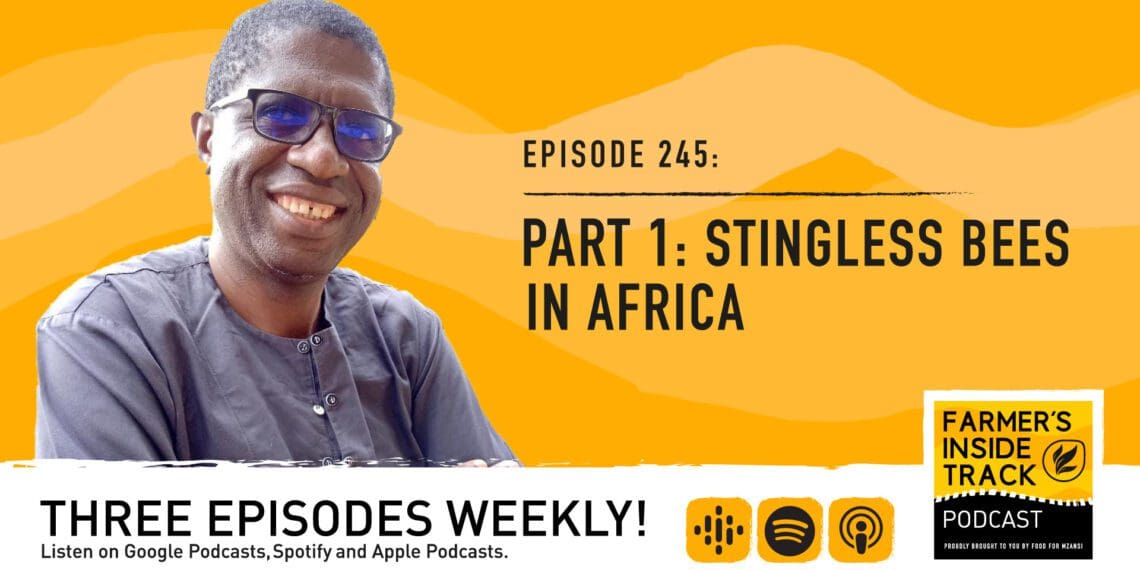
Félix Meutchieye is an associate professor in animal breeding and production systems at the faculty of agronomy and agricultural sciences at the University of Dschang in Cameroon. Photo: Food For Mzansi

Share on FacebookShare on TwitterShare on WhatsApp

Félix Meutchieye, associate professor in animal breeding and production systems at the faculty of agronomy and agricultural sciences at the University of Dschang in Cameroon, joins us in this edition of Farmer’s Inside Track to talk about stingless bees. Yes, you heard right, stingless bees.  

Meutchieye has worn many hats throughout his life but the one thing he aims to do is continue the work within the agricultural sector by making a difference.

As the head of the animal science division at the University of Dschang, his aim is to focus on enhancing food systems. “My area of interest is about biodiversity and my ambition is to build different pathways of agriculture,” he explains.

Research around stingless bees

According to Meutchieye, bees are an integral part of our ecosystem. They are essential because pollination is becoming a problem for fruit trees and plants. There’s not much attention given to the African bees even though they are a great source for our ecosystem, he says.

“After 10 years of working on bees, African bees are known to be very aggressive and people are more or less not excited about them.”

His focus is to finalise the inventory on bees and go beyond trying to understand what can be gained besides pollination. “These last four years we have been able to identify new species that are not known and that can be found and integrated into the production systems.”

Pollinator destroyers

What should also be taken into consideration are the pesticides used within the agri systems, causing pollinators to be destroyed in the process, Meutchieye remarks.

“Pesticides that are being used in agri systems are destroying most of the pollinators and it is obvious when we speak to farmers that they are complaining because the yields are declining,” he says.

In this episode, Meutchieye also discusses:

  • Food security in Africa; and
  • Where stingless bees are found.

Want to know more? Listen to the full episode of Farmer’s Inside Track. 

Option 1: Click here to listen on Spotify (all mobile and other devices).

Option 2: Click here to listen on any Apple device. 

Option 3: Click here to listen on Google Podcast.

READ NEXT: Grab indaba tickets before they’re gone

Sign up for Farmer’s Inside Track: Join our exclusive platform for new entrants into farming and agri-business, with newsletters and podcasts.

Octavia Avesca Spandiel

Raised by a close-knitted family who loves her deeply, Octavia believes in the philosophy of ‘I am because you are'. This former news and content editor for radio is now living her best life in the agricultural sector as a commercial journalist at Food For Mzansi. Her soft spot for poetry and passion for life, writing and traveling inspires her to write compelling stories. Apart from being an excellent writer, Octavia has an educational background in youth work and loves working with people. 

Tags: BeesCommercialising farmerFuture-focused farmerpollinationTeach me
Advertorial

Smart irrigation: Precision tools boost crop yields while cutting costs

by Lisakanya Venna
21st October 2026

PARTNER CONTENT: Facing persistent climate risks, Southern African farmers are turning to precision tools to trim input costs without losing...

Read moreDetails
Record farm exports overshadowed by growing drought disaster

By-laws vs. livelihoods: Barriers facing WC smallholder farmers

21st October 2026

CPAs urged to register for free governance support toolkits

21st October 2026

Potatoes and tomatoes plunge while avocado prices soar

20th October 2026
Becoming bankable: How to get your farm ready for finance

Becoming bankable: How to get your farm ready for finance

20th October 2026

Fixing SA’s agricultural visa system to protect seasonal harvests

Patensie claims Agri’s Got Talent crown for second year running

Karoo sheep tallow finds new purpose in Mzansi beauty brand

Limpopo teen farmer turns dream into growing poultry business

Godongwana unveils fuel relief and R10 billion El Niño buffer

Join Food For Mzansi's WhatsApp channel for the latest updates!

JOIN NOW!
Next Post
Communal farmers, this is your time to shine!

Communal farmers, this is your time to shine!

THE NEW FACE OF SOUTH AFRICAN AGRICULTURE

With 21 global awards in the first six years of its existence, Food For Mzansi is much more than an agriculture publication. It is a movement, unashamedly saluting the unsung heroes of South African agriculture. We believe in the power of agriculture to promote nation building and social cohesion by telling stories that are often overlooked by broader society.

Limpopo teen farmer turns dream into growing poultry business

How to protect poultry from damaging sticktight flea infestations

Eskort announces Herman Janse van Rensburg as group CEO

Agda pushes for pathways to commercialise emerging farmers

Karoo sheep tallow finds new purpose in Mzansi beauty brand

Why simple farm records beat complex systems

  • Awards & Global Impact
  • Our Story
  • Contact Us
  • Cookie Policy
  • Privacy Policy
  • Copyright

Contact us
Office: +27 21 879 1824
News: info@foodformzansi.co.za
Advertising: sales@foodformzansi.co.za

Contact us
Office: +27 21 879 1824
News: info@foodformzansi.co.za
Advertising: sales@foodformzansi.co.za

  • Awards & Global Impact
  • Our Story
  • Contact Us
  • Cookie Policy
  • Privacy Policy
  • Copyright

Chat Options

About this assistant

This feature generates automated answers summarised from Food For Mzansi articles. By using it, you are interacting with an AI system (provided by Google), not a human. AI can make mistakes. Please refer to the source articles for verification and citation purposes.

Our staff do not check or moderate Lerato’s answers in advance, but may review some later. Our journalists continue to write and edit all the articles Lerato uses as sources.

To estimate unique and returning web users, we store a random browser ID in this browser. WhatsApp users are counted by phone number. The same person using both channels may be counted twice.

I'm Lerato, your AI assistant!
No Result
View All Result
  • News
  • Changemakers
  • Lifestyle
  • Farmer’s Inside Track
  • Food for Thought

Copyright © 2026 Food for Mzansi