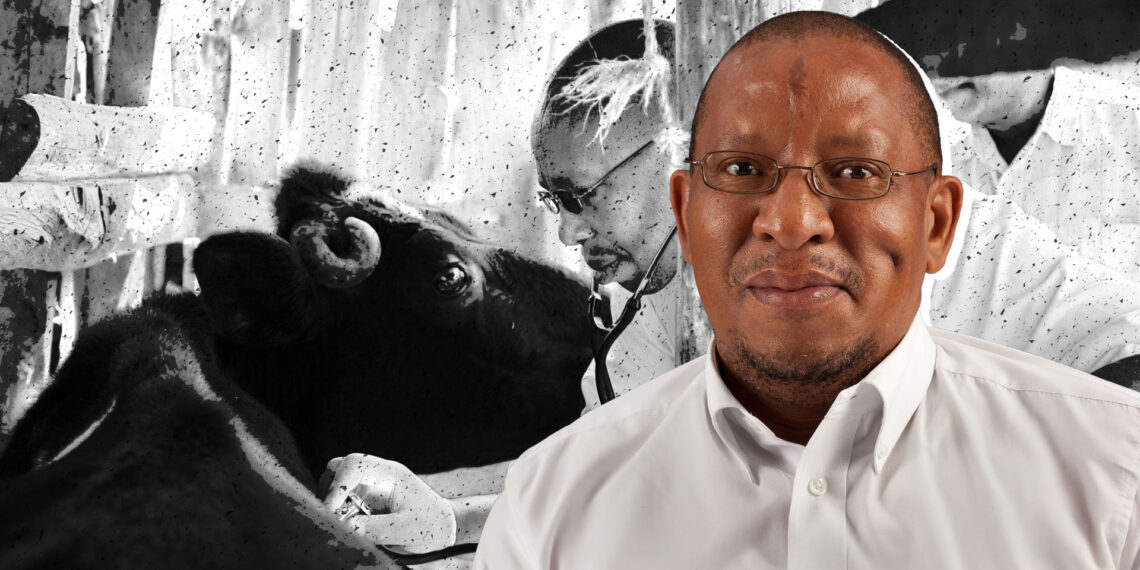
Despite policy shifts and new vaccination plans, South Africa’s fight against FMD remains undermined by weak veterinary infrastructure and a lack of decisive national leadership. Dr Rebone Moerane of the University of Pretoria calls for urgent systemic reform, sustainable funding, and stronger coordination between national and provincial departments to restore control over livestock health.
South Africa’s department of agriculture has been struggling to contain and prevent the further spread of foot-and-mouth disease (FMD), a virus that infects livestock and impacts negatively on both farmers and consumers.
The situation prompted the minister of agriculture, John Steenhuisen, to release several media statements, including an announcement of a policy shift for cattle to be vaccinated against FMD. This was followed by the release of a vaccination strategy that involves determining the vaccine quantities that are to be imported and produced locally, and identifying high-risk areas in the country.
Minister Steenhuisen also voiced an intent to redirect unspent funds under the Comprehensive Agricultural Support Programme (Casp) towards biosecurity and FMD control; it was also indicated that 5% of Casp funding will be prioritised for FMD. Additionally, the department of agriculture stated that it will not review salaries for state veterinarians, noting that newly qualified vets are paid at a middle-management level in the public service, and that the mandate fell under the department of public service and administration.
Unfortunately, the media statements and policy shifts cannot be left unchallenged. The current situation reflects on the government and its failure to plan, execute and monitor their plans to deal with outbreaks/risks.
Ultimately, the question is this: should we be worried? The simple answer is yes.
If we substituted or replaced the FMD outbreak with a contagious zoonotic disease, millions of people would be infected, leading to a possible high mortality rate.
Despite being warned more than a decade ago, the government – and the department of agriculture, in particular – failed to put interventions in place to provide incentives to rural livestock farmers working in the so-called “infected” zone. These farmers were expected to bring their cattle for weekly inspections and have their livestock vaccinated three times a year.
Lack of support for veterinary services
The initial FMD cases recorded between 2019 and 2022 could not be contained because of ineffective veterinary services. The government has failed to give due recognition to the veterinary profession.
During the reorganisation of veterinary services pre-1994, those involved in the amalgamation of veterinary services warned of the massive negative impact of listing animal disease control under Schedule 4 of the new Constitution, making it a “concurrent” function whereby both national and provinces were given the mandate of disease control. The advice at the time was that Animal Disease control must be a national function, whereas developmental programmes and clinical services could be a provincial function.
Some veterinary officials do not have offices to work from (some work from home); do not have basic resources such as gloves; are responsible for large areas (municipalities and sometimes district municipalities); and some are expected to travel between 500km to 1 000km a month to perform their respective duties.
To make matters worse, the national director for animal health and the chief veterinary officer of South Africa do not have direct power over provincial officials and have not shown themselves to be in control of the situation. It makes one wonder whether they agree with the policy shift and strategy that has been decided upon, as announced by the minister. A failure of appropriate systems and interventions
Apart from structural and governance issues, the government failed to have systems in place to respond appropriately and adequately to the FMD outbreak. If we were prepared, there would have been clear early-warning systems in place. Yet we still rely on farmers phoning state veterinarians to alert them of suspicious cases, when we should have a simple digital system in place for farmers to log cases.
Related stories
- KZN declares FMD disaster as SA launches local vaccine
- A commercial farmer’s dismay: Steenhuisen faces FMD storm
- FMD crisis: Protecting SA’s livestock from viral disaster
- Govt steps up FMD fight with mass cattle vaccination plans
Funding and resources needed
It’s also unfortunate that the minister of agriculture does not fight for state veterinarians, instead shifting the responsibility to the department of public service and administration (DPSA). In the 1990s, non-veterinary officials within the department of agriculture intentionally left out veterinarians’ officials (veterinarians, animal health technicians, veterinary nurses and veterinary public health officials) when submitting proposals on occupational-specific dispensation to the DPSA.
We must not forget that the poor rural small-scale livestock farmers rely on state veterinarians rather than private veterinarians. Therefore, we should not be surprised when state veterinarians are despondent and demoralised, and graduates seek better opportunities abroad.
Additionally, we did not have appropriate risk analyses and cost-benefit prevention or mitigation strategies in place. Had we declared the FMD outbreak a “disaster” back in 2019, we would have had ample funds and resources to contain the disease and compensate farmers. The minister of agriculture and others seem to be proud that more than R1.8 billion could be spent on procuring vaccines, yet it would have probably cost less than R100 million to cull FMD-positive herds and compensate farmers accordingly.
Veterinary services cannot be expected to deal with outbreaks without the necessary funds. The intention to use unspent funds under the Casp will not be sufficient and effective. When the Casp was established in the mid-1990s, it was agreed upon at the time that 5 to 10% of funds would be set aside to improve veterinary services. However, no funds were set aside in most provinces.
The improvement of veterinary services and disease control requires a specific conditional grant directly from the National Treasury; nobody in the respective provinces would be able to use the funds for anything other than for the improvement of veterinary services.
The Animal Diseases Act of 1984 and its amendments, in particular Section 3(1)(b), permit the national director of animal health to authorise private veterinarians and even non-veterinarians during outbreaks to assist with containing and/or controlling the disease. However, they cannot proceed if there are no specific funds for such actions.
At the same time, the act allows the director and minister to consider compensation on application – but again, how can they approve such requests using normal operational funds?
An effective recovery plan is key
Another issue is that there are no recovery plans following outbreaks. It must be acknowledged that any outbreak will affect the level of production in the livestock industry, be it a drop in production or income, or the loss of genetic material.
While farmers are complying with government regulations in dealing with the FMD, we need to consider options to assist those who are significantly affected. Yet when a farmer reports a case, even if it is clear that someone else was responsible for causing the outbreak in the area/municipality, the livestock is quarantined with no support at all.
Once a contagious “controlled” animal disease has been diagnosed, it is the government’s responsibility to put in place intervention measures and stipulate clear guidelines for the role players. The current gazette regulations stipulate clear actions on how FMD should be handled. While the department has made announcements on policy change, we have not seen amended regulations to support their decisions and implementation plans.
It is incumbent upon the minister, cabinet, Portfolio Committee on Agriculture and parliament to intervene in the state of veterinary services and interrogate the policy decision so that strategies that will benefit all can be implemented.
- This article was first published by the University of Pretoria (UP), and written by Dr Rebone Moerane, a senior lecturer in the department of production animal studies in the faculty of veterinary science at UP. The views and opinions expressed in this article are those of the author and do not necessarily reflect the views or positions of Food For Mzansi.
READ NEXT: An FMD-free future: Pipe dream or reality?