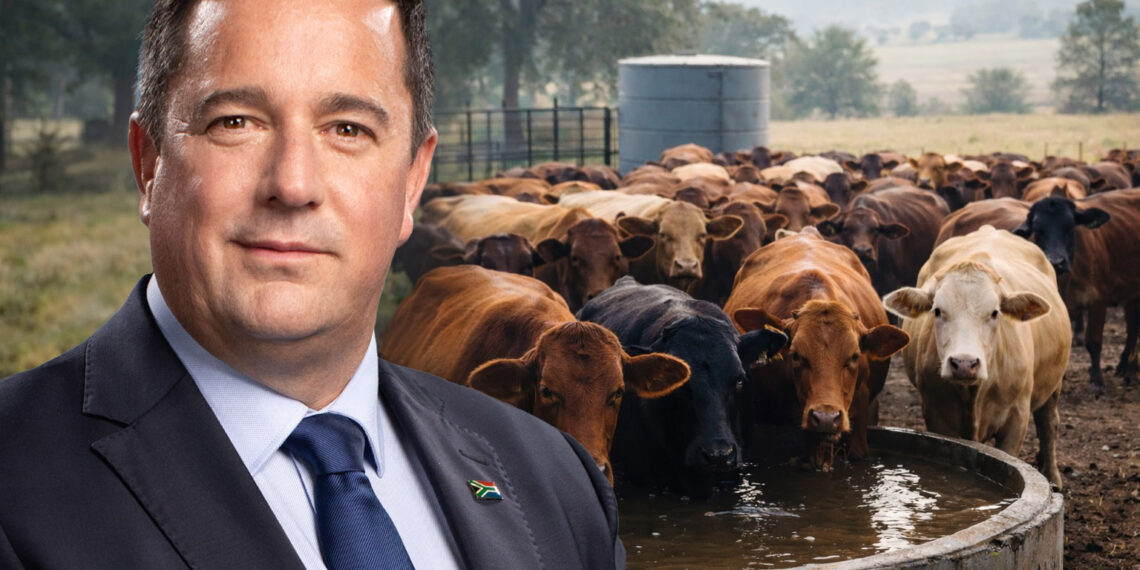
A desperate commercial cattle farmer, trapped under a 12-month quarantine with no vaccine in sight, has broken his silence after agriculture minister John Steenhuisen’s briefing on foot-and-mouth disease. In a raw and uncompromising letter sent to Food For Mzansi, he accuses the state of abandoning farmers, failing to contain the outbreak, and offering hollow promises while livelihoods collapse.
As a commercial cattle farmer and an active member within organised agriculture, I am compelled to respond to the minister of agriculture, John Steenhuisen, following his press briefing this morning on the state of foot-and-mouth disease in South Africa.
My farm is currently under foot-and-mouth disease restrictions. I voluntarily reported the outbreak on my property, in full compliance with the law and in the interests of protecting neighbouring farms and the broader industry. In doing so, I acted responsibly and transparently.
For this, I have been handed a 12-month quarantine — a significant financial and operational burden — yet the follow-up vaccination, required by protocol, has not taken place because the country has run out of vaccine. This is not a logistical mishap; it is a failure of governance and leadership by the state.
This situation raises serious concerns for the industry: are farmers truly incentivised to report outbreaks if there is no mechanism for containment, and if compliance results only in economic punishment? The Minister’s briefing offered no clarity, no plan, and no urgency to address this fundamental question.
Regrettably, the minister’s statement reflected an alarming disconnect from reality.
It was based on outdated information, seemingly from November, and failed to acknowledge active outbreaks in communal areas of the Eastern Cape — outbreaks which are widely known to industry leaders and provincial veterinary services.
This omission is deeply concerning and indicative of a lack of engagement with the very stakeholders responsible for disease management.

Systemic failure across the industry
Foot-and-mouth disease is spreading through South Africa at an unprecedented rate. The current crisis is the cumulative result of systemic inaction, ineffective oversight, and a lack of decisive leadership.
Farmers, both communal and commercial, have been left to manage the disease largely on their own, with the state providing neither sufficient vaccine nor clear emergency measures.
It must be acknowledged that provincial veterinary services are doing their best under extremely difficult circumstances. They are understaffed, under-resourced, and stretched to their limits, yet they continue to deliver service to farmers within their capabilities.
The current crisis is not their fault; the responsibility lies squarely with the minister and the top leadership of the department of agriculture.
The minister’s appointment of a ministerial advisory task team offers little reassurance. Like prior task teams since 2017, its role, authority, and decision-making processes are opaque. There is no transparency, no communication, and no evidence that its technical recommendations are being implemented. Farmers are being asked to trust a process that is invisible and unaccountable.
Of particular concern is the state’s inability to secure adequate vaccines. Private sector operators, including commercial feedlots, have obtained vaccines to protect their operations, while the government — legally and morally responsible — cannot provide a single dose to communal or vulnerable farmers.
This creates a dangerous political precedent: those in the private sector who can afford to purchase vaccines are able to conduct business and protect their herds, while the most vulnerable — farmers who are supposed to be served and protected by the department of agriculture and the minister — are left entirely unattended and exposed. This inequity undermines trust in the public veterinary service and demonstrates a profound failure of leadership.
Leadership and accountability missing
I must also lament — as do farmers across the country — the sad reality that South Africa still cannot produce sufficient quantities of its own vaccine from the field virus strains we have locally.
Despite political statements and posturing by the minister, promising collaboration between Onderstepoort Biological Products (OBP) and private sector companies, this has come to nothing. The lack of locally produced vaccine, combined with the unavailability of imported doses, leaves farmers powerless and the national herd dangerously exposed.
Another critical failure by the minister is the lack of leadership regarding animal traceability systems. South Africa has a government-designed traceability system, but it is not integrated with newly developed private sector systems.
The minister has shown no initiative to forge cooperation or ensure that government and private systems work together effectively. Merely speaking about traceability without actively driving integration and collaboration with the industry and its representative bodies is negligence, and combined with the unavailability of vaccine, represents an absolute failure of leadership.
The minister repeatedly referenced long-term plans, but planning cannot substitute for immediate, decisive action. The current crisis requires legal, administrative, and operational measures to halt disease spread, protect livelihoods, and restore confidence in animal health governance. To date, these measures have not been enacted.
Further, the “vaccinate-to-live” strategy announced late in 2025 lacks operational and legal clarity. How will it be implemented when no vaccine is available? Who is responsible within the department for driving this process? What emergency mechanisms will bridge the current situation to the new dispensation? None of these questions were addressed in the Minister’s briefing.
Words such as “a clear road map,” “actionable strategy,” and “activating a local production line” may sound impressive, but they are meaningless to farmers watching their herds destroyed, contracts cancelled, and livelihoods threatened. The dairy industry, commercial producers, and communal farmers are suffering immediate and severe consequences.
The minister’s performance raises questions about the ability to lead both the department of agriculture and the political agenda of the Democratic Alliance simultaneously. Agriculture requires focused leadership, urgency, and accountability — qualities that have been sorely lacking. It is my view that the department would benefit from leadership entirely dedicated to agriculture and the welfare of farmers.
The industry, organised agricultural bodies, and affected producers will hold the Minister accountable for the absence of leadership and inaction during this crisis. Farmers are not asking for words; they are demanding decisive action, clarity, and competence.
Anything less is insufficient and will continue to undermine trust in government and the sustainability of South Africa’s livestock industry.
In his closing remarks during the press briefing, the minister had the audacity to ask for our patience and partnership. This, while the industry and farmers have consistently given their partnership, their cooperation, and their full commitment over many years.
To end a press briefing with such an insulting remark, while leading a department and a ministry that are underperforming so profoundly, is both unacceptable and disrespectful to those who keep this industry alive.
- This letter reflects the views of the author and does not necessarily represent the views of Food For Mzansi. The publication has sent a copy of the letter to agriculture minister John Steenhuisen for response, and farmers and readers are invited to share their own experiences and perspectives by emailing info@foodformzansi.co.za.
READ NEXT: Steenhuisen unveils 10-year roadmap to eradicate FMD