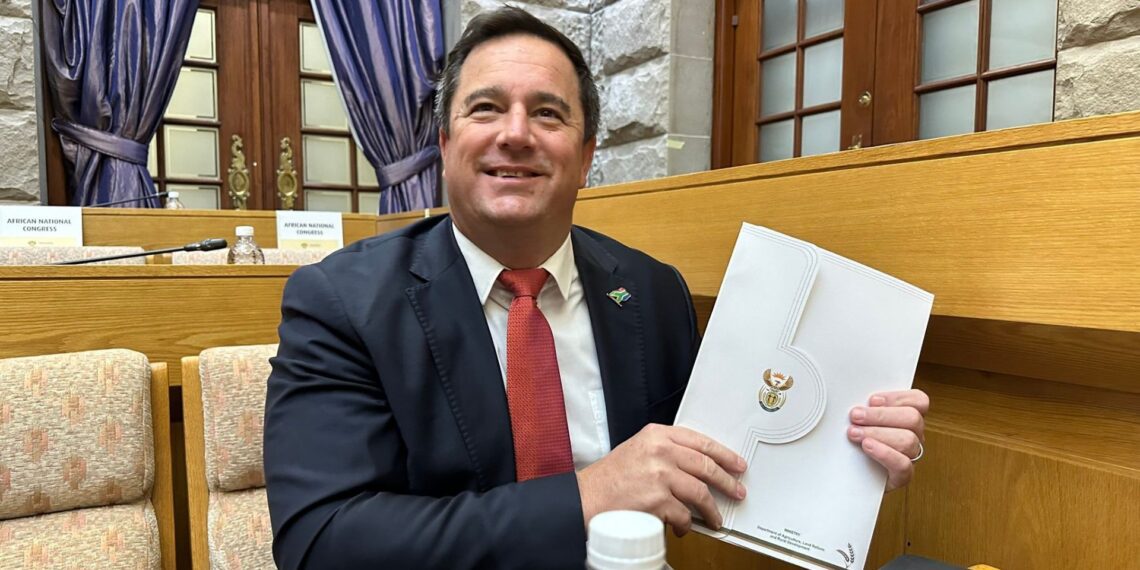
Minister of agriculture John Steenhuisen has come out strongly to advocate for transformation in the sector. He cited that the government needs to entrench fairness that does not exclude anyone or take from anyone, and instead grows the pie for everyone.
Steenhuisen addressed the media today in Parliament to respond to “misinformation” by business forum Sakeliga, a non-profit organisation that, according to its website, develops institutions and mechanisms for commercial governance outside the state.
In a statement, Sakeliga said the minister was expanding black economic empowerment (BEE) in the agricultural sector. The organisation stated that the minister’s action was harmful and adds significant risk to South Africa’s already strained international trade relations.
“AgriBEE is the department’s officially adopted policy to make BEE compulsory in agriculture. Although a serious matter, the policy is currently still far from fully implemented and agricultural activity in South Africa remains generally robust.
“In October 2024, Sakeliga alerted Minister Steenhuisen that his DG had renewed regulations that restrict quotas for reduced-duty agricultural imports and exports based on the race of farmers and business owners. It affects a minor yet meaningful portion of the total volume and value of South African agricultural trade,” the statement said.
‘Campaign of misinformation and distortion’
In response, Steenhuisen said the claims made by Sakeliga are false and used by the chief executive officer of the organisation, Piet Le Roux, to steer a public campaign of misinformation and distortion.
Related stories
- Steenhuisen urges unity for Africa’s food security goals
- Steenhuisen calls for urgent action on public-private partnerships
“I wish to turn to Le Roux’s and Sakeligas’ patently false allegation accusing me of ‘establishing several transformation funds’. The ‘evidence’ they provide for this absurd claim is the fact that I have gazetted several statutory levies. This is a statutory requirement for every minister of agriculture and has been since 1996.
“Apart from the fact that the act and measures were implemented almost a decade before I became minister, it is also important to underscore that the application for statutory measures by commodity organisations is a voluntary process,” he said.
Steenhuisen said issues raised by Sakeliga were baseless and should not stand in the way for transformation in the country, especially in the agricultural space.
“You cannot, however, cherry pick which parts of the constitution you wish to uphold and those parts that you wish to conveniently ignore. South Africa remains an economically unjust society. Most importantly our economy is not growing fast enough.
“The scale of our challenge however is set out in the book by renowned agricultural economist, Wandile Sihlobo. It sets out in stark reality that despite three decades of political freedom, this has still not resulted in the adequate improvement in the socio-economic prospects of the majority of South Africans in the agriculture sector,” he said.
‘Address inequalities of opportunity’
Steenhuisen went on to say that an economically just society is one in which economic opportunities are made available to all, and people have the capability to be able to make use of those opportunities.
“If we wish to deal with inequality and create an inclusive and non-racial society we must address inequalities of opportunity. I want to make this clear: I am not interested in engineering equality of outcome through race or other quotas.
“What I am interested in is promoting an equality of opportunity that will assist disadvantaged people to have a fair shot at accessing markets.
Minister John Steenhuisen
“I wish to be clear that I will continue to work with the commodity bodies and organised agriculture in order to create greater equality of opportunity in the agriculture space. This is because I believe passionately in growing the sector, using genuine empowerment models and equipping our previously excluded sectors of society to participate fairly in markets, and then it is for the market to determine winner and losers,” he said.
The minister said he believes passionately and genuinely empowering small-scale farmers at farm-gate level would unleash a growth and jobs revolution in the agriculture sector that will ensure that we grow the sector for everybody’s benefit.
“I will as the minister of agriculture, continue to support interventions which create equalities of opportunity rather than those that seek to manipulate equalities of outcome. Without a sense of urgency to overcome historical injustice by those in government, South Africa will not enjoy a prosperous future,” he said.
READ NEXT: Zimbabwe breadbasket myth: A zombie idea that won’t die
Sign up for Mzansi Today: Your daily take on the news and happenings from the agriculture value chain