The fourth industrial revolution is transforming the world around us, and farmers across the globe are knee-deep in it too. Despite the hurdles often keeping South Africa’s farming sector back, it is steadily pushing agricultural technology forward and growing the local agritech industry.
From tech platforms which integrate ecosystems, agricultural platforms and artificial intelligence, to platforms that give smallholder farmers a leg up – these are but a few of technological innovations Mzansi’s agri sector can expect to see more of in 2022.
Wafiq Essop, an agronomist from the Western Cape, believes that technological integration holds exciting possibilities for farmers. He explains how integration has developed and become more comprehensive over the years.

“Before, it was integrated pest management, where you dealt with pests from a cultural, biological and of course a chemical perspective.
“[Now], what we’re having is integrated plant health, where there’s easy-reading meters in the soil which can determine the amount of water in the soil at different depths,” he tells Food For Mzansi.
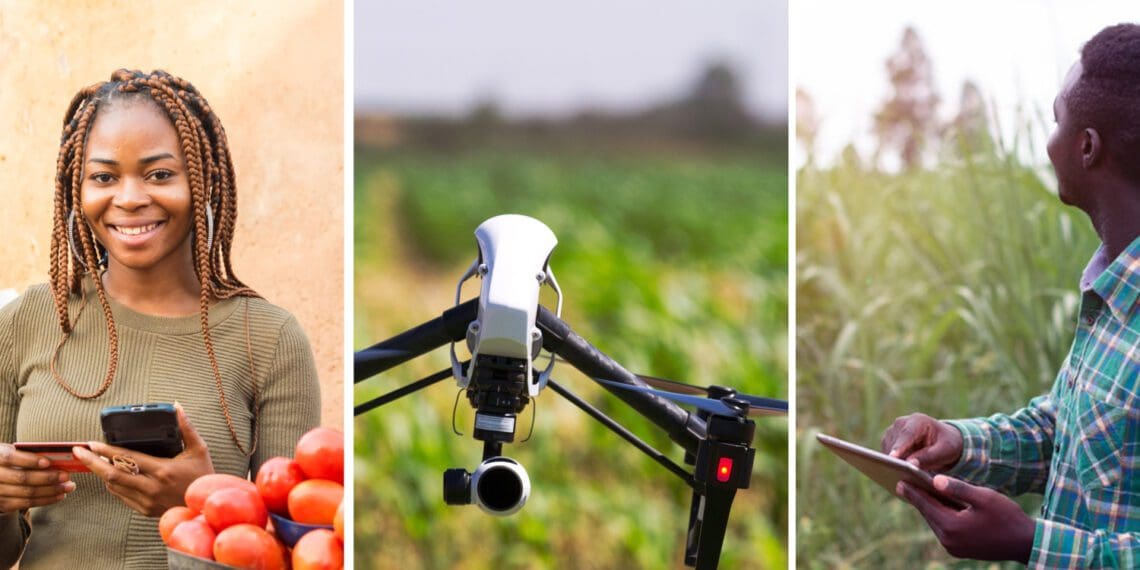
And that’s not it. Farmers can go as far as determining the canopy colour of their trees using drone technology. “Generally, if the greenery of the plants starts becoming less, you know that there’s going to be a problem in terms of yield or in terms of disease.
“And on top of this, you can also determine yield by [using] sensors that use artificial intelligence to detect circles of fruit and can tell you, with 99% accuracy, what yield you’re going to get.”
Furthermore, the integration of cloud technology with drone technology and other soil and plant technologies makes it much easier for farmers to manage their operations.
“You have this whole system on your computer, and you can know exactly what’s going on with your farm in real time. It’s going to be quite amazing,” says Essop.
When different technologies come together…
In the last five years or so, South African software engineers have put their time and talent into getting many parts of the agricultural process online. And according to Matthew Piper, chief product officer and co-founder of farmers app Khula, they are looking forward to new technology which integrates ecosystems, agricultural platforms and artificial intelligence (AI).
“We saw really incredible technology in 2021 with a lot of focus on drones, IoT [the internet of things], sensors and more, but many of that is still very fragmented and not accessible for everyone.”
Different technologies are simply scattered across many different platforms, Piper says. And as IoT grows, integration will be a key development.

IoT is a system of interrelated computing devices, mechanical and digital machines, objects, animals or people. On farms, IoT allows devices across a farm to measure all kinds of data remotely and provide this information to the farmer in real time.
“Integrations across platforms is something we’re looking forward to, to make farmers’ life easier with ‘one central source of truth’.”
New technology emerging from the digital technical support industry as well as the regenerative agriculture industry are some more developments that the guys at Khula are looking forward to.
According to Piper, there is a huge shortage of technical experts in South Africa’s agricultural field. Digital technical support can assist technical experts to serve more farmers, he explains.
“[And] with regenerative agriculture technology, farmers are allowed to do more with less. We’re looking at innovations around water tech, crop rotation and cover crops, as well as tech that is helping farmers heal their soil.”
Market access at your fingertips
It is no secret that many farmers operating on a smaller scale, especially those just starting out, often have difficulty accessing markets.

However, thanks to tech farming platforms like FoodPrint and various others, that is changing.
FoodPrint is a mobile application that uses blockchain technology to connect smallholder farmers directly to new markets. It is also the winner of the inaugural Inqola Prize for Innovation 2021.
Like a mobile shopping application, farmers can list their coming harvests on the application, and retailers and other entities wishing to purchase produce can simply scroll through the available farmer listings and purchase from the farmer.
“The core value, at the end of the day, is for the farmer; that we help them digitise their operation. We help them to get credibility and help them to access markets and services,” says Julian Kanjere, one of FoodPrint’s founders.
ALSO READ – AgriCareers: This techie connects farmers to markets
Drone and satellite technology
Drone and satellite technology has been around for quite some time but continues to grow.
These days, agricultural innovators like Aerobotics are finding new and creative ways to use drone technology. Aerobotics, for example, uses artificial intelligence, drones and other robotics to track and assess crop health.
Farmers dare not sleep on satellite technology either, reckons Essop, who is a big fan of this agritech tool.
He says topography (the surface of the soil and its relation to other areas on the farm) is determined quite accurately by satellite imagery. Topography affects agriculture quite significantly as it relates to soil erosion, difficulty of tillage and poor transportation facilities.
A lot of the tools provided through satellite tech are very affordable and, to an extent, even cheap, Essop explains.
“When you combine that with real-time data, you can then, on your computer, determine what’s wrong with your operation because you have the type of soil and the SWAT (soil, water and topography) map.
Particularly apt in South Africa with its very recent history of droughts and floods, farmers can use satellite tech to help determine all-important water flow. “You have everything being updated in real time and you can determine where water is going to flow.”
Farmers, he adds, are also able to know the first area where soil is likely to get dry, and to pre-determine if there will be too much water or too little.
ALSO READ: Looking to expand? Try these niche markets for 2022
Sign up for Mzansi Today: Your daily take on the news and happenings from the agriculture value chain.