Wednesday, March 4, 2026
SUBSCRIBE
21 GLOBAL MEDIA AWARDS
Food For Mzansi
  • News
  • Changemakers
  • Lifestyle
  • Farmer’s Inside Track
  • Food for Thought
No Result
View All Result
  • News
  • Changemakers
  • Lifestyle
  • Farmer’s Inside Track
  • Food for Thought
No Result
View All Result
Food For Mzansi
No Result
View All Result
in News

Unified vision key to driving innovation in SA’s grain industry

Collaboration, not competition, will shape South Africa’s grain future. At this week’s Grain SA Research Meeting, leaders from across the industry called for stronger public–private partnerships, smarter innovation, and a sharper focus on biosecurity

by Patricia Tembo
4th March 2026
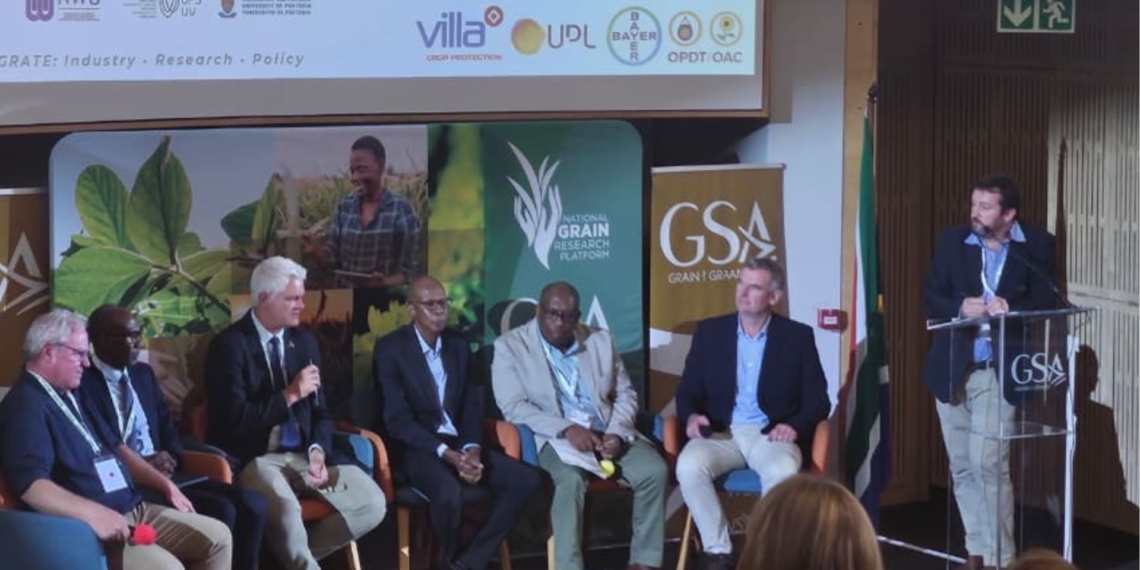
At the Grain SA Research Meeting, industry leaders called for stronger public–private partnerships, innovation, and biosecurity to secure South Africa’s grain future. Photo: Patricia Tembo/Food For Mzansi

At the Grain SA Research Meeting, industry leaders called for stronger public–private partnerships, innovation, and biosecurity to secure South Africa’s grain future. Photo: Patricia Tembo/Food For Mzansi

Share on FacebookShare on TwitterShare on WhatsApp

South Africa’s grain leaders gathered this week at the annual Grain SA Research Meeting with a clear message: future competitiveness will depend on tighter integration between policy, research and implementation, accelerated technology adoption, and a renewed focus on biosecurity and inclusion.

From government and industry to research institutions, speakers emphasised that collaboration, not fragmentation, will determine whether the industry sustains its productivity gains and navigates mounting global pressures.

Opening the discussion, Grain SA CEO Tobias Doyer called for a modernised partnership between the government and the private sector, particularly in research and biosecurity.

“We need to modernise our partnership, our integration between government and the private sector in South Africa.

“What we need is a good balance. Certain things need to be controlled by the state. Certain things need to be executed by the private sector,” Doyer said.

He cautioned against polarising rhetoric around “big agriculture” or “big state”, arguing instead for a unified vision that enables investment and innovation to flourish for the benefit of society.

Central to this vision is strengthening biosecurity systems and building a research and innovation ecosystem that attracts capital while protecting national agricultural assets.


Related stories
  • Why the environment is the real boss of farming
  • South Africa eyes bumper grain and soybean crops
  • Consumer relief comes at a cost for maize farmers
  • Three years on: Is the master plan delivering for farmers?

Policy, research and implementation

Director-general Mooketsa Ramasodi of the department of agriculture framed the sector’s future around what he termed a “tripod” of policy, research and implementation.

“You should never try to separate the areas in terms of the tripod. Policy, research, implementation, that’s all that we are here for,” he said.

Ramasodi highlighted that South Africa’s agricultural exports reached US$50.1 billion in the past year, a milestone reflecting sustained sector growth. Employment has also trended upward over the past decade.

Yet he challenged the sector to think bigger, noting that Africa is projected to import US$101 billion worth of agricultural products in 2025. “The question that I raise is: with the technology that we have in Africa, aren’t we supposed to be exporting?”

Newly appointed director-general (DG) for the department agriculture, land reform and rural development, Mooketsa Ramasodi. Photo: Suppled/Food For Mzansi
The director-general of the department of agriculture, Mooketsa Ramasodi. Photo: Supplied/Food For Mzansi

Technology and innovation, particularly in areas such as new breeding technologies (NBTs), biosecurity and climate-smart production, were identified as key to unlocking the next phase of growth. Ramasodi called for regulatory clarity and decisive engagement on whether current frameworks are sufficiently enabling innovation.

Logistics, new technology crucial for growth

Managing director of the Bureau for Food and Agricultural Policy (BFAP), Dr Ferdi Meyer, provided a sobering economic perspective.

“Gross margins for maize from this year compared to last year are down 65%. How are we going to survive that squeeze?” Meyer asked.

Despite margin pressures, South Africa’s productivity gains remain striking. Over the past decade, maize yields have increased at an average annual rate of 4.8%, nearly double that of the United States. Soybean yields have also improved steadily, though regulatory lag in accessing newer technologies remains a concern.

Since 2020, approximately 500 000 hectares of grain land have been brought back into production, supported by improved cultivars, precision agriculture and better farming practices.

However, Meyer warned that further expansion, particularly into underutilised land in provinces such as the Eastern Cape, will require coordinated support services, finance and logistics investment. “If we want to grow our grain economy, logistics are critical.”

Meanwhile, Dr Kenny Tenza, acting deputy director-general at the department of science and innovation, stressed that science, technology and innovation (STI) must translate into measurable impact on farms.

The development of an Agricultural STI Roadmap aims to ensure that research investments result in adopted technologies, stronger value chains and improved socio-economic outcomes.

“Inclusion is not an afterthought. It is a core indicator of impact,” Tenza said, highlighting the need to extend technology access to smallholders, women and youth.

Digital agriculture and decision-support platforms were identified as critical tools, provided they remain farmer-centred, affordable and accessible.

Building a resilient grain industry

Chief executive officer for the Agricultural Research Council (ARC), Dr Litha Magingxa, focused on resilience in the face of climate volatility.

“Grains are the backbone of the South African food system. The resilience of the grain sector is inseparable from the resilience of our nation,” Magingxa said.

Plant breeding remains central, with advances in marker-assisted selection, genomic tools and high-throughput genotyping shortening breeding cycles and improving precision. Genetic resource collections were described as “national insurance policies” against emerging stresses.

Beyond genetics, conservation agriculture, regenerative systems, crop modelling, cultivar trials and strengthened diagnostic capacity form part of a broader resilience strategy.

Magingxa emphasised that isolated excellence is no longer sufficient. “The time for operating in silos has passed. Our success depends on coordinated action.”

READ NEXT: Pomegranate pioneer: Debbie Theunissen’s rise in fruit farming

Sign-up for the latest agricultural news delivered straight to your inbox every day with Mzansi Today!

Patricia Tembo

Patricia Tembo is motivated by her passion for sustainable agriculture. Registered with the South African Council for Natural Scientific Professions (SACNASP), she uses her academic background in agriculture to provide credibility and technical depth to her journalism. When not in immersed in the world of agriculture, she is engaged in outdoor activities and her creative pursuits.

Tags: Agricultural Research Council (ARC)Bureau for Food and Agricultural Policy (BFAP)Commercialised farmerGrain SAInform meMooketsa Ramasodi

Related Posts

Potchefstroom Agricultural College celebrates farming’s future

Potchefstroom Agricultural College celebrates farming’s future

4th March 2026
Targeted supplier development helps Noko Trust thrive

Targeted supplier development helps Noko Trust thrive

3rd March 2026

Three years on: Is the master plan delivering for farmers?

This week’s agri events: 02 – 06 March

Turkish FMD vaccines set to boost national vaccination drive

Invasive mesquite plants threaten NC’s soil and livelihoods

Land reform: How the private sector can bridge the funding gap

Stock theft, fighting FMD high on NW and WC priority list

Plant varieties for aquaponics systems are selected based on nutrient demand, growth rate, and market potential. Herbs, lettuces, tomatoes, peppers and chillies tend to do well in the system.
News

This week’s agri events: 02 – 06 March

by Tiisetso Manoko
2nd March 2026

It's a new month, and agricultural events to look for include Agritec Africa in Joburg, North-West University is hosting a...

Read moreDetails
Mooketsa Ramasodi, director-general of the department of agriculture, welcomes the arrival of 1.5 million Dollvet FMD vaccines from Turkey at Aerolink Pharma 18, OR Tambo International Airport. Photo: Supplied/Food For Mzansi

Turkish FMD vaccines set to boost national vaccination drive

1st March 2026
Land reform stalls, CSI offers a path forward – Setou

Why the environment is the real boss of farming

1st March 2026
Ten tips to establish grazing pasture and boost profits

Invasive mesquite plants threaten NC’s soil and livelihoods

28th February 2026
Sinovuyo Senior Club grows food, love, and care in Khayelitsha

Sinovuyo Senior Club grows food, love, and care in Khayelitsha

27th February 2026

Invasive mesquite plants threaten NC’s soil and livelihoods

Stock theft, fighting FMD high on NW and WC priority list

Why SA is importing FMD vaccines from Argentina

Water infrastructure wins while extension officer hopes dry up

Potchefstroom Agricultural College celebrates farming’s future

Join Food For Mzansi's WhatsApp channel for the latest updates!

JOIN NOW!

THE NEW FACE OF SOUTH AFRICAN AGRICULTURE

With 21 global awards in the first six years of its existence, Food For Mzansi is much more than an agriculture publication. It is a movement, unashamedly saluting the unsung heroes of South African agriculture. We believe in the power of agriculture to promote nation building and social cohesion by telling stories that are often overlooked by broader society.

Unified vision key to driving innovation in SA’s grain industry

Potchefstroom Agricultural College celebrates farming’s future

Castor bean farming could be SA’s next big opportunity

Farm clinics bring healthcare closer to Cape Winelands workers

Why SA is importing FMD vaccines from Argentina

Targeted supplier development helps Noko Trust thrive

  • Awards & Global Impact
  • Our Story
  • Contact Us
  • Cookie Policy
  • Privacy Policy
  • Copyright

Contact us
Office: +27 21 879 1824
News: info@foodformzansi.co.za
Advertising: sales@foodformzansi.co.za

Contact us
Office: +27 21 879 1824
News: info@foodformzansi.co.za
Advertising: sales@foodformzansi.co.za

  • Awards & Global Impact
  • Our Story
  • Contact Us
  • Cookie Policy
  • Privacy Policy
  • Copyright
No Result
View All Result
  • News
  • Changemakers
  • Lifestyle
  • Farmer’s Inside Track
  • Food for Thought

Copyright © 2024 Food for Mzansi

This website uses cookies. By continuing to use this website you are giving consent to cookies being used. Visit our Privacy and Cookie Policy.