Saturday, May 2, 2026
SUBSCRIBE
21 GLOBAL MEDIA AWARDS
Food For Mzansi
  • News
  • Changemakers
  • Lifestyle
  • Farmer’s Inside Track
  • Food for Thought
No Result
View All Result
  • News
  • Changemakers
  • Lifestyle
  • Farmer’s Inside Track
  • Food for Thought
No Result
View All Result
Food For Mzansi
No Result
View All Result
in News

Unified vision key to driving innovation in SA’s grain industry

Collaboration, not competition, will shape South Africa’s grain future. At this week’s Grain SA Research Meeting, leaders from across the industry called for stronger public–private partnerships, smarter innovation, and a sharper focus on biosecurity

by Patricia Tembo
4th March 2026
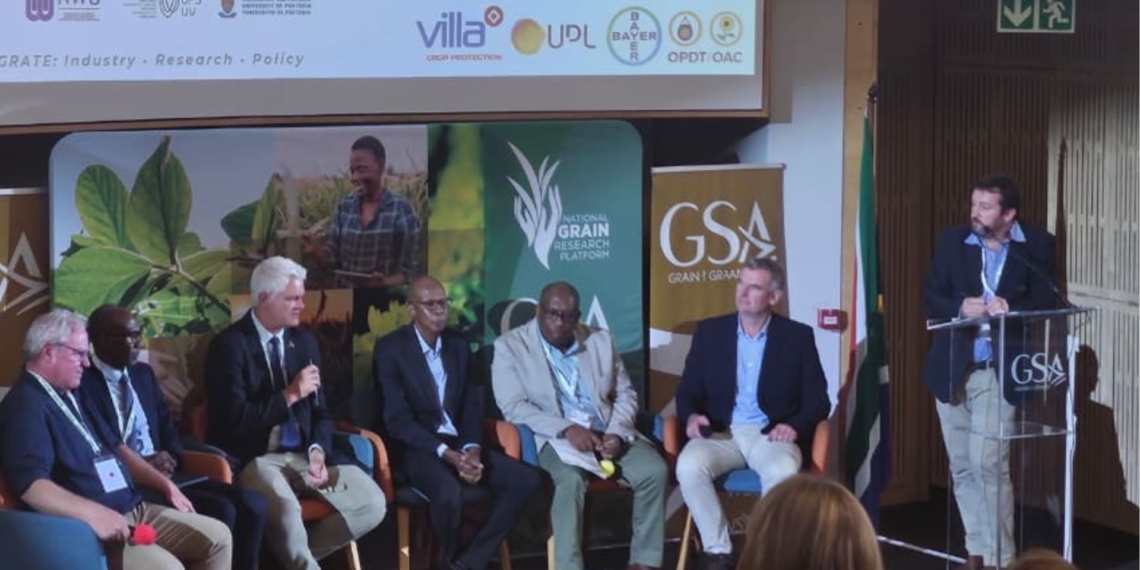
At the Grain SA Research Meeting, industry leaders called for stronger public–private partnerships, innovation, and biosecurity to secure South Africa’s grain future. Photo: Patricia Tembo/Food For Mzansi

At the Grain SA Research Meeting, industry leaders called for stronger public–private partnerships, innovation, and biosecurity to secure South Africa’s grain future. Photo: Patricia Tembo/Food For Mzansi

Share on FacebookShare on TwitterShare on WhatsApp

South Africa’s grain leaders gathered this week at the annual Grain SA Research Meeting with a clear message: future competitiveness will depend on tighter integration between policy, research and implementation, accelerated technology adoption, and a renewed focus on biosecurity and inclusion.

From government and industry to research institutions, speakers emphasised that collaboration, not fragmentation, will determine whether the industry sustains its productivity gains and navigates mounting global pressures.

Opening the discussion, Grain SA CEO Tobias Doyer called for a modernised partnership between the government and the private sector, particularly in research and biosecurity.

“We need to modernise our partnership, our integration between government and the private sector in South Africa.

“What we need is a good balance. Certain things need to be controlled by the state. Certain things need to be executed by the private sector,” Doyer said.

He cautioned against polarising rhetoric around “big agriculture” or “big state”, arguing instead for a unified vision that enables investment and innovation to flourish for the benefit of society.

FARMER POLL

📢 Which bank is powering your farming journey?

Tell us which bank you use so we can better advocate for the specialised financial tools and accessible capital needed to help South African farmers overcome growth barriers and thrive!

All submissions are kept strictly confidential. 

Central to this vision is strengthening biosecurity systems and building a research and innovation ecosystem that attracts capital while protecting national agricultural assets.


Related stories
  • Why the environment is the real boss of farming
  • South Africa eyes bumper grain and soybean crops
  • Consumer relief comes at a cost for maize farmers
  • Three years on: Is the master plan delivering for farmers?

Policy, research and implementation

Director-general Mooketsa Ramasodi of the department of agriculture framed the sector’s future around what he termed a “tripod” of policy, research and implementation.

“You should never try to separate the areas in terms of the tripod. Policy, research, implementation, that’s all that we are here for,” he said.

Ramasodi highlighted that South Africa’s agricultural exports reached US$50.1 billion in the past year, a milestone reflecting sustained sector growth. Employment has also trended upward over the past decade.

Yet he challenged the sector to think bigger, noting that Africa is projected to import US$101 billion worth of agricultural products in 2025. “The question that I raise is: with the technology that we have in Africa, aren’t we supposed to be exporting?”

Newly appointed director-general (DG) for the department agriculture, land reform and rural development, Mooketsa Ramasodi. Photo: Suppled/Food For Mzansi
The director-general of the department of agriculture, Mooketsa Ramasodi. Photo: Supplied/Food For Mzansi

Technology and innovation, particularly in areas such as new breeding technologies (NBTs), biosecurity and climate-smart production, were identified as key to unlocking the next phase of growth. Ramasodi called for regulatory clarity and decisive engagement on whether current frameworks are sufficiently enabling innovation.

Logistics, new technology crucial for growth

Managing director of the Bureau for Food and Agricultural Policy (BFAP), Dr Ferdi Meyer, provided a sobering economic perspective.

“Gross margins for maize from this year compared to last year are down 65%. How are we going to survive that squeeze?” Meyer asked.

Despite margin pressures, South Africa’s productivity gains remain striking. Over the past decade, maize yields have increased at an average annual rate of 4.8%, nearly double that of the United States. Soybean yields have also improved steadily, though regulatory lag in accessing newer technologies remains a concern.

Since 2020, approximately 500 000 hectares of grain land have been brought back into production, supported by improved cultivars, precision agriculture and better farming practices.

However, Meyer warned that further expansion, particularly into underutilised land in provinces such as the Eastern Cape, will require coordinated support services, finance and logistics investment. “If we want to grow our grain economy, logistics are critical.”

Meanwhile, Dr Kenny Tenza, acting deputy director-general at the department of science and innovation, stressed that science, technology and innovation (STI) must translate into measurable impact on farms.

The development of an Agricultural STI Roadmap aims to ensure that research investments result in adopted technologies, stronger value chains and improved socio-economic outcomes.

“Inclusion is not an afterthought. It is a core indicator of impact,” Tenza said, highlighting the need to extend technology access to smallholders, women and youth.

Digital agriculture and decision-support platforms were identified as critical tools, provided they remain farmer-centred, affordable and accessible.

Building a resilient grain industry

Chief executive officer for the Agricultural Research Council (ARC), Dr Litha Magingxa, focused on resilience in the face of climate volatility.

“Grains are the backbone of the South African food system. The resilience of the grain sector is inseparable from the resilience of our nation,” Magingxa said.

Plant breeding remains central, with advances in marker-assisted selection, genomic tools and high-throughput genotyping shortening breeding cycles and improving precision. Genetic resource collections were described as “national insurance policies” against emerging stresses.

Beyond genetics, conservation agriculture, regenerative systems, crop modelling, cultivar trials and strengthened diagnostic capacity form part of a broader resilience strategy.

Magingxa emphasised that isolated excellence is no longer sufficient. “The time for operating in silos has passed. Our success depends on coordinated action.”

READ NEXT: Pomegranate pioneer: Debbie Theunissen’s rise in fruit farming

Sign-up for the latest agricultural news delivered straight to your inbox every day with Mzansi Today!

Patricia Tembo

Patricia Tembo is motivated by her passion for sustainable agriculture. Registered with the South African Council for Natural Scientific Professions (SACNASP), she uses her academic background in agriculture to provide credibility and technical depth to her journalism. When not in immersed in the world of agriculture, she is engaged in outdoor activities and her creative pursuits.

Tags: Agricultural Research Council (ARC)Bureau for Food and Agricultural Policy (BFAP)Commercialised farmerGrain SAInform meMooketsa Ramasodi

Related Posts

Land reform in SA: Slow but steady strides forward

Land restitution leads, but reform still lacks

2nd May 2026
South Africa faces a critical shortage of veterinarians, essential for animal health, food safety, and zoonotic disease control. Boehringer Ingelheim is working to support existing vets and raise awareness of the profession’s vital role. Photo: Supplied/Food For Mzansi

R512k boost helps EC youth launch animal healthcare businesses

2nd May 2026

Female farmers commit to stronger worker relationships

1st May 2026

On the frontline: Why veterinarians are critical infrastructure

Local burrata named SA’s best dairy product

Mopane & termites: Limpopo insect trade boosts rural livelihoods

Rockman unveils R1 billion budget to combat disease, boost jobs

Tsolo farmers’ day tackles disease and market access

Calf rearing: Why the first few hours define your future herd
Farmer's Inside Track

Calf rearing: Why the first few hours define your future herd

by Patricia Tembo
29th April 2026

Successful livestock farming starts at birth. University of the Free State specialist Junior Mkansi breaks down the complexities of calf...

Read moreDetails
Harvesting success: Inga Qeja’s journey from garden to grocer

Harvesting success: Inga Qeja’s journey from garden to grocer

29th April 2026
Mopane

Mopane & termites: Limpopo insect trade boosts rural livelihoods

29th April 2026
Rockman unveils R1 billion budget to combat disease, boost jobs

Rockman unveils R1 billion budget to combat disease, boost jobs

29th April 2026
Industry experts and stakeholders lead a panel discussion at the Eastern Cape Farmers’ Day Fair Trade hosted by Food For Mzansi in partnership with Inga Qeja, a trailblazing vegetable farmer and the proud owner of Bhayi Holdings in Mbokothwana, Tsolo. Photo: Food For Mzansi

Tsolo farmers’ day tackles disease and market access

28th April 2026

Livestock prices remain high as disease and supply shocks reshape the market

Female farmers commit to stronger worker relationships

R512k boost helps EC youth launch animal healthcare businesses

Women farmers call for inclusive growth and development

Fairtrade Africa sharpens 2026–2028 strategy for impact

Join Food For Mzansi's WhatsApp channel for the latest updates!

JOIN NOW!
Next Post
Discipline and dirt define Meshack Ndongeni’s farming success

Discipline and dirt define Meshack Ndongeni’s farming success

THE NEW FACE OF SOUTH AFRICAN AGRICULTURE

With 21 global awards in the first six years of its existence, Food For Mzansi is much more than an agriculture publication. It is a movement, unashamedly saluting the unsung heroes of South African agriculture. We believe in the power of agriculture to promote nation building and social cohesion by telling stories that are often overlooked by broader society.

Land restitution leads, but reform still lacks

R512k boost helps EC youth launch animal healthcare businesses

Stoep to cellar: Sauvignon blanc takes centre stage this May

Female farmers commit to stronger worker relationships

Healing through nature: Letitia builds wellness brand from home

Fairtrade Africa sharpens 2026–2028 strategy for impact

  • Awards & Global Impact
  • Our Story
  • Contact Us
  • Cookie Policy
  • Privacy Policy
  • Copyright

Contact us
Office: +27 21 879 1824
News: info@foodformzansi.co.za
Advertising: sales@foodformzansi.co.za

Contact us
Office: +27 21 879 1824
News: info@foodformzansi.co.za
Advertising: sales@foodformzansi.co.za

  • Awards & Global Impact
  • Our Story
  • Contact Us
  • Cookie Policy
  • Privacy Policy
  • Copyright
No Result
View All Result
  • News
  • Changemakers
  • Lifestyle
  • Farmer’s Inside Track
  • Food for Thought

Copyright © 2024 Food for Mzansi

This website uses cookies. By continuing to use this website you are giving consent to cookies being used. Visit our Privacy and Cookie Policy.