In a fiscally constrained 2026 budget speech, finance minister Enoch Godongwana has prioritised large-scale water projects and biosecurity surveillance. The promise of 10 000 new extension officers, however, remains unfunded beyond existing baseline provisions.
For the farming sector, the most significant shift is the stabilisation of inflation at 3.2%, a move intended to lower interest rates and ease the debt burden on commercial and emerging producers alike.
“In water, investments are directed towards high-impact bulk water augmentation schemes, refurbishment of ageing infrastructure and the completion of strategic projects that support economic nodes, agriculture and household supply,” Godongwana said.
To address the bureaucratic red tape that often stifles farm expansion, the department aims to finalise 85% of water use license applications within 90 days this year.
This is backed by the newly operational National Water Resources Infrastructure Agency, which Godongwana confirmed will begin operations this year to tackle the maintenance backlogs and the immediate water crisis.
Extension officers and biosecurity
Despite the high-level focus on infrastructure, the department’s promise to deploy 10 000 extension officers appears to have hit a fiscal ceiling. Speaking to Food For Mzansi, the national treasury clarified that.
“There is no additional allocation above these provisions in the fiscal framework for the 10 000 officers, beyond the R300 million previously set aside for recruitment,” national treasury director general Duncan Pieterse said.
However, biosecurity received a focused boost. The department has allocated R1 billion to the Animal Production and Health sub-programme, specifically for annual surveillance of foot-and-mouth disease, goat plague, and Newcastle disease.
Related stories
- Farmers and brewers call for budget that builds, not breaks
- Godongwana increases VAT as state’s pockets run dry
- Relief at last: 1 million FMD vaccines touch down in Mzansi
- Rooibos industry holds its ground amid climate uncertainty
Furthermore, Onderstepoort Biological Products (OBP) has been tasked with an R580.1 million mandate to develop new vaccines and open 18 new distribution points to ensure smallholder farmers can protect their herds against increasingly frequent outbreaks.
Sin tax increases
As treasury looks to plug the fiscal gap, above-inflation excise duty increases on alcohol and tobacco are set to squeeze the margins of the wine and spirits value chain, even as the PPECB receives more funding to facilitate exports.
The 2026 Budget has delivered a sharp reminder that “sin” remains a primary source of state revenue.
Godongwana outlined a series of excise duty increases that will impact everyone from the vineyard to the distillery.
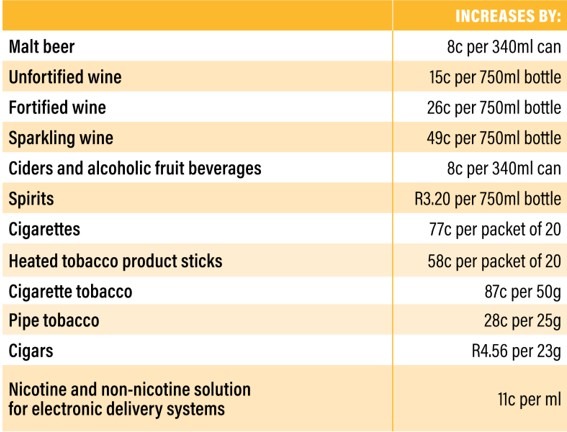
“Malt beer will see an increase of 8 cents per 340ml can, while the wine sector, already reeling from high input costs, will face a 15-cent hike per 750ml bottle of unfortified wine and a 49-cent per 750ml bottle increase for sparkling wine. The heaviest blow fell on spirits, which will see an increase of R3.20 per 750ml bottle,” he said.
Meanwhile, South Africa Wine chief executive officer Rico Basson said they had noted the government’s decision to adjust excise duties on wine in line with inflation for the 2026/27 financial year.
“Policy certainty is vital for a labour-intensive agricultural industry such as wine. Inflation-linked adjustments help balance the government’s fiscal objectives with the sustainability of rural jobs, exports and economic contribution,” he said.
Basson said while the sector continues to face structural pressures, including declining domestic consumption within the regulated market, rising input costs and constrained margins, a CPI-aligned increase provides a more stable foundation for business continuity and investment.
Food safety gets a boost
While the tax burden grows, the government is attempting to soften the blow by improving the efficiency of getting products to global markets. The Perishable Products Export Control Board (PPECB) is set to receive a portion of the R182.5 million allocated to food safety over the medium term.
The board’s focus will remain on labour-intensive quality assurance, with a plan to conduct 3 770 food safety audits. As global markets tighten their phytosanitary requirements, this funding is critical to ensure that South African fruit and wine farmers do not lose their “preferred supplier” status in the EU and beyond.
READ NEXT: Cheap potatoes bring relief to consumers, pain to farmers