Monday, September 7, 2026
SUBSCRIBE
22 GLOBAL MEDIA AWARDS
Food For Mzansi
  • News
  • Changemakers
  • Lifestyle
  • Farmer’s Inside Track
  • Food for Thought
No Result
View All Result
  • News
  • Changemakers
  • Lifestyle
  • Farmer’s Inside Track
  • Food for Thought
No Result
View All Result
Food For Mzansi
No Result
View All Result
in News

WC bird flu outbreak contained, no cause for alarm

The Western Cape has reported a new case of avian influenza in farmed ducks near Paarl, prompting swift containment efforts. Officials urge poultry farmers and the public to remain vigilant and report any unusual bird deaths

by Staff Reporter
2nd August 2025
Hartlaub’s Gulls have been found dead in the Cape Town area and have tested positive for high pathogenicity avian influenza. Photo: Supplied/SANCCOB

Hartlaub’s Gulls have been found dead in the Cape Town area and have tested positive for high pathogenicity avian influenza. Photo: Supplied/SANCCOB

Share on FacebookShare on TwitterShare on WhatsApp

The Western Cape department of agriculture (WCDoA) has confirmed a new outbreak of high pathogenicity avian influenza (HPAI), commonly known as bird flu, in farmed ducks near Paarl. This marks the province’s first poultry-related outbreak since the resurgence of the disease in other parts of the country.

The ducks, along with associated chickens, were humanely culled in early July to contain the spread. Recent outbreaks have also been reported in chickens in the North West and Mpumalanga provinces.

In addition to domestic poultry, the virus has been responsible for mortalities in wild birds, including Great White Pelicans near Malmesbury and Hartlaub’s Gulls in the Cape Town area. These are the first confirmed wild bird cases in the Western Cape since April 2024, and the first mass die-offs since 2022.

Understanding avian influenza

Avian influenza is a viral disease primarily affecting birds. Infected wild birds may behave abnormally, appearing tame, losing fear of humans, or showing neurological symptoms such as twitching or seizures. The virus is shed in bird droppings and body fluids and spreads through direct contact or contaminated surfaces.

Globally, the virus has infected a limited number of mammals and humans after close contact with infected birds, but human-to-human transmission has not been recorded. Health officials stress that the risk to humans remains low, but contact with sick or dead birds should be avoided.

Consumers are assured that poultry products sold in South African grocery stores remain safe to eat.
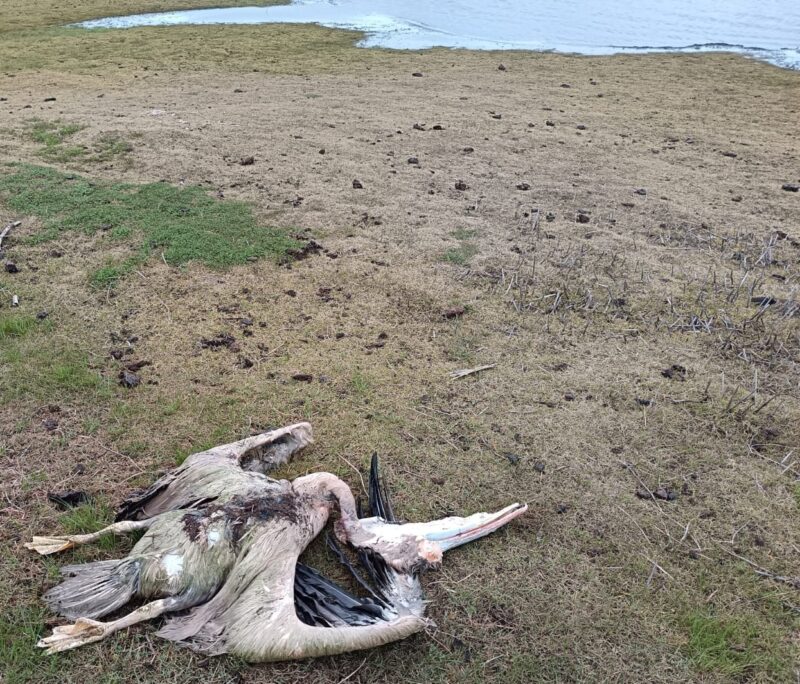
Great White Pelicans were found dead near Malmesbury in the Western Cape and diagnosed with high pathogenicity avian influenza. Photo: Supplied/M. Vrey

Call for public and sector cooperation

The WCDoA is calling on the public, poultry farmers, and the broader agricultural sector to assist in preventing the spread of HPAI. The disease is classified as a controlled animal disease under the Animal Diseases Act (35 of 1984).

Suspected cases in poultry should be reported immediately to a local State Veterinarian. Contact details are available via the department’s website: www.elsenburg.com.

Anyone encountering unusual numbers of sick or dead wild birds—approximately three or more seabirds or even one or two solitary birds of prey—is encouraged to report the sightings. Reports can be made through the “SA seabird bird flu form” on the OCIMS website or directly at https://arcg.is/1585011.

Biosecurity measures for poultry farmers

Farmers and poultry producers are urged to implement strict biosecurity protocols:

  • Limit farm access: Restrict entry to anyone who has had contact with poultry within the past 48 hours.
  • Prevent interaction between poultry and wild birds using screens, fencing, or netting.
  • Disinfect all vehicles and footwear when entering and exiting poultry facilities.

The department stresses that through collective vigilance and action, it is possible to curb the spread of avian influenza and protect both the poultry industry and broader communities.

READ NEXT: Minister warns: Fresh produce system under threat

Staff Reporter

Researched and written by our team of writers and editors.

Tags: Avian InfluenzaBird FluHPAI
Tough times, hardy cattle: Why Mzansi farmers are choosing Nguni
News

Tough times, hardy cattle: Why Mzansi farmers are choosing Nguni

by Vateka Halile
3rd September 2026

Nguni cattle are known for their hardiness and low-maintenance needs, making them ideal for Mzansi's harsh conditions. However, market prejudice...

Read moreDetails
Dragon fruit thrives in KZN valley despite tough national season

Dragon fruit thrives in KZN valley despite tough national season

3rd September 2026
The future of Mzansi's sugar industry hangs in the balance

Government hikes sugar import price, but industry warns of gap

3rd September 2026

Chicken is booming, but the real money is in the supply chain

2nd September 2026
How Tebogo beat post-harvest losses with smart agro-processing

How Tebogo beat post-harvest losses with smart agro-processing

2nd September 2026

Farmers rethink water use as shortages threaten food production

Foot-and-mouth crisis hits SA dairy industry with R1-billion loss

Rising costs, climate risk push Swartland wheat farmers to the brink

Gauteng farmers urged to harness massive urban market

Potato turning point ahead as onions double in price year-on-year

Join Food For Mzansi's WhatsApp channel for the latest updates!

JOIN NOW!
Next Post
Farmers in the spotlight! From seed to success, the Limpopo Market Day hosted by De Beers Group, Agda, and Food For Mzansi brought together the agri-stars, movers, and shakers driving rural growth one crop at a time. Photo: Duncan Masiwa/Food For Mzansi

Limpopo market day unites over 360 for brighter farming future

THE NEW FACE OF SOUTH AFRICAN AGRICULTURE

With 21 global awards in the first six years of its existence, Food For Mzansi is much more than an agriculture publication. It is a movement, unashamedly saluting the unsung heroes of South African agriculture. We believe in the power of agriculture to promote nation building and social cohesion by telling stories that are often overlooked by broader society.

Tiger Brands CEO calls for stronger food value chain

Plant, pick, protect: The rising potential of urban foraging in SA

RSVP now: Emerging farmers’ programme at Nampo Cape

Community-led farms boost food security and incomes in Limpopo

Farmers rethink water use as shortages threaten food production

Honoured roots: A father’s legacy, a daughter’s farming dream

  • Awards & Global Impact
  • Our Story
  • Contact Us
  • Cookie Policy
  • Privacy Policy
  • Copyright

Contact us
Office: +27 21 879 1824
News: info@foodformzansi.co.za
Advertising: sales@foodformzansi.co.za

Contact us
Office: +27 21 879 1824
News: info@foodformzansi.co.za
Advertising: sales@foodformzansi.co.za

  • Awards & Global Impact
  • Our Story
  • Contact Us
  • Cookie Policy
  • Privacy Policy
  • Copyright

Chat Options

I'm Lerato, your AI assistant!
No Result
View All Result
  • News
  • Changemakers
  • Lifestyle
  • Farmer’s Inside Track
  • Food for Thought

Copyright © 2024 Food for Mzansi

This website uses cookies. By continuing to use this website you are giving consent to cookies being used. Visit our Privacy and Cookie Policy.