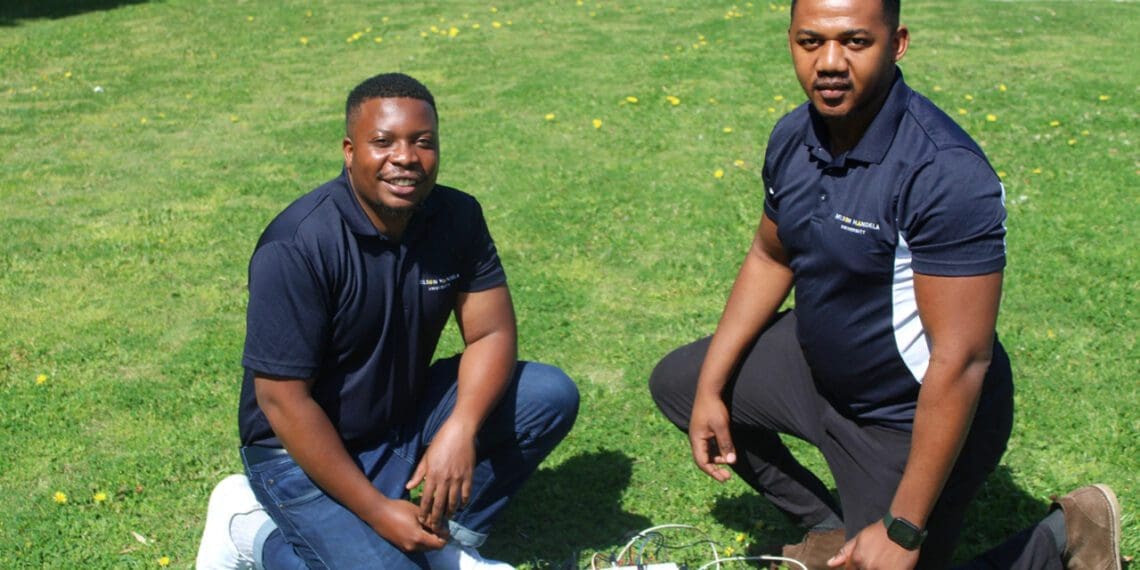
To assist farmers in Africa in dealing with the effects of climate change on their crops, post-graduate students at Nelson Mandela University’s Centre for Community Technologies (CCT) are developing an innovative tool for farmers to help them monitor soil and climate conditions and optimise their crops.
CCT director Professor Darelle van Greunen said the development of the box is being funded by the National Research Foundation and is part of Leap-Agri, a joint Europe Africa research and innovation initiative related to food and nutrition security and sustainable agriculture that was originally funded by the European Union.
“Originally, we started out with liquid fertilisation plants for South Africa and then we decided that maybe this is not the way for us to go and for the continent,” she explained, adding that most small-scale farmers still use manure.
“So we suggested that we look at climate change, soil management and sensor probes to put in the soil. We are focusing on small-scale farmers, particularly crop farmers as an initial start,” she said.
In his essay in the Gates Foundation’s Goalkeepers Report, Bill Gates suggests that innovation is likely to be key for Africa to overcome the food crisis that is facing the world. The 2022 report, titled The Future of Progress, was launched on 13 September and aims to monitor global progress towards the United Nations’ sustainable development goals.
Iterations
Van Greunen said the first version of the sensor box was developed by Portugal. “We tested it [but] we were not happy with how it was performing within the African context. So we customised it for our own purposes.
“We have 3D-printed the box with all the different sensors. We have done some sensor readings in different parts of South Africa. Tinashe [Chizema] has been doing readings in Zimbabwe as well. We are going to Uganda [and] Kenya … soon. We will be taking some boxes to Ghana for the farmers to use there as well,” she said.

Van Greunen said they were fine-tuning the app that works with the box as they had seen a need “for a number of things”.
They will also adjust the probes used with the box and will develop probes for use in aquaponic farming, she said. The team was also working on establishing a way for the box to communicate directly with farmers’ cellphones as connectivity could be a problem in rural areas.
“The aim is for it to work with SMS notifications so that you don’t necessarily need connectivity.”
Van Greunen said: “At the moment, [the box] can work without connectivity outside in the field. It runs off a battery and the farmer can take the readings off a screen and enter the readings into the app on their phone.”
How it works
Tinashe Chizema is doing his master’s degree in how information technology can be used to help manage climate change.
“I love geography. It was nice to combine geography and IT,” he said.
He explained that the probes take readings, such as the pH level of the soil, electrical connectivity, sunlight, barometric pressure, humidity, altitude and environmental temperature. Probes that measure soil moisture and soil temperature will also be added.
A farmer then reads these measurements off a screen or the results can be sent to a laptop through Wi-Fi.
“We have picked up from going into the field that we need GSM capabilities to send an SMS to farmers’ cellphones as well,” he said.
Chizema said the CCT’s app interprets the results and makes recommendations on what would be the best crop to plant.
“At the moment, the app focuses on maize and sweet potatoes … It will also recommend what a farmer can do to optimise the soil before planting.”
Farmers have been asked to test the system. “People are welcoming the idea,” he said. “They also want to know how they can get one of these.” Funding is also a factor, with farmers indicating that they would like training.
“When you are going to a small-scale farmer, you don’t want to shock them. You want to introduce ICT as a support; something that can help them understand things like crop rotation.” The best approach, he said, is to take traditional knowledge and use ICT as support.
He said work on the box was still being done and the team was learning something new every day.
Trends dashboard
Cleo Watama, who is doing his master’s degree in change management in the digital health sector and is assisting Chizema on this project, said the box can also use alternative sources of power, such as solar.
“Our aim is to get people used to the technology. The same applies to this box. One needs to make the benefit of using it more clear to small-scale farmers. As part of the training, you let them know the benefits – how they can monitor soil and climate conditions.”
He said the team had also designed a dashboard for farmers to monitor longer-term soil trends.
“They will be able to see changes over time. This can guide them about what to do,” Watama added.
This article was written by Estelle Ellis and originally published on Daily Maverick.
ALSO READ: Agri-engineers offer solutions to climate change
Sign up for Mzansi Today: Your daily take on the news and happenings from the agriculture value chain.