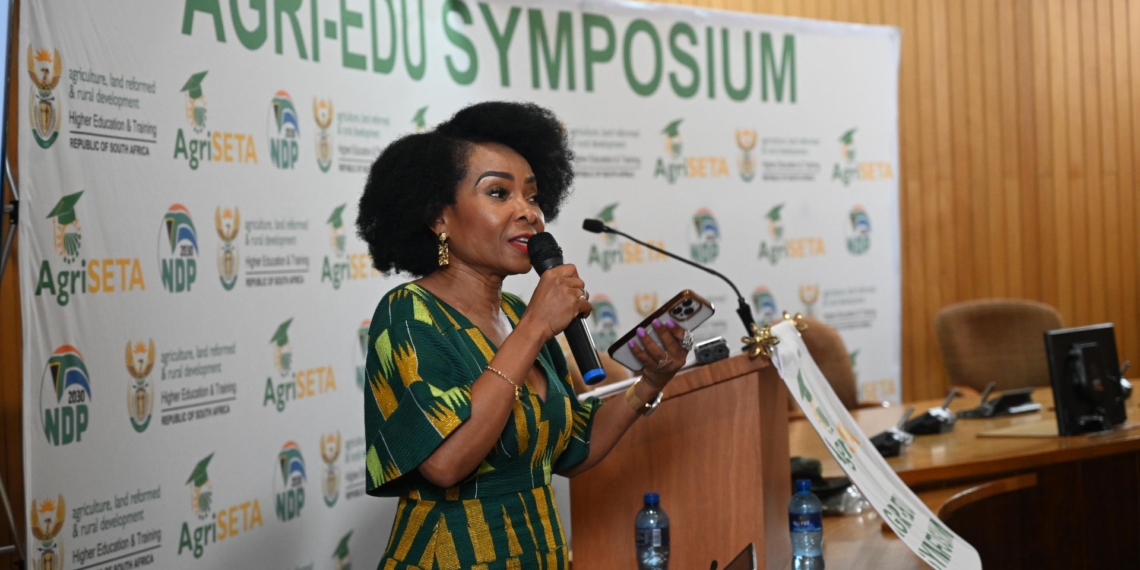
The recent AgriSETA Agri-Edu Symposium brought together a diverse coalition of thought leaders, policymakers, and practitioners to address the evolving challenges and opportunities within South Africa’s agricultural education sector.
Through this platform, participants explored the critical intersections of education, entrepreneurship, and governance, forging pathways to revitalise the sector and its institutions.
Prof. Mamokgethi Phakeng, former vice-chancellor of the University of Cape Town (UCT), highlighted the need for education that bridges theoretical knowledge with hands-on skills, aligning with the realities of modern farming and the demands of a changing agricultural landscape.
“What we’ve been really talking about today is the future, right? What do we want the future of agriculture education to be? And we’ve looked at the context of whether education takes place, the outcomes, and the whole big chain that is important skill development, location, food security, and manufacturing,” she said.
A holistic approach to agricultural education
Phakeng’s address highlighted the need for education that bridges theoretical knowledge with hands-on skills, aligning with the realities of modern farming and the demands of a changing agricultural landscape.
The integration of technology and artificial intelligence in agriculture was another focal point. Phakeng urged attendees to consider the implications of technological advancements.
“As we think about the content, as an architect, we’re going to think about the world in which our students are going to operate. It is not the world of today.
“It is the world where we have machines that are more intelligent than ourselves. What does it mean for agriculture?” she said.
Related stories
- AgriSETA calls for curriculum reform, skills training in agriculture
- AgriSETA’s CEO inspires churches, households and schools
- Agri SA Enterprises and AgriSETA join forces for rural development
Bridging the gap between academia and industry
Advisor to the vice-chancellor and principal of the University of Pretoria, Dr Diane Parker, gave a comprehensive overview of the systemic challenges faced by agricultural colleges.
“These colleges have been operating outside of the legislative framework since the high educational standards were proposed in 1994. That is our key problem.
“If you can think that the first ministerial task teams that tried to deal with this problem were in 2000. And we’re now in 2024. It’s been a very, very long time. I think that is why we are so passionate about trying to get this matter completed,” she said.
Parker emphasised the importance of a collaborative approach to strengthen agricultural colleges, highlighting the need for a comprehensive plan to enhance their capabilities.
“What we’re going to have to do – and we are working together with the department of agriculture and other partners – is to put together a holistic plan for how we support the colleges to perform in terms of developing all these capabilities and putting in place the systems required,” she said.

READ NEXT: Supporting small-scale farmers key to Zim’s agricultural future
Sign up for Mzansi Today: Your daily take on the news and happenings from the agriculture value chain.