The government has laid out an ambitious agenda for 2026, one that promises expanded support for smallholder and emerging farmers, tighter biosecurity and regulatory reform, and a push for agricultural technology, export growth and inclusive agribusiness.
With the financial year now halfway through, 2026 becomes a critical period for delivering on promises made under the 2025/26 agriculture budget, particularly for smallholder and emerging farmer support, renewed extension services, and food security.
The department of agriculture (DoA) allocated R1,685,217 billion to the Comprehensive Agricultural Support Programme (Casp), aimed at “subsistence, small-holder and Black commercial farmer promoting efficiency, enhancing food security, [and] creating wealth in agriculture.”
Within the Caso budget, R439.741 million is earmarked for the extension recovery plan “to strengthen extension and advisory services in all provinces” and R103.828 million to revamp infrastructure at agricultural colleges.
Complementing these initiatives, the Ilima/Letsema Programme received an allocation of R677.396 million to boost food production in communal rural areas, targeting vulnerable households, small-scale producers and subsistence farmers with inputs and mechanisation support.
Stronger FMD fight ahead
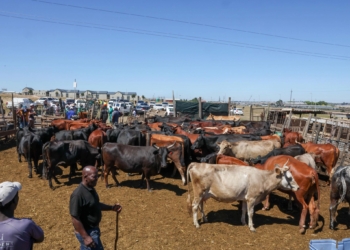
Meanwhile, after a long year of pain and setbacks for farmers battling foot-and-mouth disease (FMD), Steenhuisen acknowledged the “immense hardship” the outbreak has caused as KZN continues to carry most unresolved cases.
With illegal animal movement slowing containment, the government has intensified targeted vaccinations and said it expects to receive two million more doses by February 2026, supported by a planned local vaccine-production facility.
The department also said it aims to vaccinate the entire national herd, starting with the hardest-hit provinces, as part of a push to secure “freedom with vaccination” status and rebuild resilience in the livestock sector.
Related stories
- Govt steps up FMD fight with mass cattle vaccination plans
- Fast lane to compliance: Pesticide permits now online in SA
- Biosecurity and food security top Steenhuisen’s budget agenda
- Steenhuisen applauds farmers, workers as heartbeat of the nation
STI roadmap to transform agri-food systems
Alongside these efforts, the department of science, technology and innovation (DSTI), working with the Food and Agriculture Organisation (FAO), has also stepped into the agriculture space this year with a major long-term commitment: the development of a science, technology and innovation (STI) roadmap for agriculture.
Announced in November, the roadmap is intended to modernise South Africa’s agri-food system by strengthening research capabilities, promoting climate-smart and sustainable farming technologies, expanding agro-processing opportunities and creating space for women, youth and small-scale producers in value chains.
According to the DSTI, the roadmap “will promote the development of new high-value crops, livestock and agro-processed products; create expanded opportunities for women and youth in rural areas. It will focus on enhancing food and nutrition security through sustainable technologies and strengthening value chains that support livelihoods and socio-economic transformation.”
Importantly, the STI roadmap is expected to be completed by the end of September 2026, laying out a multi-year plan that will shape how the country integrates innovation into farming and food production going forward.
Pesticide registration set to go fully digital
In a separate initiative, the DoA will fully digitise pesticide registration by 1 April 2026, streamlining and modernising the process. This shift replaces the long-standing manual system that slowed approvals for products like insecticides and herbicides.
Under the Fertilisers, Farm Feeds, Agricultural Remedies and Stock Remedies Act (1947), the department oversees registration and monitoring of these products.
Steenhuisen noted that moving online will cut delays and create a “fast lane” for compliant applicants, ending the need for in-person paperwork submissions.
READ NEXT: La Niña: Wetter summer calls for smarter water, soil management