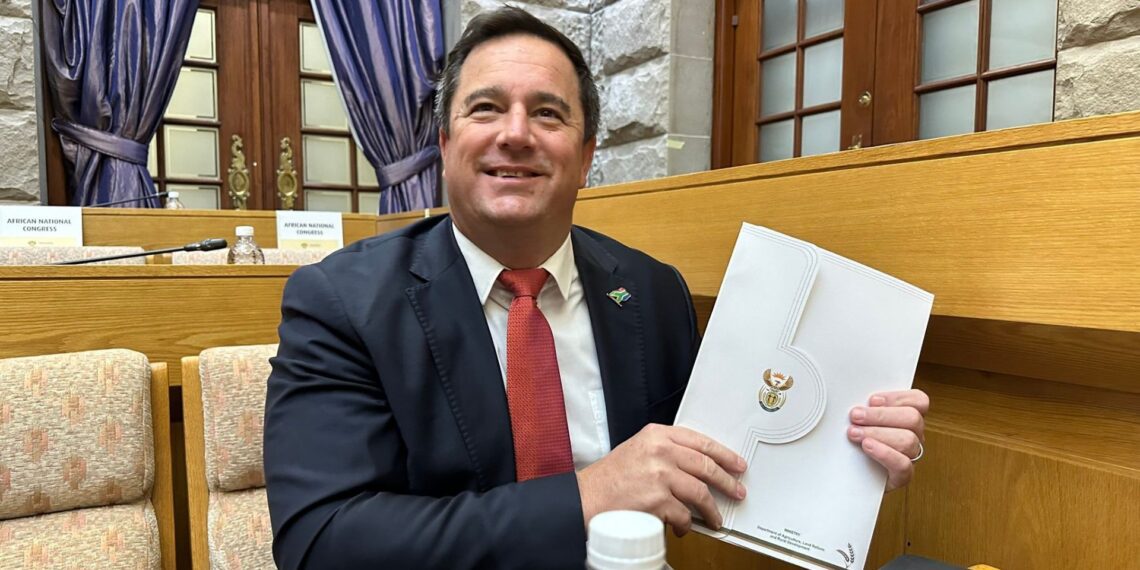
Agriculture minister John Steenhuisen delivered his 2025/26 Budget Speech in parliament today, marking a new chapter for the department. Now operating as a standalone department after its split from land reform and rural development, Steenhuisen said the department was entering a more intentional, focused, and responsive era.
Steenhuisen said their mission is to build a food system that is inclusive, competitive, sustainable and above all, one that leaves no South African behind.
To address both the immense potential and the ongoing challenges in agriculture, the department has centred its efforts around seven strategic priorities: forging partnerships for growth, creating a modern and progressive legislative environment, improving market access, delivering effective farmer support, strengthening biosecurity and disaster preparedness, advancing sector advocacy, and enhancing food and nutrition security.
“These are not catchphrases. They are a call to action and a roadmap for transformation,” Steenhuisen said.
Related stories
- Steenhuisen: ‘Ubuntu key to global food and climate crisis’
- Proposed Transformation Fund needs clarity to drive real change
- Grain SA appoints Mabuza to lead farmer development
Biosecurity council to tackle animal diseases
Calling biosecurity the “greatest unseen threat” to the sector, Steenhuisen said the 2023 bird flu outbreak and the ongoing foot-and-mouth disease (FMD) crisis highlight the urgent need for decisive action. In response, the department is establishing a biosecurity council to coordinate national efforts, launching the national biosecurity compact to define clear protocols and vaccine stock levels.
The minister confirmed expanded partnerships with the University of Pretoria’s National Biosecurity Hub and renewed investment in surveillance and graduate training.
According to Steenhuisen, climate resilience will be supported by a climate change adaptation and mitigation plan focused on water efficiency, drought-tolerant crops, and support for smallholders.
“Food security is not an aspirational goal; it is a daily crisis for millions. To counter rising food insecurity, the department of agriculture will implement the 2024 – 2029 National Food and Nutrition Security Plan in collaboration with key departments. It will also scale up initiatives such as school gardens and home food production to improve household-level nutrition,” he said.
READ NEXT: Dirty water, dirty veggies: SA’s food chain at risk
Leading through partnerships
Steenhuisen acknowledged that sometimes the most effective role for government is to step back and allow industry to lead, commending well-organised commodity groups like Grain SA, the South African Poultry Association (SAPA), and the Citrus Growers’ Association for their expertise and structure.
He noted that the department is shifting from a model of control to one of collaboration, with a strong emphasis on public-private partnerships (PPPs) to drive key initiatives such as vaccine rollout, smallholder farmer integration, and the development of inclusive and competitive value chains..
The department will also operationalise the producer support portal to streamline farmer assistance and host an agricultural extension week to revitalise technical support at the farmgate level.
Weaknesses in agriculture department
Meanwhile, the portfolio committee on agriculture has raised serious concerns about governance lapses and systemic weaknesses in the department of agriculture and its affiliated entities, following a briefing on their revised annual performance plans (APPs) and budgets for the 2025/26 financial year.
Committee chairperson Dina Pule expressed strong disapproval of the NAMC’s presentation, highlighting the absence of a board statement.
“The expiry of the board had created a vacuum, which indicated systemic weaknesses that the minister must urgently address,” Pule said.
She also cautioned Steenhuisen to ensure that similar governance lapses do not occur within other boards reporting to the department.
READ NEXT: CPA success stories offer new hope for unemployed youth