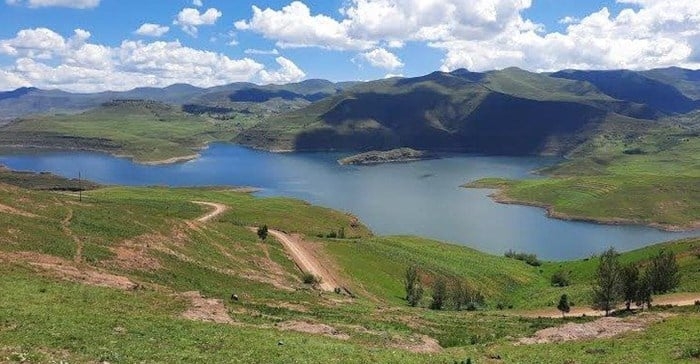
SanLei Premium Trout, which farms trout on the Katse Dam in the Lesotho mountains, claims to have invested in projects to help the communities near the dam, whose livelihoods are affected by overgrazing, soil erosion and changing weather.
But the company, which describes itself as “the biggest trout farming operation in Africa”, only contributed 5 000 Maloti (R5 000) to the Catchment Resilience Fund (CaRe Fund) in 2018 and the money was never used for environmental projects.
SanLei is owned by South Africa-based Mergence Asset Managers through its Lesotho Private Equity Fund. The main investor in the Lesotho Private Equity Fund is Lesotho’s Public Officers’ Defined Contribution Pension Fund.
SanLei CEO Dewald Fourie was quoted in November last year as saying that the firm’s current trout production was 1 000 tonnes a year and this was expected to double by 2030. The construction of the dams, built in the 1990s to supply water to South Africa, has had major effects on local populations.
In its 2023 impact report, Mergence says the CaRe fund was set up to incentivise Khokhoba farmers to improve the management of the rangeland in the dam catchment area, which had been degraded.
“The partnership committee provides annual work plans, activity targets, and quarterly reports to SanLei, reflecting its financial, management, and monitoring records.
“The CaRe Fund money is used by the Khokhoba community to implement projects benefiting the community as a whole and supporting individual households.
“These benefits serve as meaningful incentives for the community to actively contribute to the catchment management activities under the CaRe Fund.” Part of the project was to restrict grazing in parts of the catchment area to prevent further soil erosion.
Related stories
- Lesotho Highlands shutdown: Govt assures sufficient water supply
- Lesotho’s food crisis threatens SA’s border security
Villagers were to be trained on how to preserve the grasslands, and rocks were to be painted white to indicate “no-go” areas for grazing. But according to ‘Malieketso Ramokoatsi, a member of the Khokhoba village committee, the CaRe funds were instead used to provide small loans to community members and build an office for the village chief. She said the fund had collapsed despite its potential to benefit the village.
Some farmers have been compensated for the loss of their land as a result of the dams. But others are battling soil erosion, overgrazing, the loss of plants, sand and firewood.
“Even the equipment for rangeland and wetland management was vandalised, and members were discouraged from continuing,” she said.
SanLei compliance and environmental officer Relebohile Ntoi told GroundUp that the company had contributed M60 000 (R60 000) to the project. “The consultant got M50 000 for the training sessions, and the community got M10 000.” She said the rangeland management project was mainly a USAID initiative.
“They only needed somebody to partner with who knows about these communities and could put up an incentive for the communities to do the project,” she said. Ntoi later acknowledged that only M5 000, not M10 000, had been paid to the community.Ramokoatsi said what work had been done on climate change mitigation had been financed by USAID, not SanLei.
Community projects collapse after USAID withdrawal
USAID funded the Lesotho Climate Change Adaptation Project, using the Pietermaritzburg-based Institute of Natural Resources as consultants. But USAID withdrew in 2018 and the project came to an end.
“The Americans just disappeared, and the project collapsed,” said village chief Molapo Khethisa. Ntoi told GroundUp that the Lesotho Highlands Development Authority had proposed that SanLei “go back and revive the fund”.
“But for now, we haven’t really made plans to do it,” she said.
The Lesotho Highlands Development Authority (LHDA) regulates activities in the dam catchment area. In terms of the law, applicants for a fishing licence on the dam have to “specify in detail how local communities surrounding the proposed aquaculture operations will stand to benefit”.
GroundUp sent questions to the LHDA on 26 February asking whether SanLei’s contribution to the Khokhoba CaRe fund was part of its obligations as a requirement for the licence and the role of the LHDA in holding the company accountable. Spokesperson Mpho Brown has yet to respond to these questions.
The publication also sent questions to Fourie on 21 February, asking about SanLei’s contribution to the CaRe fund and the role played by USAID. He promised to respond but did not. On 12 March, he said he had forwarded our questions to SanLei’s board.
Khokhoba resident ‘Mamolapo Khethisa said the dam had changed conditions in the area. She said more frequent hailstorms swept away nutrient-rich soil into the dam and left behind stones and depleted particles.“These storms have become more frequent since the construction of the dam, resulting in the loss of crops and soil,” she told GroundUp.
She also noted that frost now arrives as early as March instead of mid-April, destroying crops such as maize, sorghum and beans before they ripen or preventing them from bearing fruit, aggravating hunger in the community.
- This article was first published on GroundUp.
READ NEXT: Women agripreneurs take the stage at Brics+ agriculture summit
Sign up for Mzansi Today: Your daily take on the news and happenings from the agriculture value chain.