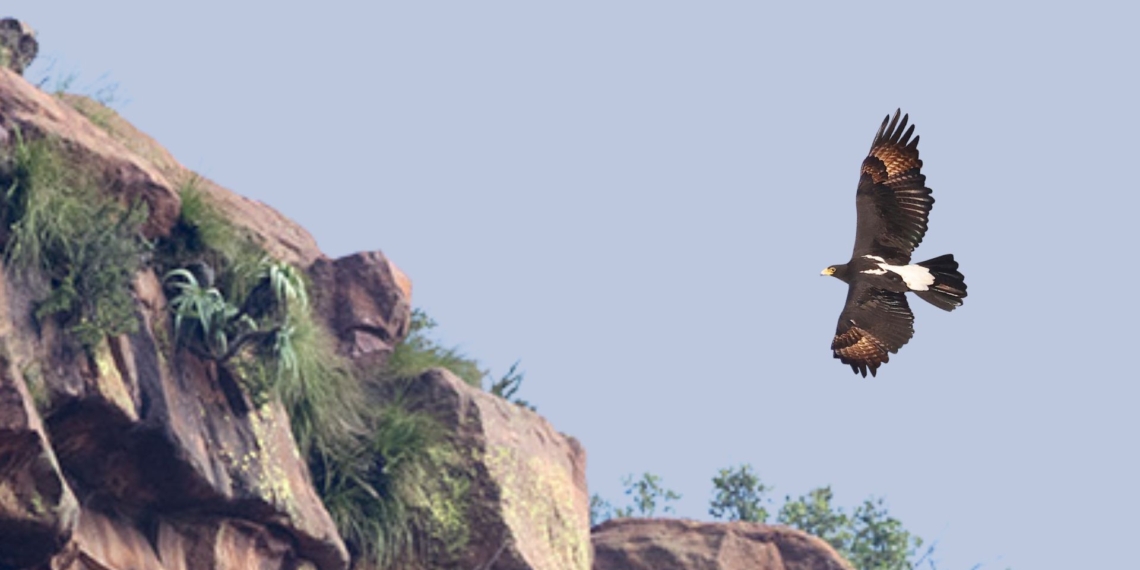
The black eagle, commonly known as the Verreaux’s eagle, often gets a bad rap for lamb killings, but according to the Northern Cape Predation Management Forum, it’s a case of mistaken identity.
According to the Red Meat Producers’ Organisation website, a breeding pair of eagles with their chicks eat around 350 badgers a year, which helps to control the numbers. This number of badgers eat almost the same amount of field as 22 healthy sheep would eat in a year.
Most eagles are opportunistic feeders, occasionally devouring large quantities of smaller animals like termites, rodents, and grasshoppers, effectively providing free pest control for farmers.
White-crested eagles do not have the physical strength to catch lambs older than three weeks. If there is sufficient smaller game such as badgers on the farm which can be used as a source of food, they are not likely to catch a lamb. They sometimes prey on lambs that are stillborn or lambs that have already been killed by other predators.
Signs that an eagle has eaten a lamb, but not necessarily killed it
- Large bundles of fur or wool will be plucked out.
- The meat between the bones will be picked out, so the carcass will be eaten clean. Only the ends of ribs are sometimes broken off.
- The lamb will have claw marks on the head or in more cases the neck or upper back bones will be crushed due to pressure from the eagle’s claws.
- Irregularly spaced holes in the skin and possibly on the skull.
- Under the skin around these holes, there will be tremendous bruising and bleeding caused by the forceful grip.
- Long tendons will still be on the legs.

Related stories
- Strategies for improving calving season success
- Heat is on as SA is set to face its hottest summer on record
How to identify if a lamb died before or after birth
- If the hooves still have membrane caps on them, the animal did not walk or frolic and was therefore stillborn.
- If the animal has never breathed before, the lungs will be a deep red colour.
- The liver will feel hard and will not be pink and spongy.
- The absence of blood clots at the end of an umbilical cord.
- A lamb that suffered during birth is spotted golden yellow with meconium and most likely died during birth or shortly after the birth process.
- A sick or starving lamb’s fat is reddish brown and jelly-like.
- Absence of milk or food in milk belly.
It is extremely important to identify the correct predator when lambs are killed. A wrong identification can lead to further and greater damage because the right predation control methods will not be applied to catch the real scapegoat.
All animals play an important role in the ecology, and advantages and disadvantages must always be weighed. The environment must also be taken into account in order to determine how the ecology has been disturbed, which may have led to a decrease in small game, the primary source of food for most predators.
- Editor’s Note: This story has been updated to clarify that the eagle mentioned in the article is a Black Eagle, not a White-Crested Eagle.
READ NEXT: Take five! These farmers are changing the agriculture game
Sign up for Mzansi Today: Your daily take on the news and happenings from the agriculture value chain