Tuesday, November 24, 2026
SUBSCRIBE
22 GLOBAL MEDIA AWARDS
Food For Mzansi
  • News
  • Changemakers
  • Lifestyle
  • Farmer’s Inside Track
  • Food for Thought
No Result
View All Result
  • News
  • Changemakers
  • Lifestyle
  • Farmer’s Inside Track
  • Food for Thought
No Result
View All Result
Food For Mzansi
No Result
View All Result
in News

Cape farms under scrutiny for labour violations

New research has found that some farmworkers on Fairtrade-certified wine farms, which are held to international standards, still have poor housing and a lack of access to water and toilets

by Liezl Human
25th March 2023
Add FFM on Google
Cape farms under scrutiny for labour violations

The study found that while the wages of most farm workers had improved, at least 31% of workers who were surveyed said they earn less than the National Minimum Wage of R25.42 per hour. Photo: Supplied/Liezl Human

Share on FacebookShare on TwitterShare on WhatsApp

New research on several Fairtrade-certified wine farms in the Cape Winelands has found that the working and living conditions at some of these farms fall short of the standards set by Fairtrade International.

Fairtrade-certified farms are supposed to uphold international standards for fair working conditions, including payment of the minimum wage, the right to collective bargaining, and adequate housing, among other things. Farmers who are certified can usually export at a higher price. The premium paid on Fairtrade-certified products is supposed to be kept in a separate account and used to improve the conditions of workers and farmers.

The researchers found poor housing on some farms, workers earning less than the minimum wage, exposure to harmful pesticides, and a lack of toilets and accessible water, among other things. However, the study also highlighted some of the improvements made to the living and working conditions on these farms.

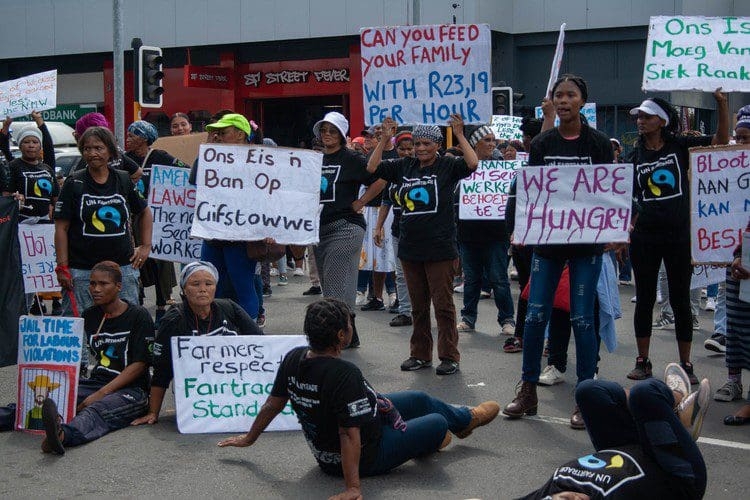
About 150 farm workers marched to the Labour Centre in Paarl on Wednesday to hand over a memorandum, calling for better living and working conditions for people on farms in the Western Cape. Photo: Supplied/Liezl Human

The study, commissioned by the Women on Farms Project (WFP), was compiled by independent researcher Celeste Fortuin who interviewed 50 women on 18 Fairtrade-certified farms.

Areas of concern

The study raised several points of concern which include:

  • 25% of surveyed farms have “poor” or “very poor” housing for workers.
  • 31% of workers earn less than the National Minimum Wage of R25.42 per hour.
  • 54% of women surveyed are exposed to pesticides in the vineyards frequently or at home. This is not in line with international best practices.
  • 35% of women workers surveyed do not have access to toilet facilities in the vineyards where they work all day.

However, it also highlighted aspects of the Fairtrade-certified farms which were working. Most of the farm workers interviewed were living in good conditions and everyone surveyed had access to electricity. On all but, one of the farms surveyed, permanent and seasonal workers had received written contracts.

ALSO READ: ‘Rights of farmworkers are not respected’

Findings shock farmworker group

On Wednesday, Women on Farms presented some of the findings during a launch in Paarl. Afterwards, about 150 farm workers marched to the Labour Centre in Paarl and handed over a memorandum.

They want the labour department to conduct frequent inspections on farms without first notifying the farm owners, and they want women seasonal farm workers to be included in the inspections. They want all farmworkers to be informed of the outcome after the inspection, and where the farms have violated labour laws, they want owners to take corrective action within 30 days or face suspension of sales. The workers believe that harsher penalties should be imposed on farms that violate labour laws.

WFP director Colette Solomon said that it was “shocking” that some of the violations noted in the report were still happening on Fairtrade-certified farms and “needless to say they’re happening on uncertified farms too”. She blamed a “lack of enforcement” of labour laws and a problem with the way inspections are conducted.

Solomon said that there were also problems with the way the department dealt with complaints from labour offices. Many women farmworkers struggle for months to get their unemployment benefit payments from labour offices despite contributing to the Unemployment Insurance Fund (UIF), she said.

Cape farms under scrutiny for labour violations
Workers listen to some of the findings of an independent study into living and working conditions on several Fairtrade-certified farms in the Cape Winelands.Photo: Supplied/Liezl Human

The negative side of minimum wage increase

Ntombi Magadla, a farmworker in Wolseley, told GroundUp that she had been sent from pillar to post by labour department officials when she tried to report pay lower than the minimum wage on the farm where she works. Magadla said that the increase of the minimum wage to R25,42 per hour in March has meant that farmworkers are now being allocated fewer working hours and days.

Cebo Kutuka of the labour department’s inspections and enforcement services in the Western Cape also addressed the workers during the launch on Wednesday. He promised that officials would go through the report and respond later. He also invited Women on Farms and workers to attend meetings with officials where some of the issues raised can be discussed in greater detail.

Christo Conradie, a manager at farmer representative NPO Vinpro, told the audience he would take the research findings to the organisation’s next meeting.

The provincial department of labour had not responded to GroundUp’s questions by the time of publication.

The article was written by Liezl Human and originally published in GroundUp.

READ NEXT: In pictures: Livestock farmers lose everything

Sign up for Mzansi Today: Your daily take on the news and happenings from the agriculture value chain.

Add FFM on Google Follow FFM on Google News

Liezl Human

Tags: Cape WinelandsFairtradeWomen on Farms
Climate Change

When to plant fodder radish for better livestock feed in droughts

by Lusanda Ncisana and Tafadzwanashe Mabhaudhi
22nd November 2026

Struggling with drought? Learn the best planting windows for fodder radish to improve livestock nutrition and growth during the upcoming...

Read moreDetails
Neat rows of young crops cover a sloping green field beneath lush, forested hills and a dramatic, overcast sky.

Private partnerships unlock millions for land reform beneficiaries

21st November 2026
Rooibos industry targets global growth while protecting local roots

African markets offer fresh growth opportunities for SA rooibos

21st November 2026
A woman wearing a straw hat, glasses, and gardening gloves stands in a large field of leafy green crops under a blue sky.

Supplying Joburg Market: Phumla Qwabe grows her next chapter

20th November 2026
How Alkelp is turning seaweed into biostimulants that deliver value on the farm

How Alkelp is turning seaweed into biostimulants that deliver value on the farm

20th November 2026

Enza Zaden field days prove crop performance from farm to market

When to plant fodder radish for better livestock feed in droughts

Business-first mindset drives success for EC mohair farmers

Top matric achiever skips varsity to build thriving farm from scratch

Why seasonal rainfall averages don’t guarantee maize yields

Join Food For Mzansi's WhatsApp channel for the latest updates!

JOIN NOW!
Next Post
Cannabis Expo: Lack of legislation lingers in CT

Cannabis Expo: Lack of legislation lingers in CT

THE NEW FACE OF SOUTH AFRICAN AGRICULTURE

With 21 global awards in the first six years of its existence, Food For Mzansi is much more than an agriculture publication. It is a movement, unashamedly saluting the unsung heroes of South African agriculture. We believe in the power of agriculture to promote nation building and social cohesion by telling stories that are often overlooked by broader society.

Working with nature: How soil health builds resilient farms

Enza Zaden field days prove crop performance from farm to market

South Africa’s job crisis: Why the agricultural sector is bleeding

Boshof Solar Power backs three-year emerging farmer programme

Why seasonal rainfall averages don’t guarantee maize yields

Top matric achiever skips varsity to build thriving farm from scratch

  • Awards & Global Impact
  • Our Story
  • Contact Us
  • Cookie Policy
  • Privacy Policy
  • Copyright

Contact us
Office: +27 21 879 1824
News: info@foodformzansi.co.za
Advertising: sales@foodformzansi.co.za

Contact us
Office: +27 21 879 1824
News: info@foodformzansi.co.za
Advertising: sales@foodformzansi.co.za

  • Awards & Global Impact
  • Our Story
  • Contact Us
  • Cookie Policy
  • Privacy Policy
  • Copyright

Chat Options

About this assistant

This feature generates automated answers summarised from Food For Mzansi articles. By using it, you are interacting with an AI system (provided by Google), not a human. AI can make mistakes. Please refer to the source articles for verification and citation purposes.

Our staff do not check or moderate Lerato’s answers in advance, but may review some later. Our journalists continue to write and edit all the articles Lerato uses as sources.

To estimate unique and returning web users, we store a random browser ID in this browser. WhatsApp users are counted by phone number. The same person using both channels may be counted twice.

I'm Lerato, your AI assistant!
No Result
View All Result
  • News
  • Changemakers
  • Lifestyle
  • Farmer’s Inside Track
  • Food for Thought

Copyright © 2026 Food for Mzansi