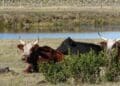
The Tyhume River, flowing from the forested Amathole Mountains in South Africa’s Eastern Cape province, gives its name to a valley of 20 villages on communal land. Much of the land is being used to keep livestock, as crop production has declined over the years. This land is under the custodianship of traditional leaders.
The valley is typical of South Africa’s communal land: affected by soil erosion, bush encroachment and water scarcity.
About one-third (over 17 million) of South Africa’s population lives on communal land, which makes up around 13% of all land in the country. The Communal Land Tenure Bill, 2017 defines communal land as “owned, occupied or used by members of a community subject to shared rules or norms and customs”. It can also be owned by the state.
This land can benefit rural communities by providing ecosystem goods and services, such as shelter, water, fuelwood, food and cultural amenities. But natural processes and human activity can transform the land.
The Tyhume River, flowing from the forested Amathole Mountains in South Africa’s Eastern Cape province, gives its name to a valley of 20 villages on communal land. Much of the land is being used to keep livestock, as crop production has declined over the years. This land is under the custodianship of traditional leaders.
The valley is typical of South Africa’s communal land: affected by soil erosion, bush encroachment and water scarcity.
About one third (over 17 million) of South Africa’s population lives on communal land, which makes up around 13% of all land in the country. The Communal Land Tenure Bill, 2017 defines communal land as “owned, occupied or used by members of a community subject to shared rules or norms and customs”. It can also be owned by the state.
This land can benefit rural communities by providing ecosystem goods and services, such as shelter, water, fuelwood, food and cultural amenities. But natural processes and human activity can transform the land.
Unmonitored and poorly managed land changes can trigger soil erosion, overgrazing, loss of biodiversity and water scarcity. In South Africa, communal land is considered to be more degraded than privately owned land. This can negatively affect the livelihoods of people who derive ecosystem services from it.
Common indicators and causes of land degradation are generally understood. But less is known about how people living in communal lands interpret land changes and their impact. It’s unclear what they perceive as land degradation or which kinds of land changes matter most to them. This helps explain the lack of sound policies and practical strategies to rehabilitate land.
Our team of geoinformation scientists at South Africa’s Agricultural Research Council and the University of the Free State carried out a study which mapped land use and land cover change in the Tyhume Valley over 30 years.
To understand the extent, causes and impact of communal land change, we analysed a series of historical satellite images from 1989 to 2019 and conducted interviews with locals. Instead of interviewing experts and leaders, the study measured the most common perceptions among community members.
As far as we know, this study is one of the first in South Africa to combine satellite data and local perceptions. This offered a more complete view of communal land change, and valuable insights on its impacts.
We suggested some ways in which this land could be managed better to provide ecosystem services and livelihoods.
Satellite imagery and community perceptions
Our study set out to discover whether satellite-measured trends of land use and land cover corresponded with those perceived by the community. We also explored the causes, rate and impact of these trends.
Satellite imagery from 1989 to 2019 revealed increases of the sweet thorn tree (Vachellia karroo) by 25% and the residential area (2.5%). It showed declines of grazing land (18%), cropland (9.6%) and dams (1.1%).
Assisted by 102 long-standing residents, most above 50 years of age, we asked about the causes and impacts of the observed changes.
Most respondents (over 80%) noted the encroachment of the sweet thorn tree on grazing land and abandoned cropland. They said contributing factors were a decrease in fuelwood harvesting due to increased reliance on electricity, the abandonment of cropland (providing habitat for the sweet thorn) and seed dispersal caused by unrestricted movement of animals.
Many saw the tree as beneficial because goats like to eat it and it makes good fuel. Others were concerned that this tree was invading productive agricultural land and causing a loss of biodiversity. They mentioned increased scarcity and disappearance of medicinal and culturally significant plants.
Most respondents noted a decrease in grazing land, cropland and surface water. As reasons, they cited lack of access control (poor management, allowing bush encroachment), lack of farmer support and equipment, and poor rainfall.
New houses had been erected on grazing land. This was seen as a result of population increase and inward migration. Livestock farmers saw this as a problem because they had to buy fodder or trek their cattle long distances to graze. The population increase also put strain on water resources.
Every village in the area had at least one communal dam that had dried up. Despite 14 years of below-average rainfall and a negative rainfall trend between 1989 and 2019, the trend was not statistically significant. The community perceived that water resources had declined because of overuse and poor maintenance of dams. They said the government no longer desilted community dams, and that the community had abandoned traditional practices such as the maintenance of surface water channels and homestead ponds.
They gave water scarcity as one of the main reasons that croplands had been abandoned.
Most said the communal lands were healthier and offered more resources when areas were fenced off and people had to get permits to use land. Local residents had cut fences to give their animals unlimited access to grazing and water.
Overall, the changes to the Tyhume Valley environment were not positive. The respondents said the decline in agricultural activity had resulted in increased unemployment and consumption of unhealthy food.
Similar changes have been reported on many other communal lands.
Better land management
The land can be better managed through interventions by village committees, tribal authorities and extension services, and by following spatial planning and land use guidelines.
The sweet thorn can be controlled by stocking more browsing animals. Studies have demonstrated that this plant has a high nutritive value.
The community, with help from the government, needs to reinstate water harvesting practices and the regular desilting of dams. Other communal dam restoration projects in the Eastern Cape have succeeded by dredging and augmentation of stock dams.
This study shows that the combination of satellite imagery and local perceptions provides valuable insights about the extent, causes and impacts of land change in communal areas.
This article was first published on The Conversation.
ALSO READ: CPAs need good governance for private-sector land reform support
Sign up for Mzansi Today: Your daily take on the news and happenings from the agriculture value chain.