An organic vegetable farmer who started with five tilapia, a collective citrus venture creating opportunities for transformation and a third-generation apple farmer leading a growing enterprise were among Friday night’s agricultural award winners.
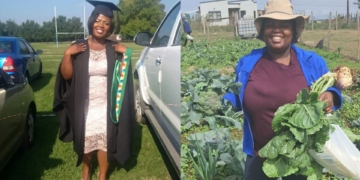
Angelo Marman’s journey into commercial farming began with five tilapia in his Malmesbury backyard. Today, he runs an organic vegetable enterprise near Chatsworth in the Western Cape, employs about 13 people and uses his farm to create opportunities for aspiring farmers.
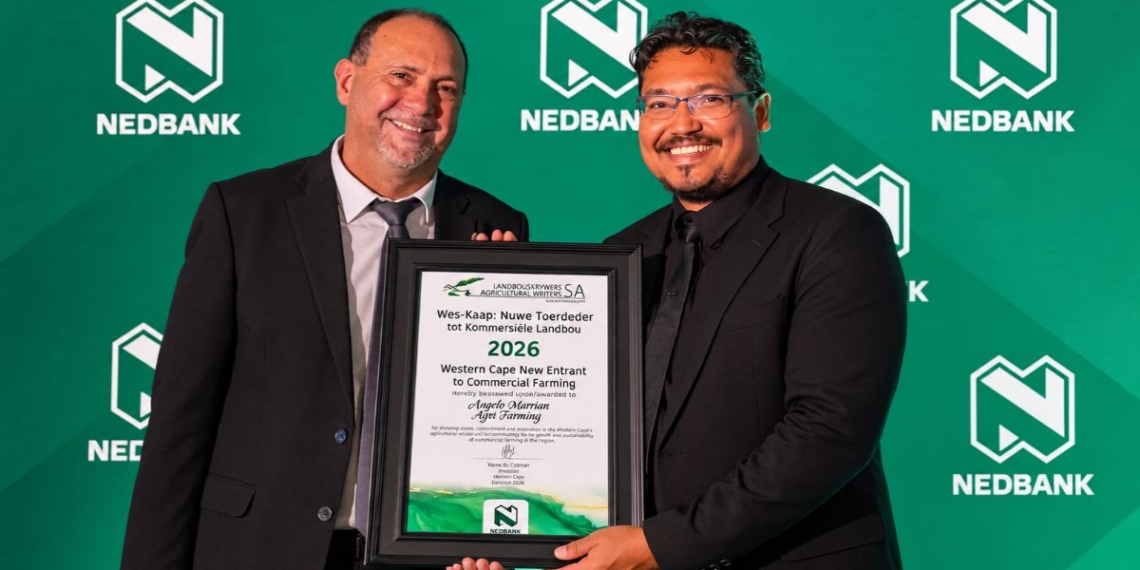
On Friday night, Marman was named the Western Cape New Entrant to Commercial Farming of the Year at the Agricultural Writers SA !Xhariep regional awards, held at Durbanville Hills.
The awards also recognised Ikamva Lethu Farms in the Sundays River Valley as the Eastern Cape New Entrant to Commercial Farming of the Year, while third-generation farmer Stephan Beukes of Dennegeur Farms in Grabouw took the overall Western Cape Farmer of the Year title.
Sponsored by Nedbank, the awards celebrated three different approaches to building sustainable agricultural businesses, from developing a small backyard venture into a commercial enterprise to pooling resources for large-scale citrus production.
A backyard venture grows into a commercial farm
Marman’s agricultural journey started in childhood, when he grew and sold vegetables in soil enriched with compost made from donkey manure.
After completing a diploma in agriculture at the Cape Peninsula University of Technology, he joined the Perishable Products Export Control Board. But his ambition to farm led him to start a tilapia venture in his Malmesbury backyard.
He called it “Vyf Vissies en ’n Blaartjie”, inspired by the biblical story of the multiplication of loaves and fish.
The venture generated R25 000, which he reinvested in vegetable production on a 2 000m² municipal plot. He subsequently developed the site into a training centre for children and small-scale farmers.
As limited land and water constrained growth, Marman rented an 8ha farm near Chatsworth, which he bought in 2025 for R4 million.
Today, approximately 8ha is under organic vegetable production, integrated with pigs and poultry. Abitz Farming generates about R2.9 million in vegetable turnover, excluding livestock.
Marman secures markets before planting, staggers production and aggregates produce from neighbouring growers to meet demand.
His circular farming model turns waste into a resource. Pigs help clear land and consume crop waste, while manure and plant residues are converted into compost. Legumes support soil fertility, and companion planting helps suppress weeds and attract beneficial insects.
For Marman, however, the farm’s success is about more than production and turnover. It employs about 13 people and hosts more than 60 Social Employment Fund participants for seven days a month during six-month cycles.
By sharing skills, markets and logistics, he is building a business that creates opportunities beyond his own farm.

17 farmers join forces to build a citrus enterprise
In the Sundays River Valley, Ikamva Lethu Farms offers a different model for growing commercial agriculture.
The name means “Our future” and reflects a shared ambition to create economic opportunities and participation in commercial citrus production while protecting the sustainability of existing farming businesses.
Many producers in the region wanted to create opportunities for their workforces, but dividing their individual farms risked undermining their commercial viability.
Instead, 17 producers and the Sundays River Citrus Company pooled resources to establish an entirely new citrus enterprise on previously undeveloped land.
Building the business from the ground up required environmental approvals and water rights, followed by the development of water-transfer and storage infrastructure, roads, irrigation systems and orchards.
Ikamva Lethu now has producing orchards, an expanding internal management team and a defined path towards full production.
The initiative demonstrates how established producers can work together to create a new commercial farming operation rather than compromise the viability of existing businesses.
Its development also highlights the scale of investment, infrastructure and planning required to establish a new citrus enterprise.

Third-generation farmer recognised for growth and resilience
The overall Western Cape Farmer of the Year award went to Stephan Beukes, CEO of Dennegeur Farms in Grabouw.
Since taking the helm in 2019, Beukes has expanded the business through the acquisition of Vredenhof and Applethwaite. The enterprise now manages 455.65ha of orchards and has invested in storage, packing facilities, energy resilience and leadership capacity.
Packhouse throughput increased from 33 111 bins in 2019 to 55 050 in 2025, while the farm’s 2026 packout report recorded 58% Class 1 export fruit.
Beukes’s management approach was tested by the devastating 2023 floods. Crop protection spray coverage was restored within 72 hours, while irrigation across the orchards was restored within two months.
The business also invests in environmental rehabilitation and community initiatives through the Dennegeur Foundation, which supports childcare, education, healthcare, counselling and retirement programmes.
At peak season, Dennegeur Farms employs 1 067 people.
Agriculture’s impact extends beyond the farm
Delivering the keynote address at Friday night’s awards, Agri Western Cape CEO Jannie Strydom highlighted agriculture’s contribution to the provincial economy through exports, employment and livelihoods.
Marike Brits, chairperson of Agricultural Writers SA’s !Xhariep region, said this year’s winners demonstrated how farming businesses could contribute to a broader economic and social impact.
“Each of this year’s winners is building something bigger than their own farm,” Brits said.
“Stephan Beukes has shown what disciplined leadership and resilience look like after a disaster, while keeping more than a thousand people employed at peak season. Angelo Marman started with five fish in a backyard and now runs a circular organic farm that opens doors for others. Ikamva Lethu proves that when producers pool their resources, transformation and commercial success can grow together.”
“As agricultural writers, it is our privilege to tell these stories. They remind South Africans that agriculture is about food, jobs, land and the future of our communities.”
The awards were supported by Agri Western Cape, Durbanville Hills, Lucentlands and Food For Mzansi, with Nedbank as the main sponsor and PostNet Paarl printing the programme.
READ NEXT: Crucial management habits every livestock farmer must practice