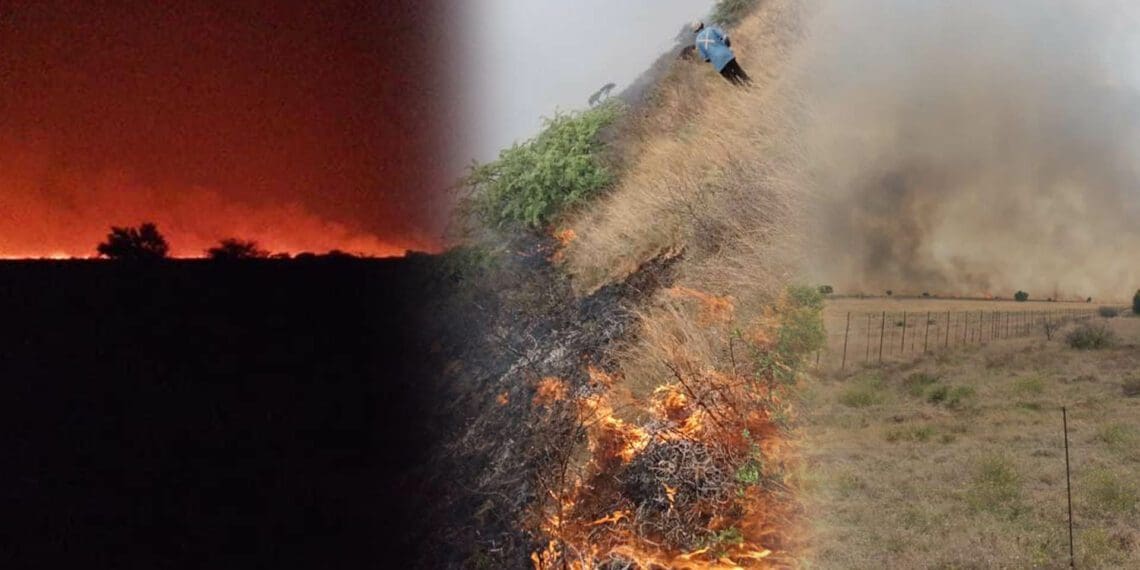
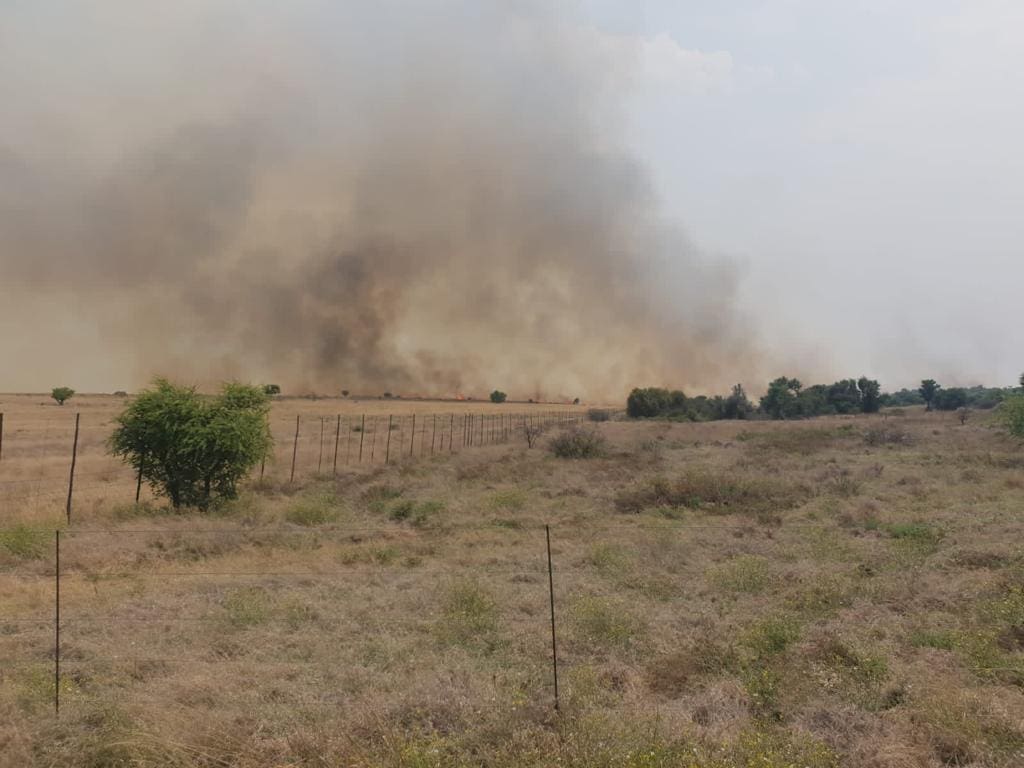
Farmers in the Northern Cape and North West have for the past five days had to watch in agony as thousands of hectares of grazing land turned to burnt ash. Between the two provinces, more than 120 000 hectares of land have been destroyed by raging fires driven by strong winds.
Since last Thursday, firefighting teams have been battling fires in several towns and villages in the Dr Ruth Segomotsi Mompati District Municipality.
Dikabelo Petrose, a livestock farmer from Kgokgole village in North West, says he lost all of his grazing land.
“All my grazing land is gone, all of it. So far my cows are okay. The fire started in our area on Thursday and it started moving to our property on Saturday.”
Petrose farms on communal land that he shares with other livestock breeders who have also reported major losses. With all his grazing land scorched, Petrose says he is now forced to buy feed at expensive rates.
“We don’t really buy feed for our cattle, it will be the first time. We normally depend on grazing land,” he explains.
Petrose has 40 cows, and supplying feed to his livestock for a period of one month will cost him about R3 500 per cow, he says.
“This will equal to R140 000 per month for 40 cows. I [also] have a Simmental stud bull which I feed strictly in the kraal. It eats 10 X 50kg of Phase D Cubes per month. Each bag cost R350.”
With rising input costs, Petrose has barely been able to keep his head above water and fears that he will have to sell some of his cows to avoid financial failure.
“I need to sell some of my cows so that I can buy feed and roughage. I need to sell otherwise I risk losing all.”
Firefighters allegedly not allowed on farms
For Olerile Lekgetho, a livestock farmer in Taung, this is the worst veld fire he has seen in years.
“Everything has been destroyed – farms and communal land – it’s a mess and no one is saying anything. Some farmers lost their livestock and its calving season. I’ve never in my life seen such a fire.”
Lekgetho is concerned that the provincial department of agriculture has not said anything about the fire which started last week already.
“We’ve heard nothing,no one has said anything and we really need assistance,” he says.
What’s more concerning, he explains, is local firefighting authorities informing them that they are unable to assist with getting the fire under control.
“They are saying that they are not allowed to go and assist on farms. Why can’t they not go on communal land and farms?” Lekgetho wants to know.
“The fire is out control and our fire department is not assisting. Only those people that have formed fire associations are assisting.”
What is the department doing?
Food For Mzansi spoke with the MEC for agriculture in the province, Desbo Mohono, who says that her office is still waiting for a report on the fire.
“The disaster committee of the province is also sitting to look at everything. Once they have concluded I’ll have a full report.”
When asked on what grounds the local fire department could refuse assistance, Mohono says they are not supposed to refuse. “That is not the truth. We are affiliated as agriculture with [them].”
Farmers have since taken to social media to request urgent assistance. One such farmer is well-known livestock breeder Thabo Dithakgwe, who posted on twitter, “Dear God please hear our cry, shower our burning velds with rain.”
Dithakgwe says, “We don’t have enough resources to control the fires, the fire is still moving. There are firefighters but they are not enough. Some of the farms have burned down and farmers have lost animals as well.”
Feed assistance available
Farmers in the Northern Cape have also had to battle raging fires in the area between Kuruman and Danielskuil, Kuruman and Kathu, and in the Lohatlha area.
It is reported that the fires broken out in the exact same area as they did in 2021, causing untold damage to thousands of hectares of land.
In an interview with Food For Mzansi, spokesperson of the Northern Cape department of agriculture, environmental affairs, rural development and land reform, Zandisile Luphahla, says that fire had started spreading to mountainous areas.
“On Sunday, 9 October, two aircrafts were deployed to reach those mountainous areas. The did do the job overnight and when we received a report, the fire was 95% [under control].
“But [on 10 October] when we woke up [the fire started again due to] strong winds and hot weather. Usually during this time [of the season] you will get fires taking place and they will be powered by the wind and sun.”
The department is implementing measures alongside other role players to bring he fire to a halt, he adds.
“We are working together with the department of CoGTA who is assisting with finances. CoGTA deals with disaster management.”
Luphahla further says that they would be roping in assistance from Free State firefighters as they are anticipating veld fires to happen frequently this season. “It’s fire season and we know that every time we have strong winds they fire will spread.”
So far no damage to property or dead livestock have been reported in the province.
Luphahla says farmers who lost grazing land are being assisted with fodder. “We have enough [fodder] stock, we have five fodder banks so we have enough fodder in stock.”
Meanwhile, farmers in distress can contact their local department of agriculture offices or extension officers to received further assistance.
ALSO READ: Cape Wine 2022 gives W. Cape a R6m cash injection
Sign up for Mzansi Today: Your daily take on the news and happenings from the agriculture value chain.