 Two eco-warriors from Durban in KwaZulu-Natal are using unconventional spaces to grow food. Delwyn Pillay (36) and Sean Kuryschuk (29) believe breaking agricultural norms and gardening in uncommon spaces is the only way to unlock potential for sustainable food growth in Mzansi.
The community garden they started in 2019 at the Sutton Park swimming pool in Morningside, Durban, may have become overgrown during the covid-19 lockdown, but the duo are looking forward to when they can once again welcome visitors.
“We were looking for different spots and came across the public pool. It’s actually a very nice area and the pool attracts a diverse group of people. We have a bunch of boards hanging in and around the garden explaining the basic principles of permaculture and this also intrigues visitors,” says Pillay.
“We work with nature and don’t use chemicals, because we recognise within an ecosystem everything has its place.”
Labelled as a professional volunteer for his work with Green Peace Africa, Pillay heads up the eThekwini garden where he has gone to great lengths to raise awareness on the importance of farming sustainably. The Sutton Park Pool Community garden aims to educate communities on the use of permaculture to grow healthy food in their backyards.
“Finding land to farm should not deter you from reaching your full potential within the agricultural sphere to grow healthy food,” Pillay adds. The duo founded the project in a bid to connect like-minded individuals around their shared interest in sustainable food practices. “It started about a year ago. My friend and myself, we just wanted to illustrate how diversely food can be produced and grown anywhere,” says Pillay.

He adds that the project was centred around showcasing how vacant plots from as high as the skies to municipal pools can be used in food production. They also see it as a tool to raise awareness on food security and the benefits of consuming healthy indigenous foods.
“We want to teach people growing methods and also create a space for community members to learn from nature and work with it,” he says. His inspiration and passion to grow his own food stems from his grandmother Dorothy Rampaul’s teachings.
The 89-year-old is an avid gardener who, in her spare time, ran a soup kitchen feeding families in need in her community. She also champions raising awareness about food security in SA.
Pillay remembers collecting discarded produce from supermarkets that would then be used to cook meals for the homeless. He was devastated at the amount of fresh fruit and vegetables supermarkets would throw away.
“We are passionate about growing food and teaching sustainable ways of growing food.”
But collecting this discarded produce to feed families who could not feed themselves made him feel like a superhero. “My grandmother comes from a farming background and used to tell me all these stories of when she was small working on the farm,” he says.
The garden is run by volunteers under the guidance of Pillay. In August 2019 it was registered as a Slow Food Community Garden. Pillay says he was intrigued by the organization’s efforts in raising awareness of backyard gardens.
“We are passionate about growing food and teaching sustainable ways of growing food. We recognize the current problems of mainstream and commercial food. The methods we use are holistic. We work with nature and don’t use chemicals because we recognize within an ecosystem everything has its place,” Pillay adds.
Slow Food is a global organization that was founded in 1989. The organisation addresses food issues holistically and aims to raise awareness about the disappearance of local food cultures and traditions.

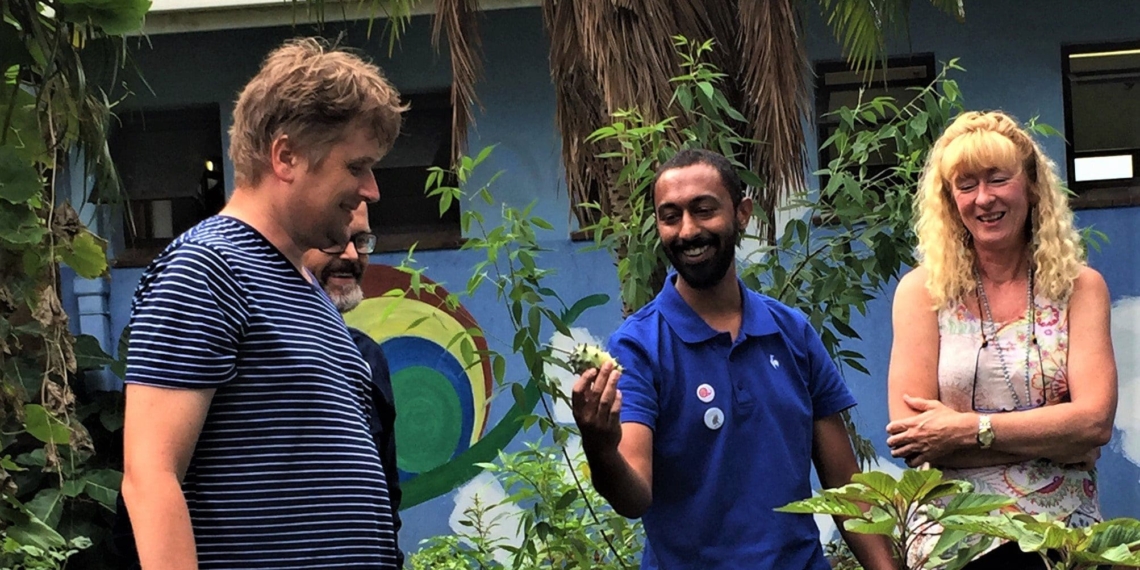
The Sutton Park Pool Community garden sits on a seven by four metre space on the grounds of an eThekwini municipal pool and boasts a variety of low maintenance vegetable crops and plants ranging from aloe vera, african horned cucumber, herbs and marigolds, which help attract butterflies and bees to the ecosystem. The produce is used at events on the grounds where visitors are educated on how to replicate the practice in their own home gardens.
The community has welcomed the project with open arms, with volunteers ranging from full-time students to community members eager to learn about permaculture. Pillay has hopes to expand the operation to the informal market and a seed bank.
“Looking forward we hope to start harvesting crops and making products from pitting the seeds of our African horned cucumber. We also hope we can use those seeds to help build our seed banks so that we use them for our next community garden,” he says.
Of course, things have taken a different turn under national lockdown. Pillay’s biggest regret is not hosting more interactive sessions on permaculture at the community garden while he could do so. He believes that the key to food security lies in the indigenous farming method. “We took a lot for granted.”
As a public socialising point, the Sutton Park Pool Community garden has been closed indefinitely and will only see its gates open under level 1 of the lockdown.
“Its physically impossible for us to tend the garden now because the gate has been locked by the municipality,” Pillay says.
However, the monkey troop on site is having the time of their lives while the humans are away, he adds.
“It’s wild! Everything has just grown wild. But I think the monkeys will be enjoying the space while we are away,” Pillay bursts into laughter.