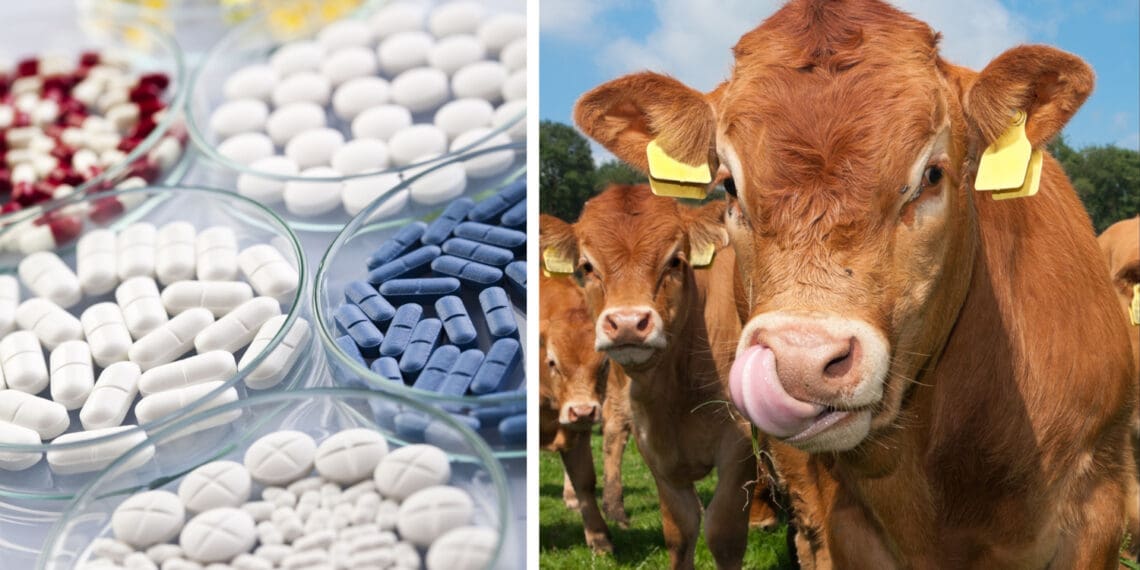
Since its discovery in 1928, antibiotics have become a global hero of human and animal health. But in recent years scientists have noticed a steady rise in antibiotic resistance, or antimicrobial resistance (AMR), sparking fears that straightforward bacterial infections will soon be the death sentences they had once been.
Several experts speak to Food For Mzansi to answer questions about the looming crisis, farmer access to antibiotics, the development and spread of resistant bacteria, and food safety in Mzansi.
‘Resistance pandemic’: we need all hands on deck
In South Africa, the use of antibiotics in animals is legislated by the Fertilisers, Farm Feeds, Agricultural Remedies and Stock Remedies Act (Act 36 of 1947). The act does not bar farmers from using antibiotics as growth promoters in their animals, and also allows farmers to purchase antibiotics over the counter.
In human health, antibiotics are also often given unnecessarily and ineffectively, creating room for resistance to develop.

Sounding the alarm on what he calls the “antibiotic resistance pandemic”, Professor Marc Mendelson, head of infectious diseases and HIV medicine at Groote Schuur Hospital, urges various government departments to take more decisive action against the issue. In a recent article he said that some of the reasons driving unnecessary antibiotics use include a desire to “cover all bases” regardless of how likely a bacterial infection is.
AMR section lead at the Centre for Healthcare-Associated Infections, Antimicrobial Resistance and Mycoses (CHARM) at the National Institute for Communicable Diseases (NICD), Professor Olga Perovic, says that managing AMR in the country is a complex task.
She acknowledges that an integrated approach from government is needed – one that government has been working on – but that change must come from all stakeholders.
“[The] national department of health has been proactive with a National Action Plan (NAP) in 2014, and since then, working on [an] integrative approach with other governmental structures. This process is not only scientific but requires behavioural changes at all levels: professional organisations, educational institutions, regulatory bodies, the public, media and many others,” Perovic says.
Limiting farmer access to antibiotics
Banning farmer access to antibiotics would make little sense in the South African context, says Moritz Van Vuuren, emeritus Professor of Veterinary Microbiology at the University of Pretoria. In a developing country like Mzansi, veterinary services are not readily available, so some access to antibiotics is critical. But that access needs to be limited, he cautions.
“In Africa, livestock suffer from acute and highly fatal tick-borne diseases such as heartwater and anaplasmosis. Farmers should always have access to at least one or two injectable antibiotics for emergency treatment, especially in the deep rural areas where veterinarians often cannot attend to such outbreaks in time.”
He says that, with livestock that frequently suffer from conditions like pneumonia, foot rot, wounds, and navel infections, access to injectable antibiotics are critical, but that these injectables represent less than 20% of total use in the country.
“It is especially the 80% of antibiotics used in the feed and water of animals that must be put under veterinary oversight and not be available over the counter.”
“Veterinary oversight of the use of antibiotics, and by implication the requirement of prescriptions for dispensing of all antibiotics by veterinarians or authorised para-veterinarians, is an objective of the major international agencies including the World Organisation for Animal Health (OIE), World Health Organisation (WHO), Food and Agricultural Organisation of the UN (FAO) and the European Commission,” Van Vuuren says.
He adds that South Africa’s legislative efforts to manage antibiotic oversight has been going on for many years through attempts to merge the Medicines Act and the Stock Remedies Act. He explains that this will push all antibiotics under the oversight of veterinarians, but achieving the merge remains contentious and requires collaboration between several government departments.
Additionally, the use of antibiotics for growth promotion is something government is busy addressing, says Van Vuuren. The issue is one that has been under international scrutiny since the 1960s, with the overall view being that it should be phased out entirely. Van Vuuren says the country’s Ministerial Advisory Committee on AMR shares this viewpoint.
“The regulations of the Stock Remedies Act 36 of 1947, where all the in-feed/in-water growth-promoting antibiotics are registered, are currently being revised and early indication from recent drafts is that growth promoters will be phased out. The regulator has already, some time ago, informed all registration holders that all references to prophylactic use and growth promotion use must be removed from their package inserts.”
Putting the brakes on in human health
AMR management in the country has multiple approaches, says Perovic, one of which is the Antimicrobial Stewardship Programmes (AMS) at healthcare facilities, established on a provincial level by the department of health.

She explains, “The [department] has established provincial AMS programmes led by pharmacists and including other faculties such as infection prevention and control (IPC), clinicians, hospital management and others. These AMS programmes are established at public health facilities. Private health founders established similar programmes, but under different funding groups.
“AMR status reflects the health system in the country, which needs a more holistic approach. Restructuring the health system to address all the steps in the chain of patient management is needed. We know that prevention is the best cure. From immunisation to hand hygiene, clean water, wastewater, sanitation… all these need to [be] puzzled [out] for successful AMR management,” Perovic points out.
Once these issues are addressed, it leaves the way clear to properly review AMR management for various institutions within the patient management chain.
“We can address outpatients, hospitalised patients, other institutions like nursing, childcare, old-age homes, etc, and their approach to combat AMR, such as a decrease in duration of stay in healthcare facilities, appropriate use of antibiotics based on laboratory diagnostics of infections, and susceptibility testing and implementation of infection prevention and control measures.
“Endorsing the NAP programme takes a whole health system, integrated with animal and environmental fields,” says Perovic.
The risk of picking up a resistant bacterium
Perovic says that no data is available yet on the transmission of resistant bacteria between animals and humans, but that the NICD has received funding to conduct a study on the issue.
“The NICD have obtained funding from the South African Medical Research Council (SAMRC) for a study on the transmission of resistant bacteria from animals to humans in the feed process. We have performed very specific objectives in this study and our findings are in the final stage but not yet ready for publication.”
Moritz van Vuuren, emeritus professor of veterinary microbiology at the University of Pretoria, explains that one of the main drivers of AMR is poor hygiene during the slaughter process, where resistant bacteria end up on the carcass. It is not the only route, however.

“Animal to human transmission can also take place via the environment, especially water sources. Bacteria from food-producing animals, whether in manure freely deposited on cultivated pastures or stored in manure storage sites, can [also] find its way into water sources that can contaminate crops,” Van Vuuren says.
Poor sanitation and poor socio-economic conditions where urban agriculture is present may also be conducive to spreading antibiotic resistant bacteria, Van Vuuren explains. Especially through peri-domestic animals or animals that tend to live close to human habitations, like rats.
“Such conditions are ideal for resistant bacteria and resistance genes to be exchanged in the rich soup of bacteria that exist under such conditions. Those bacteria can find its way back to humans directly from contaminated water or indirectly back into the food chain and affect humans. For example, when meat is not handled or cooked properly.”
He also highlights that antibiotic resistant bacteria can get into the human system directly through the handling of animals in an unhygienic manner, outside of the food chain.
For meat consumers, the obvious question is whether they are at risk of ingesting antibiotic-resistant bacteria when they eat the meat of animals treated by antibiotics. Van Vuuren explains that multiple studies have researched this issue and found that the risk was very low.
“The findings pointed out that this risk is miniscule. [It] was described as a human [being] more likely to die from a bee sting than for their antibiotic treatment to fail because of resistant bacteria in meat or poultry.”
He points out that, as long as the proper hygiene protocols were followed when the meat was processed, eating meat from antibiotic-treated animals is fine.
“When meat is purchased from retail outlets that obtain their products from abattoirs in controlled areas that apply adequate meat inspection, and the meat is properly cooked, there is virtually no risk to humans to become sick from ingested resistant bacteria.”
Advice for farmers
Van Vuuren urges farmers to adopt “non-antibiotic best practices” that improve animal health. He says these practices are ones that farmers are already familiar with, and simply require will and effort in application.
These practices include “improving hygiene practices, access to clean water and food, improved biosecurity – especially vaccination against all the diseases that lead to a high antibiotic consumption – applying best antibiotic practices. The best is using, whenever possible, only antibiotics prescribed or dispensed by a veterinarian or authorised para-veterinary professional such as an animal health technician.”
He says the message to farmers is crystal clear. “Reduce the need for antibiotics in animal husbandry. Use less antibiotics.”
ALSO READ: ‘You’re ingesting antibiotics and you don’t even know it’
Sign up for Mzansi Today: Your daily take on the news and happenings from the agriculture value chain