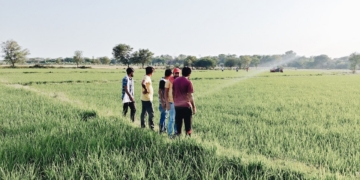
On an 800-square-metre plot at Buhlebemfundo Secondary School in Tsakane, east of Johannesburg, Plenty Green Africa was born. This permaculture food security project emerged out of necessity when Covid-19 robbed two friends of their only source of income.
“We didn’t have an income because of the lockdown, so farming became a food security strategy for us,” explains Nkululeko Motloung, co-owner of Plenty Green Africa. He runs the garden alongside his friend, Sizwe Ndhlovu.
The small but well-organised garden boasts a wide range of crops and herbs.
Their approach focuses on permaculture, creating a functional ecological system, which they use to grow Swiss chard, lettuce, onions, chives, cabbage, kale, beans, cucumbers, pumpkins, tomatoes, peppers, beetroot, and carrots.
They also grow medicinal plants such as comfrey and lemon balm, as well as flowers like pansies, violas, and marigolds.

Reviving abandoned land
It all started with R500 in their pockets which was used to buy seeds and cow manure from a local livestock farm in September 2020.
Motloung, who was working as a freelance digital marketing associate and assistant fashion director for Tshepo Jeans at the time, found himself drawn to farming when the lockdown hit.
He says the school has a hectare of land that was once part of a co-op, but the initiative stopped when it was managed by elderly members, some of whom retired and some passed away.
As a result, the space was abandoned, though some former co-op members continued farming individually on a much smaller scale.

Looking back on their journey, Motloung says, “We can now see the growth. We’ve learned how to manage and prevent crop failures, although there’s always uncertainty when working with nature.
“We’ve built relationships with people who value our services and have attracted those interested in volunteering or joining our team.”
Related stories
- Fadana follows her heart and builds thriving 280-hectare farm
- Hortgro bursary propels Buhle to thrive in deciduous fruit industry
Why permaculture works
Plenty Green Africa supplies households and local chefs with fresh produce, focusing on Swiss chard, lettuce, tomatoes, onions, and beans, which perform better than other vegetables. Motloung notes that rosemary, thyme, and lemon balm also grow well.
“The formula has been companion planting, crop rotation, and soil amendment (mulching, cover crops, organic fertilisation) that has helped us,” he says.
Their decision to adopt permaculture stems from its ecological benefits and ability to foster interaction between plants, people, animals, buildings, and communities, explains Motloung. “Everything in a permaculture garden is nature-inspired and sustainable.”

They steer clear of chemicals in their farming. “We also don’t produce seasonal crops throughout the growing seasons,” he says.
Motloung highlights their belief in the value of organic food.
He says, “It minimises the risks of getting ill and improves your general well-being. It improves soil health, decreases pollution, and also emphasises the water-food-energy nexus: honour the past, meet the needs of the present without compromising the future.”
Weathering the storms of farming
Motloung opens up about the challenges they’ve faced on their farming journey, from low yields that resulted in losses instead of profits to harsh weather conditions like frost that damaged all their crops, as well as struggles with funding.
“We overcame them by not giving up and always reaching out for help from experts and the general public,” he says. “We also go back to the drawing board every time the outcomes are not impressive.”
He explains that although he didn’t have formal farming training, his traditional background, along with research and curiosity, helped him develop his craft.
“It’s been intergenerational knowledge transfer from my grandmother who used to farm in her backyard and our homestead.”

He mentions they would also love to introduce more indigenous crops.
“Our goal is to turn the farm into an interactive space that will develop plant-based recipes, supply local chefs and restaurants with fresh produce and herbs, and host more educational workshops and events,” adds Motloung.
READ NEXT: Sheena’s Tri Toad Nursery: Where seeds of faith flourish
Get Stories of Change: Inspirational stories from the people that feed Mzansi.