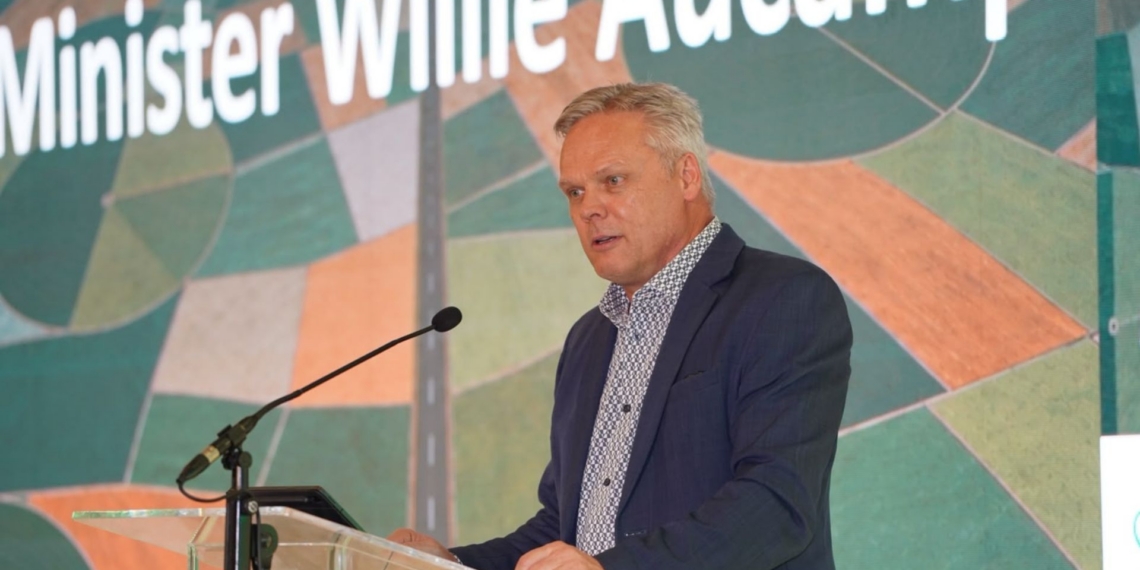
Agricultural finance, land reform, export growth and rural safety took centre stage at the AgriSA Congress yesterday in Irene, Centurion. Agriculture minister Willie Aucamp called for more reliable support for farmers.
Discussions also highlighted the importance of stronger public-private partnerships, improved infrastructure and practical policy implementation to unlock the sector’s growth potential.
Aucamp highlighted the need for more reliable agricultural finance, particularly for farmers who need funding to produce crops on land they do not own.
“Land Bank must get their act together. They cannot feed our farmers like they are doing,” Aucamp said.
He stressed that farmers need certainty well before planting, as late funding decisions can disrupt production plans and undermine their ability to farm profitably. His remarks placed agricultural finance alongside land reform, export growth, infrastructure and biosecurity as key issues requiring practical solutions.
Aucamp said land reform must be matched by access to finance, noting that farmers leasing government-owned land often struggle to secure funding without land ownership as collateral. He highlighted blended finance as a potential solution and called for timely, reliable Land Bank funding decisions to help farmers prepare for planting.
Related stories
- Hope restored as Land Bank secures R500m to end funding freeze
- Stronger rural policing needed to protect lives and livelihoods
- Aucamp outlines strategy for biosecurity, trade, and infrastructure
- Minister Willie Aucamp: What farmers need now
Collaboration is key to growth
Beyond financing, Aucamp urged government, organised agriculture and the private sector to move beyond discussions and focus on implementation.
“The path is clear. We can set a path, but unfortunately, there are some stumbling blocks. We know where we’ve got to go, but we’ve got to clear that road.”
He stressed that no single organisation could address the sector’s challenges independently. Stakeholders need to move beyond personal differences and ideological divides towards practical implementation and measurable results.
Aucamp added that farmers’ profitability had to remain central to agricultural policy, arguing that the sector needed to be competitive and ensure farming businesses generated sustainable returns.
Agri SA vice-president Derek Mathews highlighted agriculture’s contribution to the national economy. Since the launch of the National Development Plan in 2012, the sector has grown by an average of 3% annually by volume, compared with less than 1% for the national economy, he said.
However, Mathews cautioned that farmers’ efforts could be undermined without an enabling environment.
“You can do anything you like, but if the system isn’t there to support you, if you don’t have a support system, then all of that is wasted,” he said.
He identified trust, care and respect as essential to building effective relationships between farmers, government and other stakeholders.
Policy review to strengthen structures
AgriSA president Willem de Chavonnes Vrugt said the organisation had reviewed its policy positions across five centres of excellence: land, natural resources, labour, economic affairs and rural safety. The process included input from member organisations and grassroots structures, with the revised positions presented to congress for endorsement.
He said the aim was to establish a clear direction for the organisation and its partners.
“It isn’t a promise that we will be able to deliver 100%, but that’s what we will stand for, and that’s what we will fight for,” he said.
De Chavonnes Vrugt added that the process was intended to strengthen the agricultural sector’s collective voice and clarify expectations of government and industry partners.
Exports and infrastructure remain priorities
Wandile Sihlobo, chief economist at Agbiz and an envoy of the department of agriculture, said agricultural growth had been driven by improvements in farm productivity and exports.
“If you ask what’s the ingredient that has driven South Africa’s agriculture? It all comes back to two aspects. It’s the efficiency gains and the productivity at the farms. The second aspect is around the exports,” he said.
Both, he argued, required government involvement, from enabling technology adoption to establishing trade relationships. “You’re not going to be able to export without the government,” Sihlobo said.
He cited agricultural export performance over the preceding year, while warning that infrastructure constraints continue to limit the sector’s potential for further growth.
Aucamp highlighted efforts to open additional export markets, including a newly signed protocol allowing South African cherries to enter China for the first time. He also referred to efforts to establish blueberry exports to China and expand red-meat markets.
“If we are not going to expand our red meat markets, we will very soon have an oversupply of red meat in our country, and that will drive down our prices,” he said.
READ NEXT: Smart soil and strong networks drive Kopana Holdings’ success