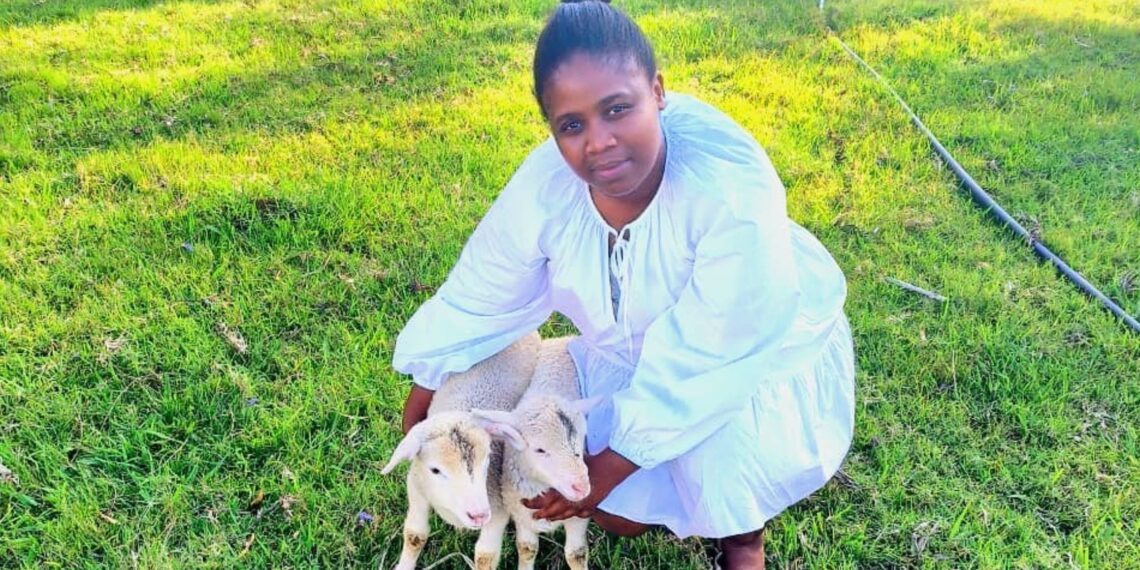
Qhawekazi Fadana from eNgcobo, Eastern Cape, always had that hustle mindset and knew she wanted to be self-employed. After university, she opened a butchery in East London but it didn’t work out. So, she took a leap into farming and hasn’t looked back.
Today, she owns Mhlelisa Farm, a 280-hectare property bought by her parents. There, they cultivate lucerne, maize, and fruit trees. They also rear cattle, sheep, and chickens.
“I started with my parents, raising chickens in a small two-shed structure. My parents contributed to the growth by adding 110 Bonsmara cattle to our herd,” she says.
Fadana’s parents are from eNgcobo. Faced with opportunities and uncertainties, they moved to Mthatha and eventually to Gonubie in East London.
She explains that her parents were subsistence farmers for a long time, and they lost a huge number of livestock due to theft in eNgcobo.

A life-changing accident and career shift
Mhlelisa Farm was established in 2017 and is based in Haga-Haga village on the Wild Coast, 60 km east of East London.
The business was funded with 50% of her capital from the butchery business, with her parents covering the other 50%. Setting up the business did not come without tough times, she admits.
After matric, Fadana went to the Cape Peninsula University of Technology (CPUT) to study information technology but dropped out in her third year.
“I was involved in a bad car accident in 2010 with my mum, and after that, I lost the motivation to continue with my studies.”
Fadana tried to finish her studies in financial information systems at Fort Hare University in Alice, but again, she couldn’t continue. Eventually, she started a business selling hot dogs at the beachfront in East London. Her love for business grew each day.
Related stories
- Tradition meets tech: For Jurie, precision farming is everything
- Tsholofelo quits lab job and sells car to pursue farming dream
She remembers telling her parents about going big in business, who encouraged her to make her own capital.
“My parents aren’t the type to give handouts; if you ask them for money, they will ask you if you have any idea about making it.”
After hustling in the streets of East London with her small business, she expanded by opening a butchery in Oxford, East London in 2014, which allowed her to save for her farming business.
Leveraging technology to improve operations
Fadana explains that they manage the entire chicken value chain, from hatching chicks to processing meat.
“As for the livestock, I haven’t finalised arrangements with the abattoir yet. For now, I’m mainly selling my livestock for events and farming purposes.”
Fadana says she has a stable market with hotels around East London and Kei Mouth, supplying eggs, vegetables, fruits, and chicken meat. She adds that she also sells packed manure to other farmers and backyard growers.

To enhance her operations, she’s incorporating technology and has installed cameras to monitor stock theft.
“Now I’m working on going off-grid. I have around 20 solar panels, an industrial inverter, four lithium batteries, and I’m planning to add generators soon,” she says.
Support from neighbours and learning the ropes
Getting started came with a lot of support and her neighbours have been her learning guides.
“They are always ready with advice and support. I don’t have an agricultural background; everything I know I’ve learned from them,” she shares.
Along with her parents, she has attended numerous farming workshops organised by the department of agriculture. As Fadana became more independent, she even purchased four white Brahman cattle.
In 2019, she expanded further by adding her own 45 sheep, including five Merino rams and eight heifers, along with a Brangus bull. “It’s been challenging,” she admits, “but with the right support, I never felt out of options, not even for a single day.”
She tells Food For Mzansi, “When I started, I felt like a fish out of water. There was a time I was advised to stop and find a job.”

Despite the obstacles, her love for hands-on work and making an impact kept her going. “As a woman in this industry, people often underestimate you, which is challenging for growth.”
Fadana says her dream is to establish a local marketplace, set up an abattoir, and start dairy processing.
She envisions a future where her employees can enjoy a better quality of life, including the ability to buy their own cars and live comfortably. “It is tiring to see that the market is very far from people, and to struggle to get fresh meat,” she says.
READ NEXT: Mogase’s livestock success built on heritage and hard work
Get Stories of Change: Inspirational stories from the people that feed Mzansi.