Floods, triggered by consistent rains are costing South Africa businesses thousands of rands, and unfortunately the country’s food producers are not immune to the above-normal rainfall experienced in large parts of the country.
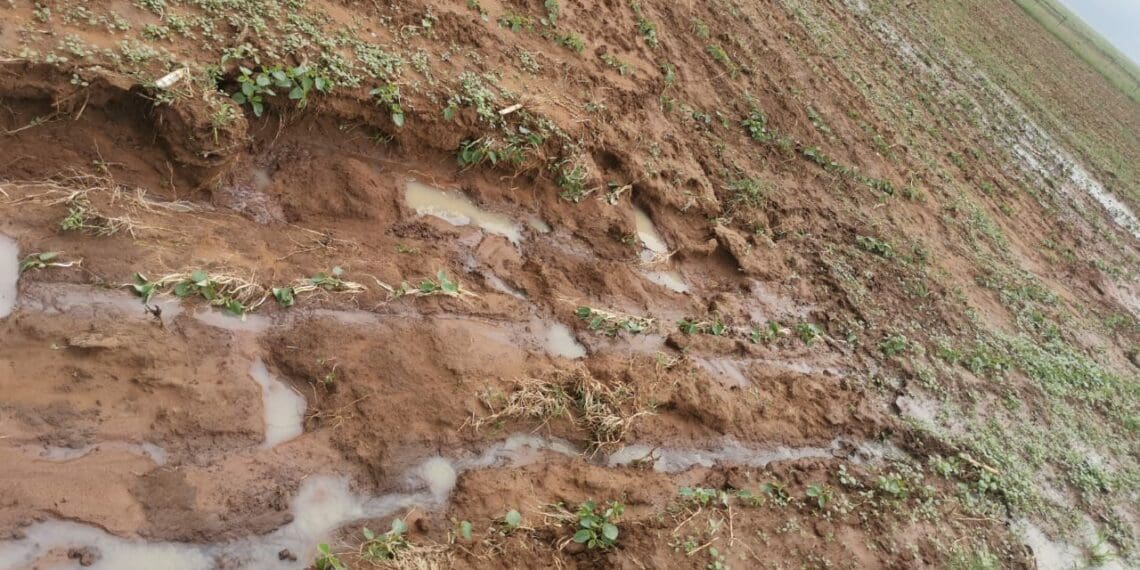
Free State farmer Clifford Mthimkhulu is suffering the same fate as some farmers in the province who are struggling to get their grain seeds into the ground due to their fields being flooded.
Some of the grains he has managed to plant have washed away, costing him over R20 000 so far.
“I have lost 10 hectares of maize which cost me R13 000 and 15 hectares of soya which amounts to R9 000. Sunflower, I have not planted yet,” Mthimkhulu said.
Livestock also affected
For livestock farmer Dingaan Boikanyo in Rustenburg, North West, the weather poses a risk to the health of his cattle herd.
“We have clay soil which means when it rains continuously, we are unable to open [the kraal] or fetch our livestock [from the fields] for at least five days after the rain has stopped,” Boikanyo explained.
“No vehicle can move in and out. It is a serious concern that we are having.”
Boikanyo is concerned for his livestock and other livestock breeders in the area too. However, some farmers are grateful for the downpours, he added.
ALSO READ: Above-normal rain threatens planting, harvesting
Mzansi’s new reality?
Floods and wet weather conditions are a new reality that South Africans will need to come to terms with, explained Dr Peter Johnston, climate scientist from the University of Cape Town.
According to Johnston, farmers should expect the wet weather to last until at least March 2023, as the country is in the La Niña season.
“The very first thing is that farmers are used to adapting to weather patterns; they know when they had a good crop, drought, made a loss, profit, or break even. So, for them it’s a matter of adjusting to the new weather patterns,” he said.
Farmers need to ensure that the production wheels on their farms keeping on turning, Johnston advised.
“It is critical for farmers to start preparing for this season and putting measures in place like doing shade netting especially on the crops.
“They should embrace technologies like irrigation drip, change the way they farm and even change the agricultural produce that is favourable to them. We have even seen farmers changing from farming wheat to olives.”
ALSO READ: Meet the Spanish lady behind Mzansi’s wet summer
Intense wind also a concern
In the Western Cape, farmers have not been sparred. Crop and infrastructure damage can been seen across the province after devastating storms this week.
Johnston indicated that some areas received between 50 and 70mm of rain in an hour, but said that this was nothing out of the ordinary. “The problem is that there is no drainage system to carry that amount of water. For grape farmers, we could say they are off the hook with the hail they got because, at this time, the grape is not fully formed yet, so they will appreciate the rain now.”
In a previous article, Vinpro confirmed that while the heavy rain in the province did leave some damage in its wake, wine grape farmers were mostly positive regarding their their vineyards.
ALSO READ: Floods: Wine grape farmers can bounce back
Meanwhile, according to horticultural science graduate Heinrich Geldenhuys, due to the heavy winds also experienced in parts of the province which could lead to damaged fresh produce fruits, more focus should be placed on windbreaks.
“When the winds become more intense between October and December, it can cause up to 87% of the total severe wind scar damage seen in a season. However, if managed correctly, suitable windbreaks or other forms of wind protection can minimise such losses,” he said.
Geldenhuys added that the decision to use either windbreaks or shade netting was balanced.
“Many producers are turning to shade netting these days due to exceptional pack out rates, but the initial investment cost can be quite steep for most farmers. Also, the long-term impact of netting on the farm’s carbon and plastic footprint is still an area of uncertainty,” he explained.
Excessive heat not helping
A vegetable farmer in Khayelitsha Thozama Sekiti said that she did not have shade netting covering her crops and suffered major losses due to excessive heat temperatures.
“I had damage on my crops. A quarter of a hectare was damaged by the heat we experienced. I do not have shade netting on my crops, so I am very grateful for the rain that we have received as it has eased the burden on my crops,” she explained.
The city of Johannesburg has also suffered damage following big storms that hit the city. So far, reports indicate that the flooding damaged infrastructure in Roodepoort, Hursthill, Northcliff and Lenasia.
Food For Mzansi reached out to the Gauteng department of agriculture, rural development and land reform. They said even though the province had experienced heavy downpours, they have not received any information regarding flooded farms.
ALSO READ: WC farmers counting the costs after floods
Sign up for Mzansi Today: Your daily take on the news and happenings from the agriculture value chain.