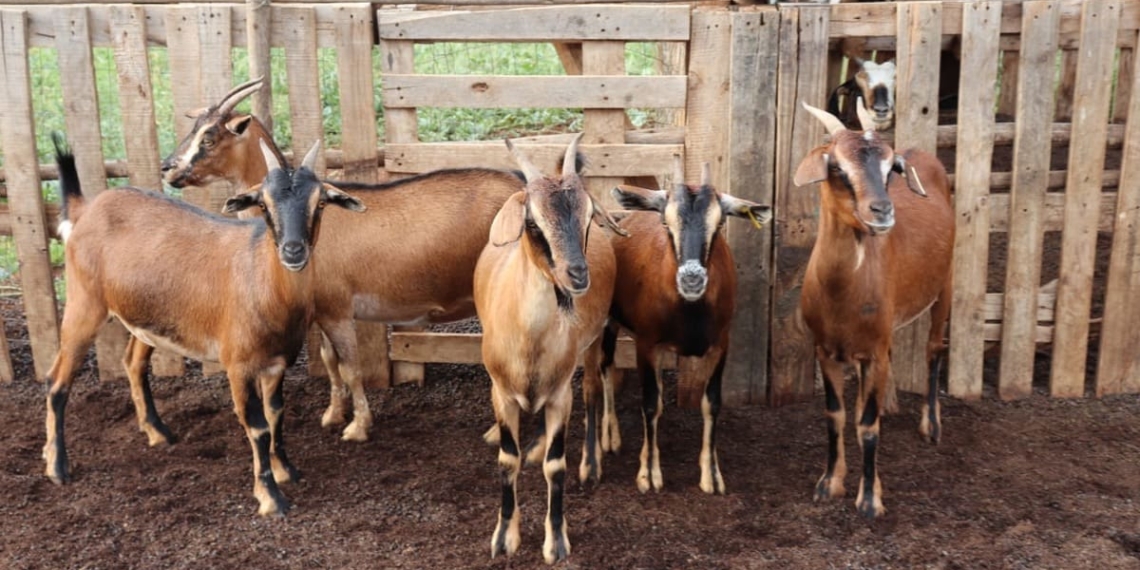

Have you been dreaming of farming with goats, spotting big market opportunities out there? If you’ve been wanting to learn how to farm with goats, then look no further! Here is a guide to the different aspects of starting a goat farm, along with inside knowledge from a seasoned goat farmer.
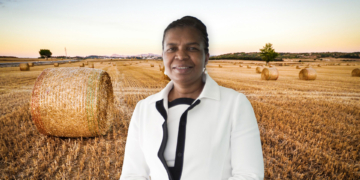
Neo Leburu, a young female farmer from Ganyesa, North West, has been a goat farmer for more than a decade now.
Her mother was got a pregnant goat as a gift when Leburu was in high school. When her mom suggested they barter with it, Leburu was adamant that they should rather keep it.
“We decided to start our own small livestock herd, and I never looked back,” Leburu says.

Her goal is to breed quality Boer goats and also sell and supply good products. Her business specialises in selling goat meat, and she employs five women. She loves her job.
“At times I don’t even notice the workload that comes with goat farming,” she says.
So, let’s get started with the first steps to starting your goat farming enterprise: choosing you breed. This is a crucial first step.
1. Choosing your breed
It is important to choose the correct goat breed for your farming enterprise. Leburu says she struggled at the start, because she initially started with the wrong breed.
“Do your research properly, you need to know what breed to invest in,” she says. “Had I started with a quality breed I would be a commercial farmer now.”
For this it would help to know what market you want to enter. There are particular breeds that are best for goat milk and cheese, for meat or for breeding. Leburu says there is a big market gap for goat meat and also for goat milk with people who are allergic to cow’s milk.
Here are some of your options for goat breeds in South Africa:
Goat breeds such as the Boer goat, Savannah and Kalahari Red are world-renowned and most sought after for their superior characteristics such as adaptability, hardiness, good maternal instincts, meat production and high reproduction rate.
The famous Boer goat breed originated in South Africa, according to Boer Goats. Because of intense breeding over the past 50 years or more by South African goat breeders, the Boer goat is considered far superior to any other breed for meat production.

There are specific breeds for mohair and cashmere fibre as well. The Gorno Altai and the Saffer are two goat breeds recognised for their production of cashmere while the Angora goat produces mohair.
In some dry regions of north western South Africa, extensive ranching of goats is done together with Persian, Dorper and Karakul sheep. The Angora goat is also an important goat breed in the Eastern Karoo.
2. Training, experience and mentorship
Farming is seldom an area you want to enter without any sort of experience. There are options to read up online, take training courses, as well as to work part-time with a seasoned farmer to learn from them and get a mentor.
Leburu farmed part-time before settling into farming with goats full-time. Even then she still maintained her side-hustle.
“I’ve got a mentor who’s mentoring me to become a commercial farmer,” she says. “With his help I will hopefully soon go commercial.”
“Experience comes with time,” Leburu says.
You can find Boer goat training courses here.
3. Choosing the right land
Land is a critical need in the commercial goat farming business and must be adequately available. It is important to ensure you have enough space for each goat to live comfortably and without health risks.

They will need land to roam and graze, as well as sheds to sleep in. After you have established how many goats you will farm with, you can then build your goat shed for the estimated size of your flock. Goats require a minimum 60 square meters of grazing land per goat, according to Farm and Animals.
As for indoor space, timber providers Sabie Poles recommends that a single Boer goat needs at least two square meters housing space, on average. To be safe, you should work with 2.5 square meters per goat. Therefore, if you are planning to start out with five goats, your goats’ shed will have to be at least 10 square meters.
4. Ensure adequate fencing
Fencing is considered as one of the most important factors to consider before starting a goat farm, according to Roy’s Farm. It is also one of the most costly up-front investment that you have to make for your goat farm.
One of Leburu’s struggles is that she cannot at the moment buy a quality Boer goat stud due to inadequate fencing. So, it is important to have quality fencing in order before buying good quality rams. If they are not adequately fenced in, your top studs will go roaming and mess up your herd’s genetics.
Even though you might want to start off with a cheaper fence, upgrading as you go, just take the leap and do it right from the start. It will save you hassle and money further along in your goat farming journey.

The reason for this is quite cute: goats are inquisitive and very active. They are also great escape artists. Goats will climb on a fence, try to stick their head through it, try to run through a fence and they will also rub alongside it vigorously. So, your fence needs to be hardy enough to keep its integrity if your goats do any of these activities.
5. Get proper feeding
Like all other animals, goats need easy access to clean water and lots of food. And even with open pastures for grazing, feeding costs can still be one of your biggest expenses, according to Bizbolts. This is because you have to provide them with extra feed.
The goats will primarily browse in the pasture, while needing supplementary food if you intend on going commercial, or in seasons when the pasture does not have as much foliage to offer. Supplementary feeds constitute grains, hay, commercial goat feeds, salts and minerals. Your goat farming business plan should take into account the feeding costs.
It’s tough out there for female goat farmers
And that about covers it for the basics of starting to farm with goats. As Leburu said, experience comes with time. So make sure to take your time and do proper research and training to gain experience. She also advises that you always keep your eyes open for new learning opportunities while you start up.
Even though the internet is full of articles prompting you to start goat farming (they really are very cute animals, with lots of economic benefits), it’s not all fun and games.
“Challenges are everywhere,” warns Leburu. “I cannot say that it is easy.”
Her main challenges come with being a woman in a male dominated industry. Also, with some of the heavy duty farm work she requires help. Farming isn’t a one-person job.

She also struggled to find a mentor. “They didn’t take me seriously,” she says. “Maybe because I was young, or because I am a woman.”
ALSO READ: Struggling NW goat farmer dreams of going commercial
Final advice for future goat farmers
“Have patience and be passionate,” Leburu advises. “Farming is not a get-rich-quick scheme. But the rewards are big, the market is big, especially with goat meat.”
She also wants to encourage more women to join the goat farming world, opening her arms to all women who want to come to her for advice and guidance.
“I advise young ladies to join in,” she says. “This is not only for men, we are also here and we are winning.”
Leburu finishes off her advice to goat farmers with, “Do not be afraid, this is doable.”
ALSO READ: ‘Farming is the best way to fight poverty,’ exclaims goat farmer