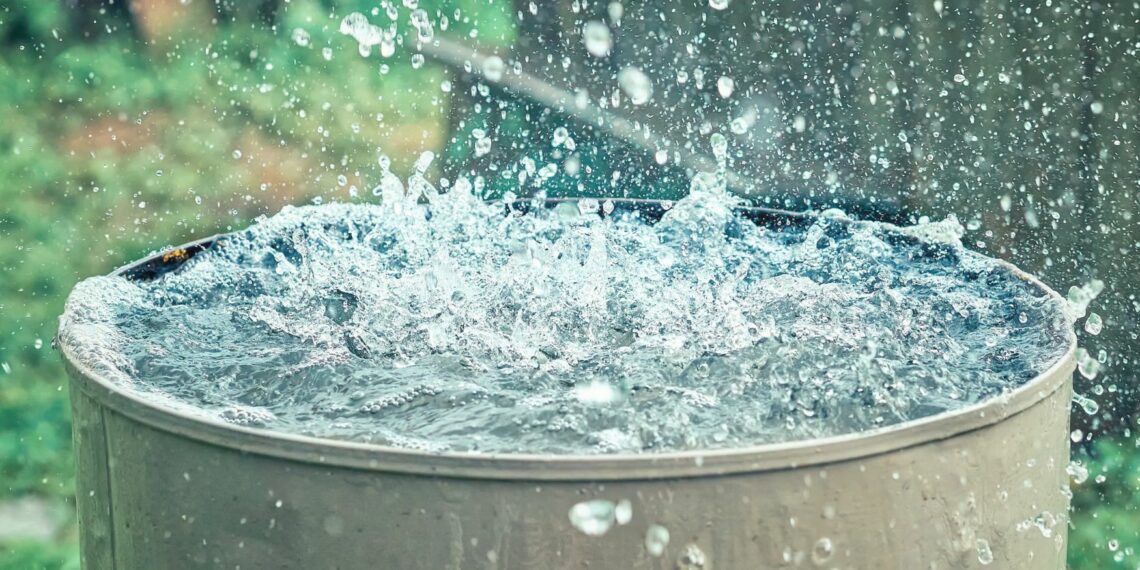
Several regions in the world, like Southern Africa experience water constraints as well as severe and prolonged droughts. Fanie Vorster an Agricultural Research Council researcher specialising in irrigation and agricultural infrastructure engineering, shares insights on the advantages of passive rainwater harvesting.
Typically, rainfall occurs in South Africa in a four-to-five-month period, with the remainder of the year dry. During the growing season, frequent hot dry spells can occur.
Therefore, especially in rural areas, the practice of storing a sufficient volume of rainwater could save a crop or secure a good yield. Provision could also be made for household water during the winter months when in general no rain falls in the summer rainfall areas.

With municipal service delivery problems in urban areas, harvesting rainwater for backup purposes is a good idea. Peak run-off flood damage could also be reduced if rainwater harvesting could be implemented on a large scale in a catchment area.
Collecting rainwater from roofs and storing it in tanks (Active rainwater harvesting), is in most cases only viable for backup household use or backup purposes. The reason is that usually the roof area (catchment) and/or the tank (storage) are the constraints – preventing the storage of a volume of water sufficient for crop production.
Passive rainwater harvesting is when the flow of run-off water originating from rain that fell on and adjacent to a catchment area, is slowed down, spread over the area, and facilitates the infiltration thereof into the soil profile for storage. This allows for storage of a sufficient volume of water for crop production.
In this article, we are going to focus on passive rainwater harvesting.

What does a passive rainwater harvesting system consist of?
It consists of:
- A catchment area, which can include soil surfaces, roads, roofs and parking lots;
- A water distribution system acts to slow down run-off water and direct it to appropriate storage areas, which could include dry trenches, small unlined ponds, berms and swales, rock walls or vegetation hedges on contour.
- An area in the landscape where the water could be stored, which could include tanks, subsurface reservoirs, small ponds or “infiltration pits”, basins, French drains and in the subsurface soil profile.

What advantages does passive water harvesting have?
- The materials that are used can mostly be sourced locally, on or near the site – thereby reducing cost.
- Construction and maintenance are simple, making it achievable for anyone who only has a basic understanding of the principles involved.
- It causes runoff water to slow down and spread across the soil surface, thereby reducing the erosion potential of the water, and increasing the portion of the water that infiltrates into the soil.

Interventions for managing and harvesting rainwater passively
Start with a small intervention and then extend and improve incrementally. Observe the measure of success in actual rain events and make improvements.
Start at the top (highest elevation) of the catchment area, then draw a map of the areas involved. Mark the different catchment areas, as well as other sources of runoff water entering the relevant catchment area.
Start intervention at the top of the catchment area, proceeding down the slope to reduce the volume and eroding power of the collected water at the bottom of the catchment.
- Use several small catchment areas in combination with each other.
- It is easier to manage water in several small catchments than in one large catchment area.Therefore, utilise the natural topography of the site to subdivide the catchment into more than one sub-catchment.
- If the natural topography is uniform and sub-divisions cannot be recognized as such, the catchment can be divided into sub-catchments artificially to facilitate easier water management.
Facilitate slowing, spreading, and infiltration of the runoff water. Infiltrating water into the soil and thereby storing it there is the most economical option.
Storing water in the soil has a major beneficial influence on the local climate and environment. By allowing water that is concentrated in a channel to spread out over an area in intervals, slows the flow and reduces the erosion potential. This causes sediments to deposit and facilitates a larger portion of the water to infiltrate into the soil.
Surface stormwater is decreased due to more water infiltrating into the soil. Vegetation should be established in the areas to utilise the water infiltrated into the soil to maximise the environmental and climatic benefits.
- Ensure overflow areas are of suitable size and lined to protect the soil from erosion.
- Overflow areas need to be level across their width and lined with rocks for protection against erosion.
- The overflow structures need to be sized (width and flow depth) to make provision for runoff from extreme rainfall events on the catchment – especially in the case of larger catchments.
- Overflow structures need to be maintained regularly.

Don’t forget about mulching
Provide a layer of organic mulch to limit evaporation. This has the effect of making water available for plants over a longer period.
A layer of mulch consisting of organic material could be made 75 mm-150 mm thick. In the case of rocks or other inorganic materials, the layer could be 50mm thick.
Over time organic mulches decompose, thereby improving soil fertility. Therefore, it needs to be replenished periodically.
Utilise the water harvested and do regular maintenance. The earthworks and especially the overflow structures need regular maintenance to function optimally for an extended period.

For more detailed information on the different interventions as well as the effect that water stored in the soil has on the environment and local climate, the publication “Changing climate: The role of water and what you can do to drought-proof your land”, can be consulted. It can be ordered from the ARC-NRE publication office at StoltzE@arc.agric.za
- Fanie Vorster researcher for irrigation and agricultural infrastructure engineering. The views and opinions expressed in this article are those of the author and do not necessarily reflect the views or positions of Food For Mzansi.
READ NEXT: Water harvesting: Reap the benefits via nature
Sign up for Mzansi Today: Your daily take on the news and happenings from the agriculture value chain.