Tuesday, October 20, 2026
SUBSCRIBE
22 GLOBAL MEDIA AWARDS
Food For Mzansi
  • News
  • Changemakers
  • Lifestyle
  • Farmer’s Inside Track
  • Food for Thought
No Result
View All Result
  • News
  • Changemakers
  • Lifestyle
  • Farmer’s Inside Track
  • Food for Thought
No Result
View All Result
Food For Mzansi
No Result
View All Result
in News

ICYMI: Heat and dryness threaten Southern Africa’s maize harvest

Maize production woes continue in Southern Africa as dry weather persists. Economist Wandile Sihlobo highlights concerns over South Africa's ability to meet neighbouring countries' maize needs amid declining harvest forecasts

by Staff Reporter
5th March 2024
The maize harvest season has just started and should gain momentum in the coming weeks through to July. Photo: M. Yusuf Ali and Shah-Al-Emran/CIMMYT

The maize harvest season has just started and should gain momentum in the coming weeks through to July. Photo: M. Yusuf Ali and Shah-Al-Emran/CIMMYT

Share on FacebookShare on TwitterShare on WhatsApp

There is concern regarding the maize supplies in the Southern African region for the 2023/24 production season. Agbiz senior economist Wandile Sihlobo said with Zambia, the second-largest maize producer in the area, having declared a drought disaster, there will be heightened pressure on South Africa to meet the maize demands of neighbouring countries.

According to Sihlobo, the issue will be white maize for human consumption in most countries.

“South Africa’s early production forecasts indicate that we, too, have a challenge. For example, the Crop Estimate Committee places South Africa’s 2023/24 white and yellow maize harvest at 7.0 million tonnes (down 17% y/y) and 7.3 million tonnes (down 8% y/y), thus placing the overall maize production estimate at 14.3 million tonnes (down 13% y/y).

Heat and dry conditions a concern

“The challenge for maize is the possible poor yield because of dryness in some regions, as the area plantings are higher than in the 2022/23 season,” he said.

Agbiz/IDC Agribusiness Confidence Index: Agbiz chief economist and author Wandile Sihlobo. Photo: Supplied/Food For Mzansi
Agbiz chief economist and author Wandile Sihlobo. Photo: Supplied/Food For Mzansi

Sihlobo added that the excessive heat and scant rains across South Africa are a significant concern for farmers, particularly in the summer grains and oilseed-producing regions. He said the 2023/24 summer crop season started on favourable footing.

“We received widespread rains, which was unusual in an El Niño season, which would typically start with drier weather conditions.

“Those good early-season rains led us to believe the country would have a decent harvest in the 2023/24 production season. But this view has now changed. We worry about possible poor harvests if there is no widespread rain during these closing days of February into the first week of March,” he added. 

Sihlobo said while this expected maize harvest of 14.3 million tonnes was significantly lower than the previous season if it materialises, it would still meet South Africa’s annual maize consumption of roughly 12,00 million tonnes, and the country would remain a net exporter of maize, although a much lower volume than the previous years.

Rising stars of agriculture to meet at Mzansi Young Farmers Indaba

Uncertainty if harvests will be enough

However, he said, if the region struggles with drought, South Africa’s possible small surplus may be too tight to meet regional needs.

“There are also drought concerns in neighbouring countries such as Botswana, Lesotho and Zimbabwe.

“Still, there is profound uncertainty about the maize harvest size currently in South Africa. The March production forecasts of the Crop Estimate Committee will give us a better picture. For now, we all pay for rain, and the recent Crop Estimates Committee’s data possibly did not factor in the disruption currently caused in recent days by the excessive heat in various regions of the country,” he said.

ALSO READ: Election showdown: KZN’s agri sector braces for battle

Sign up for Mzansi Today: Your daily take on the news and happenings from the agriculture value chain.
Staff Reporter

Researched and written by our team of writers and editors.

Tags: Commercialising farmerInform meMaizeWandile SihloboZambia
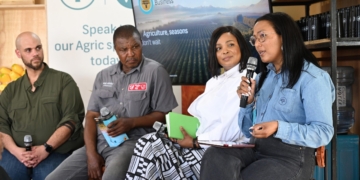
The panellists at FNB Business’s “Farming together” discussion at the Royal Show explored how market access, mentorship, financial discipline and strong commercial relationships can help farmers build sustainable businesses. Featured from the left are Bertram July (FNB’s distribution sales lead), commercial farmer Shakes Shabalala; Sandy Gumede (co-founder of Zulu Girl Wines), and Janis Robson (FNB’s head of development and SME business development). Photo: Food For Mzansi
News

FNB puts relationships at the heart of commercial farming

by Staff Reporter
17th October 2026

From buying a farm with cattle to building a wine brand from scratch, entrepreneurs shared how strong relationships, market access...

Read moreDetails
Agri Skills Transfer students gain hands-on experience at the institution’s Cullinan Farm Training Centre, where agricultural theory meets the realities of commercial production. Photo: Supplied/Food For Mzansi

Build your future in agriculture with Agri Skills Transfer

17th October 2026
Durbanville Hills tastes sweet success at Michelangelo Awards

Promising early conditions predicted for 2027 SA wine harvest

17th October 2026

Reclaiming the kraal: Cultural heritage sparks a farming dream

16th October 2026

How animal welfare and human rights shape food security

16th October 2026

Reluctant farmer scales EC cabbage enterprise to supply Spar

Farmworkers rally against rising evictions and housing insecurity

Fixing SA’s agricultural visa system to protect seasonal harvests

Stop the rot: Four steps to slash post-harvest losses

Agda conference to tackle finance, market access and agri growth

Join Food For Mzansi's WhatsApp channel for the latest updates!

JOIN NOW!
Next Post
Five ways to protect farmworkers from the heat

Training and collaboration crucial for programmes like Pesi

THE NEW FACE OF SOUTH AFRICAN AGRICULTURE

With 21 global awards in the first six years of its existence, Food For Mzansi is much more than an agriculture publication. It is a movement, unashamedly saluting the unsung heroes of South African agriculture. We believe in the power of agriculture to promote nation building and social cohesion by telling stories that are often overlooked by broader society.

Fixing SA’s agricultural visa system to protect seasonal harvests

SA and Namibia reevaluate livestock trade after FMD outbreak

Agda conference to tackle finance, market access and agri growth

Reluctant farmer scales EC cabbage enterprise to supply Spar

Reality check: What SA agri interns really experience on the farm

This week’s agri events: 19 – 23 October

  • Awards & Global Impact
  • Our Story
  • Contact Us
  • Cookie Policy
  • Privacy Policy
  • Copyright

Contact us
Office: +27 21 879 1824
News: info@foodformzansi.co.za
Advertising: sales@foodformzansi.co.za

Contact us
Office: +27 21 879 1824
News: info@foodformzansi.co.za
Advertising: sales@foodformzansi.co.za

  • Awards & Global Impact
  • Our Story
  • Contact Us
  • Cookie Policy
  • Privacy Policy
  • Copyright

Chat Options

About this assistant

This feature generates automated answers summarised from Food For Mzansi articles. By using it, you are interacting with an AI system (provided by Google), not a human. AI can make mistakes. Please refer to the source articles for verification and citation purposes.

Our staff do not check or moderate Lerato’s answers in advance, but may review some later. Our journalists continue to write and edit all the articles Lerato uses as sources.

To estimate unique and returning web users, we store a random browser ID in this browser. WhatsApp users are counted by phone number. The same person using both channels may be counted twice.

I'm Lerato, your AI assistant!
No Result
View All Result
  • News
  • Changemakers
  • Lifestyle
  • Farmer’s Inside Track
  • Food for Thought

Copyright © 2026 Food for Mzansi