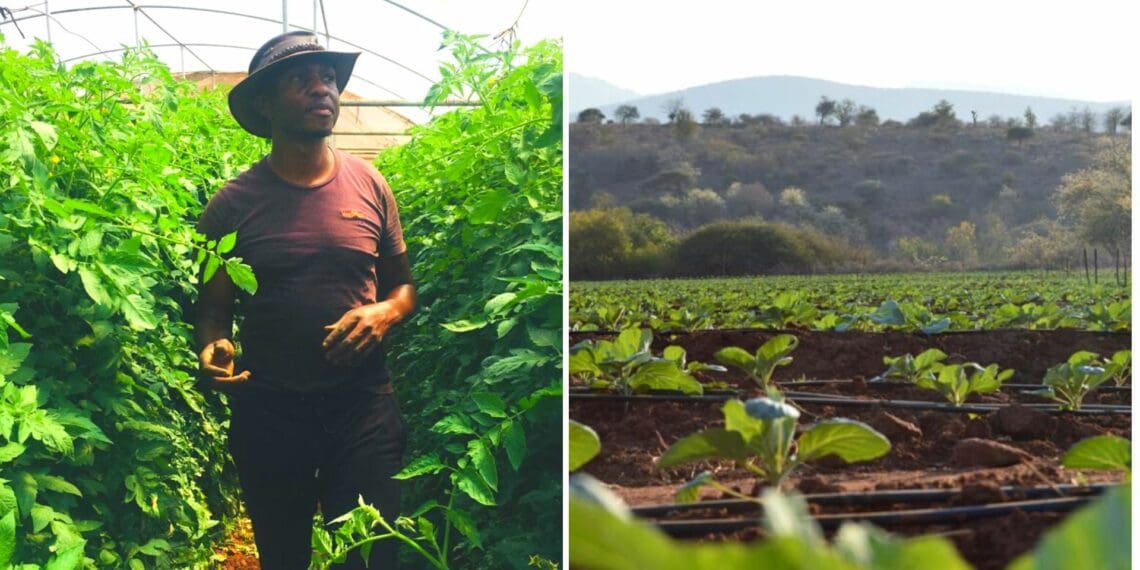
When Kgapane Phillip discovered that vegetables at most retail stores near him are grown and supplied by people from outside the province, he saw a gap in the market and took immediate action. Today, he runs an award-winning farming operation in Mafarafara village in Burgersfort, Limpopo.
The few suppliers that local retailers had, as well as the distance that they covered to deliver to the area, are what nudged ,him into starting his agri-business, ‘The Veggie Guy’.
“My business started when I realised that there is a gap in my hometown and there were just two suppliers at Fruit and Veg and some retail stores, mostly your eating outlets. So, the suppliers were coming from as far as Johannesburg and Nelspruit. I then approached the retailers with the idea of being a local vegetable supplier,” Phillip says.
Phillip now lives with his family on the 870-hectare farm but grows various vegetables on only 10 hectares, depending on the need. None of these would have been possible, he admits, were it not for the help of his farm and logistics managers, Malatji P.S and Kgapane S.T.

Spreading his wings
While he primarily supplies markets such as the Joburg Market, City Deep, and the Tshwane Market, Kgapane also distributes a share of his fresh produce to retail stores such as Spar, Food Lovers Market, and food outlets like Debonairs, Nandos, Barcelos, and Spur in and around his area.
“Honestly, I farm with everything I have got a market for. So, with me, I need to secure a market, either a client or a specific group of people with that we can have some sort of agreement. It doesn’t only necessarily mean those vegetables, but if you see me planting something, there’s probably a client who’s already going to buy that product.
“Like now, there’s already four hectares of butternut which has been grown for a particular client, and is ready to be collected,” says Phillip, with broilers purring in the background.
Unexpected hurdles
But in business, as is the case in any sphere of life, it won’t always be a smooth ride. Kgapane remembers how his business took a knock in the earliest part of 2020 due to heavy rainfalls.
“Between late 2019 and early 2020, there was heavy rainfall in the province. At the time we had about four hectares of tomatoes, which were all destroyed by the rain, and I lost close to a million rand in cash,” recalls Phillip.

A few weeks later, Covid struck, and things couldn’t get any worse from there. “I supply Steers, Debonairs, Nandos, and Barcelos, and those were some of my core clients. So, you can imagine what happens when suddenly they must close. I also had a store in town which supplied these eateries, but the operation unfortunately also had to close down,” Phillip says.
“And at that time, we had a lot of produce at the farm, which we suddenly couldn’t sell. So, a lot of money was lost during that time.”
Phillip further points out that the loss doubled when one of his uninsured delivery vehicles got into an accident, resulting in all the products being destroyed.
Resolving to withstand challenges
The challenges, however, did not pull down the curtain on Phillip’s farming career. If anything, they have just scratched the surface of his resolve.
After recovering from the ordeals, The Veggie Guy has continued to grow in leaps and bounds. As well as receiving a cash injection in the region of a million from the Masisizane Fund, the business recently added Boer goats to its farming range, Phillip explains.
In 2020, one Boer goat ram fetched over R100 000 at the GWK auction and was declared the most expensive goat in the country.
Phillip credits his success and resolve to the two years he spent serving at the South African National Defence Force (SANDF).
“I am a proud product of the Military Skills Development System (MSDC) which is part of the SANDF. I don’t think I owe credit to anything other than that programme because that’s where I was moulded. That’s where I developed the mental strength,” he acknowledges.

Flawed narratives
Farming is often associated with either the elderly or white people by young people, says Phillip, something he believes will change with time.
“Unfortunately, the lifestyle that young people are looking at does not reflect well in farming. If I come across as a farmer with a tractor that’s worth a million, I am still going to look poor in the eyes of many young people, compared to the guys who are maybe, driving golfs and all these cars.
“Until such time comes, when we can associate young people with successful farmers, and show them what farming can do for us, agriculture will always be looked at like something that cannot bring income,” warns Phillip.
ALSO READ: Vegetable garden helps Iris cope with son’s death
Get Stories of Change: Inspirational stories from the people that feed Mzansi.