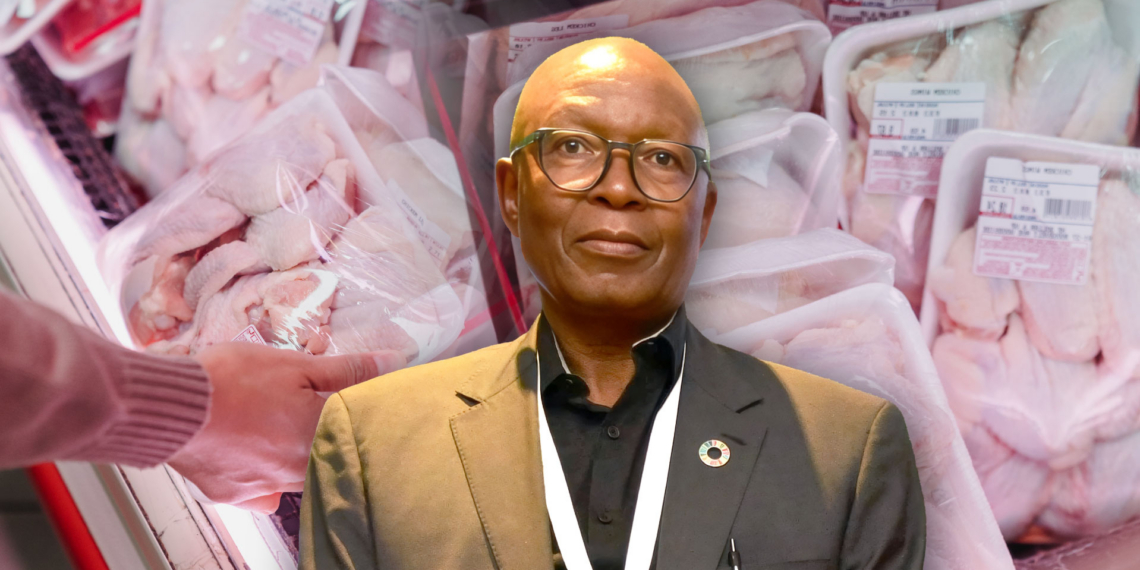
Demand for chicken is booming across Southern Africa, but who gets to supply it? Sacau CEO Ishmael Sunga highlights that emerging suppliers struggle not from a lack of demand, but from failing to meet strict commercial standards.
Southern Africa’s chicken economy will not become inclusive by wishful thinking. It needs buyer-led enterprise development that starts with real supply-chain pain points.
Chicken sits at the centre of southern Africa’s food economy. It is the protein on the family table, the anchor product in supermarket fridges, the workhorse of township and urban takeaways, the backbone of school and workplace meals, and the star of the region’s fast-food boom.
The missing link: Demand is high, but supply falls short
Yet behind every quarter chicken, bucket, burger, wing, drumstick and deli rotisserie lies a hard commercial truth: demand is not the problem. Reliable supply is.
The poultry industry across southern Africa has shown remarkable resilience. Production is recovering in several markets, feed prices have eased in recent periods, and chicken remains one of the region’s most important affordable animal proteins.
At the same time, the sector continues to face familiar vulnerabilities: disease shocks, uneven access to inputs, high logistics costs, cold-chain constraints, processing bottlenecks, weak supplier readiness, import disruptions and intense price pressure on consumers and brands alike.
This is why the next frontier of poultry transformation cannot be limited to producing more birds. It must be about building suppliers who can meet the standards of modern consumer-facing markets. The question is not whether emerging poultry enterprises should be included. They should.
The real question is: included into what, on what terms, at what scale, and with what support to ensure they can deliver consistently, safely and competitively?
Flipping the script: Starting with the buyer’s problem
For too long, enterprise development has often started from the supply side: find farmers, train them, give them some inputs, and hope a market will emerge. That approach is well-intentioned, but it is often backwards.
Related stories
- Poultry value chains: Driving rural economic growth in SA
- SA poultry industry calls for urgent bird flu vaccine rollout
- Govt and industry unite for phase 2 of Poultry Master Plan
- Poultry farming: Tips to manage unpredictable weather patterns
In a demand-led poultry economy, the starting point should be the buyer’s problem. What exactly prevents major chicken brands, supermarkets, processors and food-service companies from sourcing more locally, more inclusively and more reliably? Where do suppliers fail on volume, price, product specification, traceability, food safety, packaging, grading, delivery windows or documentation? What would make an emerging supplier commercially credible rather than merely developmentally desirable?
These are not academic questions. They go to the heart of whether transformation in the poultry value chain will remain a policy slogan or become a commercial reality. Major consumer-facing chicken brands cannot gamble with food safety, quality, traceability or availability. A missed delivery does not only inconvenience a procurement department; it disrupts menus, damages brand trust, raises costs and ultimately affects consumers.
Inclusion that ignores these realities will fail both the buyer and the emerging supplier.
That is why southern Africa needs a more practical, buyer-led approach to poultry enterprise development. The process should begin with confidential one-to-one conversations with major consumer-facing chicken brands: fast-food chains, supermarket deli divisions, institutional food-service companies, processors and distributors. These discussions would surface the real sourcing bottlenecks brands face, without forcing them to disclose commercially sensitive information in front of competitors.
The findings should then be anonymised and brought into a focused roundtable where common constraints can be validated and converted into practical interventions. This sequencing matters. Start with trust. Protect confidentiality. Aggregate the evidence. Then convene the market around problems that are real, shared and solvable.
Expanding opportunities across the full value chain
The opportunities are wider than primary production. Emerging enterprises can enter the poultry economy through feed ingredient aggregation, maize and soya logistics, day-old chick distribution, contract-growing support, biosecurity services, veterinary support, traceability systems, slaughter support, grading, packaging, cold storage, refrigerated transport, waste valorisation and route-based aggregation.
In many cases, the most realistic entry point for smaller players may not be owning the entire value chain, but solving a specific constraint within it.
Smart financing: Funding market readiness over assets
This is also where finance must become smarter. Funding poultry enterprises without a clear buyer requirement, supply-chain role, technical standard, and route to market is risky. But finance linked to validated buyer demand, supplier-readiness criteria, aggregation models, compliance support and off-take pathways has a stronger chance of creating bankable enterprises.
Development finance institutions, commercial banks, enterprise development funds and public programmes should therefore finance market readiness, not just production assets.
Poultry sector strategies across southern Africa have already placed local production, competitiveness, transformation, exports and regulatory compliance on the agenda. The next step is to connect that agenda more deliberately to the buying power of the brands that move chicken at scale.
If procurement standards are the gate, then supplier development must build the bridge to that gate. If cold chain is the bottleneck, then enterprise support must invest in cold-chain solutions.
If traceability is the barrier, then digital record systems and compliance support must become part of the intervention. If feed costs are the pressure point, then input aggregation and feed-efficiency solutions must be treated as enterprise opportunities.
This approach is not about asking brands to lower standards. It is about helping emerging suppliers rise to them. That distinction is crucial. Consumers deserve safe, affordable and reliable chicken.
Brands need dependable suppliers. Emerging enterprises need a fair pathway into commercial markets. The region needs jobs, local value addition and a more inclusive poultry economy. These objectives are not in conflict if the value chain is designed intelligently.
A four-step roadmap to practical transformation
A practical starting point would be a structured consultation with leading chicken brands and major buyers. Not another talk shop. Not another generic stakeholder meeting.
A serious, sequenced process:
- Confidential bilateral conversations to understand brand-specific constraints;
- An anonymised synthesis of recurring bottlenecks;
- A focused roundtable to validate common issues;
- Concrete pilot projects around supplier development, aggregation, cold chain, processing, compliance or finance readiness
Done properly, this could produce a new kind of poultry enterprise pipeline: not a list of hopeful producers looking for buyers, but a set of enterprises built around actual market gaps. One supplier cluster could be organised around reliable live-bird production.
Another enterprise could provide cold-room and last-mile delivery services. Another could specialise in packaging and labelling. Another could manage compliance records and traceability. Another could aggregate feed inputs for small producers. Each would be linked to a real constraint and a real buyer requirement.
This is how transformation becomes practical. It moves from broad promises to defined standards, from scattered support to targeted capability-building, from isolated farmers to organised supply systems, and from charity language to commercial credibility. It also recognises that large buyers are not merely end-markets; they are sources of intelligence about what the value chain needs to function better.
The chicken economy is already one of southern Africa’s most important food and employment systems. But its future cannot rest only on the strength of large integrated firms or the protection of domestic production. It must also rest on a deeper, broader and more capable supplier base. That base will not emerge by accident.
It must be designed around demand, disciplined by standards, supported by finance, enabled by infrastructure and pulled into the market by buyers who understand that resilient supply chains are also inclusive.
Southern Africa does not need to choose between commercial rigour and inclusive growth. In poultry, the two must reinforce each other. If the region wants more emerging enterprises in the chicken value chain, it must stop asking only how to support suppliers and start asking what the market actually needs.
The brands know where the bottlenecks are. The task now is to listen carefully, organise intelligently and build enterprises that can solve them.
- Ishmael Sunga is the CEO of the Southern African Confederation of Agricultural Unions (Sacau). The views and opinions expressed in this article are those of the author and do not necessarily reflect the views or positions of Food For Mzansi.
READ NEXT: 15 000 jobs shed: Why the SA agri sector is feeling the pinch