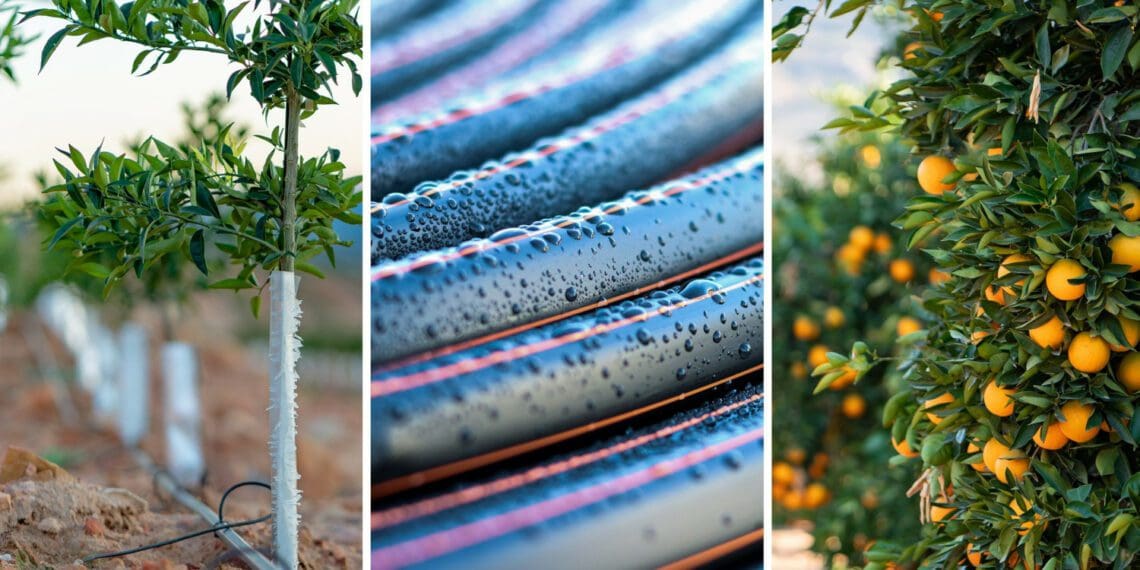

One of the most common mistakes amongst farmers when irrigating orchards, is overirrigation that causes the plants to be deprived of oxygen. Netafim agronomist Jovan Erasmus shares some welcome guidance.
Regardless of the irrigation equipment and system design on your farm, if you don’t know how much water to deliver to each plant, and when, you will never achieve optimal precision irrigation. What’s more, is that there are basic differences between irrigation scheduling in open fields and in orchards.
Netafim agronomist Jovan Erasmus explained in a previous article that some basic principles will always stay the same:
- Your soil has a certain water holding capacity based on the percentages of sand, silt, and clay, also referred to as soil texture.
- A plant has a certain daily water requirement, which can be calculated or checked with the help of standard formulas.
- Different crops have different rooting depths.
- The main aim of precision irrigation remains to supply the right amount of water in the right place (in this case, the entire root zone but not deeper or wider than that), at the right time, as efficiently as possible.
It is, however, also important for farmers to understand the differences in approach when they plan the watering schedule for either their field crops or their fruit trees.

Orchards vs open fields
Erasmus says that root zones and plant spacings are some of the main differences between orchards and open fields.
“Orchards tend to have deeper root zones compared to open field crops. Orchards also tend to have wider plant spacings – up to 6 or 7 m between plant rows and needing two or three drip lines per row – compared to open field plant rows. Here, rows could be less than 1m apart and need only one drip line for every one to two rows.
Because of the deeper root zones in orchards, farmers will typically need to irrigate for longer to fill those root zones with water (but not wetting the soil past the root zone).
Orchard root zones are usually between 40 and 60 cm deep, compared to 10 to 40 cm root zones for vegetables.
Different growth stages
Because any plant will need different amounts of water in its different growth stages, it goes without saying that orchard scheduling will undergo significant adaptations as trees grow from saplings into fruit-bearing trees.
However, it is just as important to get the scheduling right in the early growth stages as it is in the later years.
“Young orchards tend to take long to deliver a return on investment. Do not neglect your orchard in the first few years. This is important to ensure long-term productivity.”

Base every decision on accurate data
Erasmus believes that correct watering contributes by far most of the input that is needed for a good harvest. “Get your irrigation right first – before spending money on ‘miracle’ products,” is his advice.
And “getting right” the watering schedule entails crop- and area-specific calculations but also continuous monitoring of soil moisture. This applies as much to orchards as to open fields and will allow farmers to adapt the schedule as it is needed.
If the data, for example, shows that the soil is too wet for the specific crop, you must adapt by reducing the active irrigating hours. On the other hand, if data shows that the soil is dry, the irrigation hours can be increased.
“You have to learn to know your soil, and you have to learn to know your irrigation system,” Erasmus says. “Dig profile pits in your orchard to see how deep the root zones are. You can also make use of a hand auger to see how deep an irrigation event wets the specific soil.
“You can use a soil moisture probe, but then you need to make sure that it is installed correctly and calibrated to your specific soil and specific crop. If you don’t calibrate your probes correctly, you will end up using the wrong information to make bad decisions.
He issues a stern warning, though. “One of the main issues I see amongst farmers, is overirrigation in orchards. When plants show stress, farmers often default to giving more water but measuring the soil moisture and getting accurate data will help you make better decisions.”

Consult with an expert
As always, the knowledge and experience of an industry expert can help farmers avoid costly mistakes. However, the choice of expert is vital. “Do your homework. Consult a reputable expert who can take your unique scenario into consideration and who will factor in things you may have missed.
“There are general guidelines but never a one-size-fits-all solution. Experts can make all the difference to ensure that your investment is fruitful in the long run.”
He leaves farmers with a final thought, saying that fruit farming is a long-term investment, and early decisions could still have an effect decades down the line. “Farming can look very lucrative and can be fruitful, but farming is not easy. Making sure you plan properly, is crucial before spending money on the investment.”
Farmers who want to gain more knowledge and practical tips on irrigation scheduling, can visit Netafim’s Precision Irrigation Academy at www.netafim.co.za.
• To hear a full interview with Erasmus, listen to the latest episode of Farmer’s Inside Track. For more information on Netafim South Africa, click here.
Full podcast episode:
Spotify
Apple Podcasts
Google Podcasts
ALSO READ: Irrigation 101: Getting the watering schedule right
Sign up for Farmer’s Inside Track: Join our exclusive platform for new entrants into farming and agri-business, with newsletters and podcasts.