In 1972, when dairy farmer Jacques Theron joined his father’s farm, it was a modest beginning, with just six cows and a rudimentary setup.
The family farm was purchased in 1969 for a mere R40 000, and the following year, the neighbouring property was acquired for R55 000. Yet, despite the promise the land held, the farm’s infrastructure was nearly non-existent, and the herd consisted of only six cows, each milked by hand.
Today, Theron stands as a highly accomplished dairy farmer from Helderstroom near Barrydale in the Western Cape.
His dairy operation boasts 170 milking cows and an eight-point herringbone parlour. The total herd comprises around 200 animals, with additional heifers being raised for the future.
Inspired by Mr Jersey
In those early days, the Therons did what they could to make ends meet, with the milk being delivered to Nestlé in 40-litre cans. However Theron, ever the visionary, could see the potential for more.
Determined to improve the farm’s cash flow, he set out to transform their humble dairy operation.
”To improve our cash flow, I started developing pastures with Prop van Vuuren from Fedmis as my mentor, and with help from Koos Langehoven and Tesman Beyers from the ARC, Frans Haasbroek from Bonnita, and Johan Bloemerus, who managed the Outeniqua research farm. This laid a strong foundation for expanding our dairy.”
In 1980, Theron upgraded his dairy parlour, invested in a milking machine, and decided to specialise in Jerseys. His inspiration came from MC Truter, known as “Mr Jersey” in the Southern Cape, whose mentorship was pivotal.
Jerseys were the right choice
Adopting artificial insemination in the late 1970s marked a turning point for Helderstroom, significantly improving the herd’s genetics.
“The most important characteristic of a successful dairy farmer is feed. Our dairy cows graze for six hours a day in pastures. They receive concentrated feed in the barn, and at night they get hay in the kraal because we want to collect manure to use on the fields again.”
Theron’s choice to farm Jerseys was driven by practical considerations and market demands.
“I farm with Jerseys because they calve easily and produce milk with high solids, which is preferred by the cheese factory we supply.”
Related stories
Data-driven dairy management
Theron acknowledges the challenges faced in the sector, particularly rising input costs exacerbated by global events like the war in Ukraine. However, his pragmatic approach remains focused on managing resources effectively.
“Dairy farming always comes with its own challenges, from unpredictable weather to fluctuations in product prices like milk prices. We live a high-quality but modest life here on the farm, and we can’t imagine being anywhere else.”
Theron emphasises the importance of measurement and data in managing a successful dairy.
“What you don’t measure, you don’t know,” he explains. “Measuring production is the only way to manage your herd successfully.”

Theron’s leadership and influence
By now, Theron is more than just a farmer. His commitment to innovation and his drive for excellence saw him take on leadership roles beyond the farm.
He became a board member of the Milk Producers Organisation (MPO), where his influence shaped the future of dairy farming in South Africa. Today, he also serves as a member of the South African Milk Board, further cementing his place as a leader in the industry.
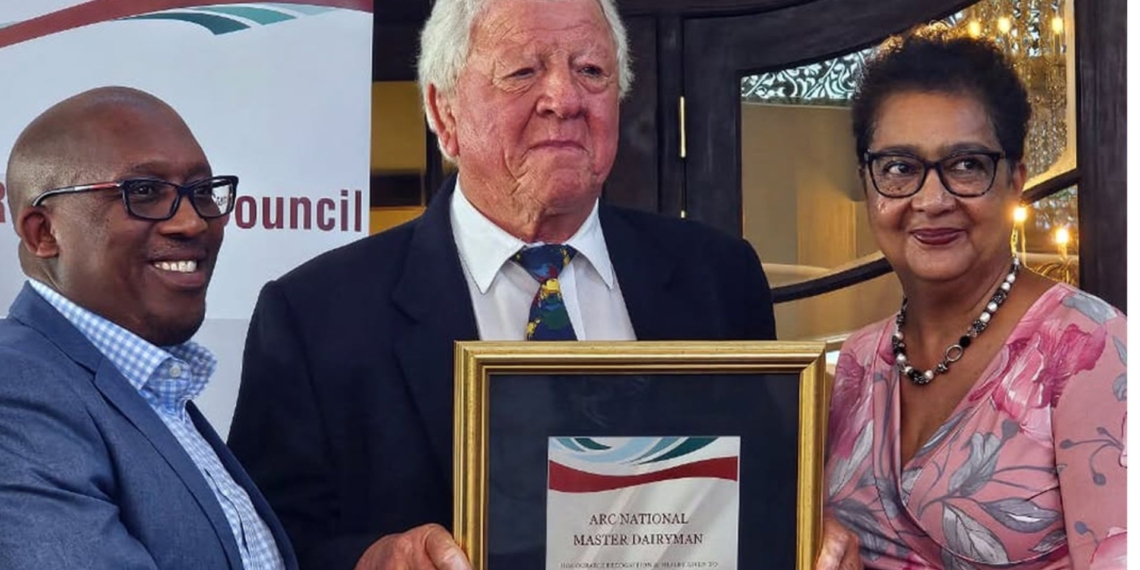
Theron has also been honoured with a special award at the 2024 National Master Dairy Farmer Awards, highlighting his contribution and decades of service to South Africa’s dairy industry.
Theron firmly believes in the critical role of the dairy industry within South African agriculture and the economy.
“I can’t imagine how South Africa could exist without dairy farmers or milk. It is a staple food and forms the base of many other essential nutrients.”
READ NEXT: Grain SA CEO calls for overhaul in agricultural education
Get Stories of Change: Inspirational stories from the people that feed Mzansi