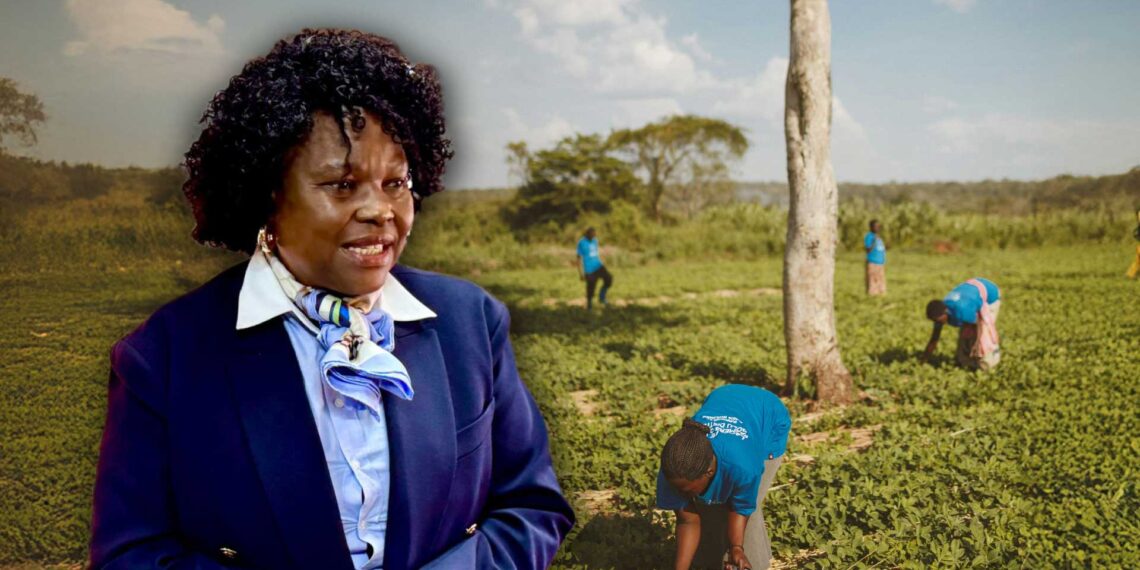
In honour of Women’s Month, Food For Mzansi sat down with Naledi Kekana, the MEC for agriculture and rural development in Limpopo, to reflect on the role of women in agriculture and the strides being made in the province to support farmers at all levels.
From empowering women and youth in rural communities to investing in climate-smart infrastructure and expanding cross-border trade, Kekana outlines a comprehensive vision for agricultural development.
Patricia Tembo: As we celebrate Women’s Month, what message would you like to share with women in agriculture?
Naledi Kekana: As we celebrate Women’s Month, I want to salute every woman working the land, feeding the nation, and leading the way in agriculture. Women in agriculture are not just farmers; they are innovators, entrepreneurs, scientists, and custodians of our food systems.
My message to them is simple: your place is not just in the field, but at the forefront of decision-making, ownership, and value-chain development.
Related stories
- Rural Limpopo gains from public-private push, but gaps remain
- Limpopo market day unites over 360 for brighter farming future
- Women who farm, lead, and grow the heart of Mzansi
- It’s a mess! Limpopo River spill sparks fear for farmers’ future
How is the department improving extension services in the province?
The department is committed to ensuring that extension practitioners are both visible and well-equipped through ongoing training and access to modern ICT tools. This approach enables them to stay aligned with the latest developments in the agricultural sector, allowing extension services to effectively respond to real-time challenges faced by farmers on the ground.
In addition to the traditional one-on-one advisory support provided by agricultural advisors, the department also employs participatory extension methods such as study groups and farmer field schools. These inclusive approaches foster collaboration, knowledge sharing, and community-based problem-solving among farmers.
To encourage excellence, the department honours outstanding extension practitioners during the Extension Awards, recognising their commitment to providing the highest quality service.
How is the department assisting farmers with water use licensing?
The department assists qualifying farmers who do not have water use authorisation by conducting water development studies and issuing hydrological reports to the farmer. The farmer is then assisted with guidance to apply with the department of water and sanitation (DWS) and by sharing and distributing information packages from the department of water and sanitation.
What is being done to promote climate-smart agriculture in Limpopo?
The department is promoting climate-resilient practices such as drought-resistant crop cultivars, water-efficient irrigation systems, and climate-smart livestock breeding.
We support provincial farmers through various departmental funding programmes, mainly the Comprehensive Agricultural Support Programme (Casp), which helps with infrastructure like shade nets, drip irrigation, water reservoirs, desilting of silted earth dams, environmentally controlled poultry houses, and greenhouses.
Extension officers are available at all agricultural zones to assist the farmers in familiarising themselves with the application forms and requirements. The department is also embarking on research programmes to establish specific crop cultivars that are suitable and highly adaptive to specific agricultural zones.
Limpopo borders three countries. How is this being utilised in terms of agricultural trade and market access?
Limpopo province’s borders with Botswana, Zimbabwe, and Mozambique are leveraged for agricultural trade and market access by facilitating access to both domestic and regional markets. The province’s strategic location as a gateway to Africa allows for the distribution of agricultural products locally and internationally.
All SADC member states are part of the SADC free trade area, which aims to facilitate trade within the region. Botswana is a key export market for South African vegetables, with Limpopo being a major producer. However, restrictions and bans on vegetable exports to Botswana have impacted trade flows. Recent developments indicate an easing of these restrictions, with the certainty of increased trade in the future.
Zimbabwe has lifted the ban on South African livestock; this marks a significant step toward normalising agricultural trade in the region.
The Maputo Corridor, particularly the Phalaborwa Spatial Development Initiative, has significantly impacted Limpopo province by enhancing trade and investment opportunities through improved road and rail infrastructure connecting to the Maputo port. Agriculture trade is also benefiting from the corridor’s transport links, enabling more efficient distribution and trade.
The Limpopo Development Corridor, a key SDI, specifically targets the Limpopo River Basin, encompassing parts of South Africa, Zimbabwe, and Mozambique. This corridor acts as a spatial framework for promoting cross-border trade and economic cooperation, with agriculture as a key sector.
A flagship project of the African Union’s Agenda 2063 is the African Continental Free Trade Area (AfCFTA), which will boost intra-African trade. The AfCFTA lays the basis for the establishment of a single African market comprising 54 nations and 1.2 billion people with a combined gross domestic product of over US$3 trillion.
What legacy do you intend to leave behind as MEC of LDARD?
I want my legacy to be one of transformation, empowerment, and inclusion, where women, youth, and previously marginalised communities find real opportunity and dignity through agriculture.
I want to be remembered as a leader who didn’t just occupy the office, but who opened doors for emerging farmers to become commercial players, for rural spaces to become vibrant economic hubs, and for agriculture to be seen not just as a sector, but as a solution.
READ NEXT: Farming smarter: Digging into GIS data