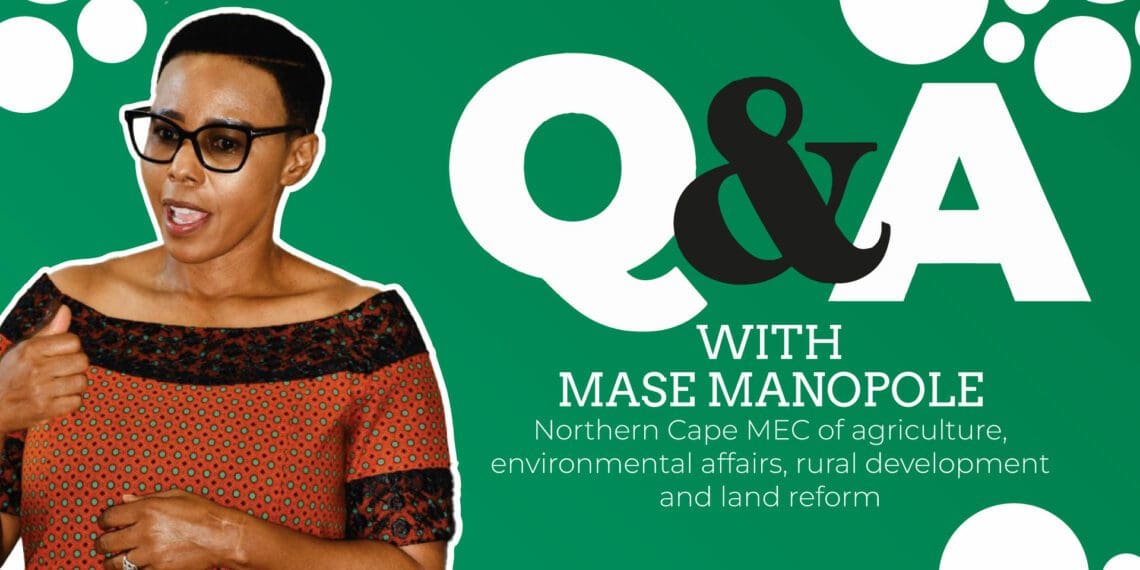
All hands will be on deck this year to turn around all the misfortunes caused by the energy crisis, water-shedding, climate change and lack of accountability in the agricultural sector in the Northern Cape. In an exclusive interview with Food For Mzansi, MEC of agriculture, environmental affairs, rural development and land reform, Mase Manopole, said she was working around the clock together with the provincial government to ensure that the province remains food secure.
A province with a high production of raisins, grapes, and livestock farming is faced with uncertainty and farmers have called for the government to step in to help rescue their operations.
Tiisetso Manoko: The death of workers in Kakamas shook the agricultural industry. What’s the latest and how is your department dealing with the matter?
Mase Manopole: We are working closely with the department of employment and labour because they are the custodians of the regulations and safety.
We have received a preliminary report which gave us a picture of what happened, however, we agreed that further investigations into this matter are required. The department of employment and labour has asked that we wait for a final report.
In that final report, we will get an indication of what type of sanctions to be given, or if there is a need for a commission to further investigate. We should be getting the final report within a month. We want to make sure the matter is closed without any loopholes.
Are there issues of compliance?
From the reports that I receive from my team, there are pockets of farmers in the province that are not complying with regulations, especially in the commercial sector. I must also say [that] at times, we have to ask the department of employment and labour to accompany us to enforce regulations [with] some of the bigger farming operations. We are monitoring them and should crack the whip on those who are not complying sooner.

We must also report that there are farmers who comply. When we visited farms in the areas of Kakamas, we found that their compliance is up to date.
Some have a partnership with the department of health, where a nurse will visit the farm to do screening [on] workers to ensure farm workers are fit to work. So, this is the type of care we want to see farmers giving to their workers.
I won’t generalise and say farmers are cruel and not taking care of their workers. Not all of them are chasing production.
How is your department stepping up to help farmers in the province tackle load shedding?
We do understand the frustration of farmers as seen by minister Thoko Didiza’s task team. We have already held a minister-MEC meeting where the task team was introduced to us. It will have four sub-committees and energy experts who will be giving a report and analysis to the minister on their findings.
In the province, I have also met with organised agriculture. Eskom was also part of that meeting and they vowed to help where they can. Our farmers gave us a presentation on how to better mitigate the effects of load shedding provincially.
Some of the proposals in the short term were the purchase of generators for small-scale farmers because installing solar panels is a long-term [solution] and [a] financially demanding exercise.
We are even looking at better ways of assisting our commercial farmers with operational costs like purchasing diesel, however, these are proposals we are taking to the national department for consideration.
Some of the proposed ideas from our farmers to Eskom was how possible it is for the power utility to keep some of the farming areas or entities on stage 2 or 3 load shedding because higher stages like stage 6 have a negative impact.
Some of our poultry farmers have told me that their chickens are ready, but they cannot slaughter them because of uncertainty with the power supply. So as a government, we are concerned about that and we will be having a follow-up meeting where Eskom will come again to tell us what is possible.
In 2022 farmers tabled matters of concern at the regional imbizos. What were the issues raised?
Indeed there are concerns, not only relating to the energy crisis, among the farmers. They raised other concerns during our imbizos that we as a provincial government are working around the clock to resolve.
Our farmers have raised the issues of access to land, availability of water, access to markets for all commodities we have in the province, funding models, and the development and mentoring of women and youth in agriculture.
These are matters farmers across the province have asked us to address. I have met with my colleague from the department of public works on the available state land that could be released, and we have met with the cooperative governance and traditional affairs MEC on the commonage farms and farmers having access to grazing land.
So, in my next engagement with them, I want to present solutions for our farmers and follow up on how these solutions are being implemented.

There’s great concern that your department has had an acting HOD for the past five years…
The premier is committed to finalising the recruitment of the head of the department. I am also looking forward to having the post filled permanently. The premier has told me that he understands the frustration that there is no stability in the department, so there are processes being followed to have a permanent accounting officer.
Having merged with the department of environment, there is a need for stability, and I have been given assurance by the premier that the matter will be resolved. He understands the urgency of it.
READ NEXT: Manopole gives biggest budget slice to farmer support
Sign up for Mzansi Today: Your daily take on the news and happenings from the agriculture value chain.