Monday, September 7, 2026
SUBSCRIBE
22 GLOBAL MEDIA AWARDS
Food For Mzansi
  • News
  • Changemakers
  • Lifestyle
  • Farmer’s Inside Track
  • Food for Thought
No Result
View All Result
  • News
  • Changemakers
  • Lifestyle
  • Farmer’s Inside Track
  • Food for Thought
No Result
View All Result
Food For Mzansi
No Result
View All Result
in Between the Headlines

Minimum wage ‘not enough’ say farm workers

by Mologadi Makwela
29th October 2019
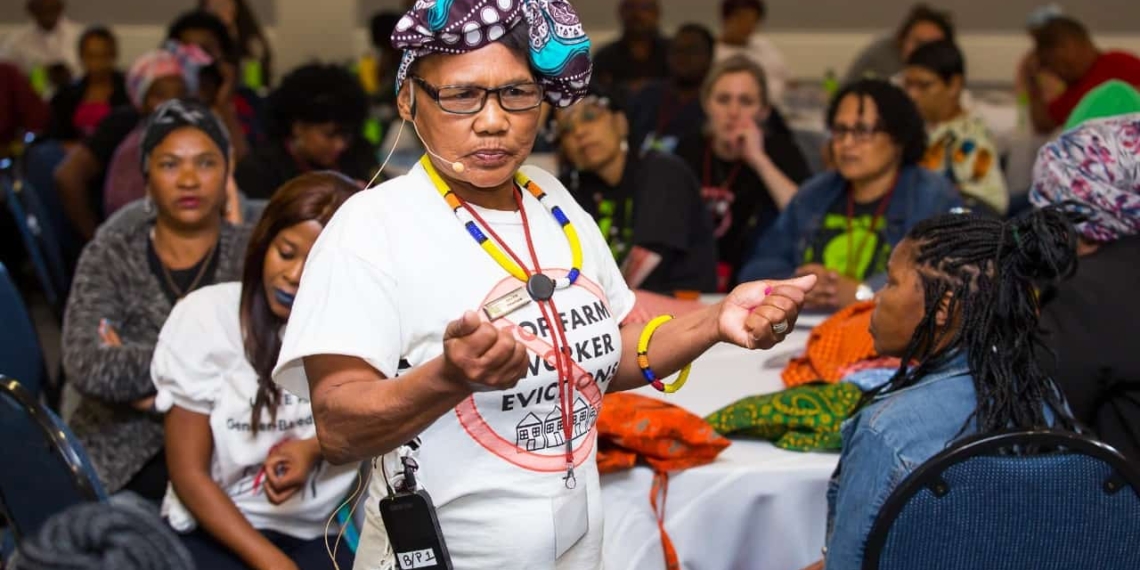
Bettie Fortuin, agri-worker and representative of the Women on Farms Project, addressing agri-workers at the Future of Farmworkers conference held at the University of the Western Cape. Photo: Supplied/Food For Mzansi

Bettie Fortuin, agri worker and representative of the Women on Farms project. Photo: Supplied/Food For Mzansi

Share on FacebookShare on TwitterShare on WhatsApp

Farm workers attending the recent Future of Farmworkers conference, held at the University of the Western Cape, were very vocal about their dissatisfaction with the minimum wage of R18 per hour for their labour that came into effect on January 1 this year.

While the wage agreement was seen as a triumph by some politicians and commentators, for the workers on the farms it remains a contentious issue.

Speaking to delegates attending the conference, Neil Coleman, co-director of the Institute for Economic Justice, admitted that the hourly wage was “a bit of a curveball” because the labour movement had been pushing for a monthly minimum wage. But, he said, it was estimated that at least 500 000 farmworkers were better off because they had been earning less than R18 an hour at the time the minimum was introduced.

“The gap between the average earnings of farm workers and managers is second only to the wage gap in the energy sector,” Coleman said.

Co-director of the Institute for Economic Justice, Neil Coleman.

“The sector is characterised by deep and extensive poverty,” he said. “Even though there was a 52% rise in minimum wages after the 2012-13 farmworkers’ strikes, we estimate that 90% of farm worker families are still living below the poverty line.”

At the time of the negotiations, a strong lobby from the farmers claimed that a minimum wage would result in job losses, but there is no evidence of a significant impact on employment. Coleman also pointed out that very few farmers have applied for exemptions from the increase.

Key issues still to be examined were whether the national minimum has been enforced and whether higher paid workers have been laid off to make way for those earning the mandated minimum.

  • READ: Celebrating our agri-workers – with some ways to go…

Coleman admitted that the choice to group farm workers and domestic workers together in the minimum wage negotiations was “a tactical decision” and that the agreement to R18 an hour was a medium term target. The hoped-for result is a much more rapid rise to a minimum of R20 per hour by 2020, but, according to Coleman, the trade unions are worryingly quiet about what is going to happen next year.

In response, a farm worker spokesperson pointed out that the trade unions are largely irrelevant in their sector.

“Where would we get money to pay the unions?” she demanded.

The situation is exacerbated by the increase in seasonal – as opposed to permanent – farm jobs and the fact that most farm workers no longer live on the farms where they work.

“When we lived on the farms we had land. We could grow our own vegetables and keep animals. Now we have nothing,” said one delegate. “Enough is enough! Nothing has improved – where are my opportunities? Where are my rights?

“Where is my land?”

Mologadi Makwela

Mologadi Makwela is a communications manager at the DST-NRF Centre of Excellence in Food Security at UWC. She specialises in strategic communication, stakeholder engagement, crisis communication; measurement and evaluation, social media management and brand development. She has extensive experience within the higher education sector, having been communications consultant for the Institute for Poverty, Land and Agrarian Studies (UWC), and a media liaison officer at the University of Cape Town. She was a Science Communication finalist in the 2018/2019 NSTF-South32 Awards. Mologadi holds an Honours degree in Media Theory and Practice, and a Masters in Political Communication. She is currently pursuing her PhD in Political Communication at the Department of Film and Media Studies, University of Cape Town.

Tags: University of the Western Cape
Farmers rethink water use as shortages threaten food production
News

Farmers rethink water use as shortages threaten food production

by Vateka Halile
5th September 2026

What happens when the taps run dry? Farmers know the answer all too well. Experts and farmers at the Water...

Read moreDetails
Honoured roots: A father’s legacy, a daughter’s farming dream

Honoured roots: A father’s legacy, a daughter’s farming dream

4th September 2026
Gauteng farmers urged to harness massive urban market

Gauteng farmers urged to harness massive urban market

4th September 2026
ONCE-OFF USE; DO NOT REPUBLISH

Foot-and-mouth crisis hits SA dairy industry with R1-billion loss

4th September 2026
Tough times, hardy cattle: Why Mzansi farmers are choosing Nguni

Tough times, hardy cattle: Why Mzansi farmers are choosing Nguni

3rd September 2026

Tiger Brands CEO calls for stronger food value chain

Early calf care: Key growth targets every cattle farmer must track

Dragon fruit thrives in KZN valley despite tough national season

Farmers rethink water use as shortages threaten food production

Rural safety under fire as stock theft and farm violence persist

Join Food For Mzansi's WhatsApp channel for the latest updates!

JOIN NOW!
Next Post
As part of agri company VKB's birthday celebrations, they have worked with various schools and organisations and have planted 500 trees in the Eastern Free State and Limpopo.

VKB celebrates 100 years by planting trees at schools

THE NEW FACE OF SOUTH AFRICAN AGRICULTURE

With 21 global awards in the first six years of its existence, Food For Mzansi is much more than an agriculture publication. It is a movement, unashamedly saluting the unsung heroes of South African agriculture. We believe in the power of agriculture to promote nation building and social cohesion by telling stories that are often overlooked by broader society.

Young farmers need structured opportunities, not just open doors

BenicaTheFarmer: The nurse who built an agricultural empire

Rural safety under fire as stock theft and farm violence persist

This week’s agri events: 07–11 September

Tiger Brands CEO calls for stronger food value chain

Plant, pick, protect: The rising potential of urban foraging in SA

  • Awards & Global Impact
  • Our Story
  • Contact Us
  • Cookie Policy
  • Privacy Policy
  • Copyright

Contact us
Office: +27 21 879 1824
News: info@foodformzansi.co.za
Advertising: sales@foodformzansi.co.za

Contact us
Office: +27 21 879 1824
News: info@foodformzansi.co.za
Advertising: sales@foodformzansi.co.za

  • Awards & Global Impact
  • Our Story
  • Contact Us
  • Cookie Policy
  • Privacy Policy
  • Copyright

Chat Options

I'm Lerato, your AI assistant!
No Result
View All Result
  • News
  • Changemakers
  • Lifestyle
  • Farmer’s Inside Track
  • Food for Thought

Copyright © 2024 Food for Mzansi

This website uses cookies. By continuing to use this website you are giving consent to cookies being used. Visit our Privacy and Cookie Policy.