
Tuesday, July 21, 2026
SUBSCRIBE
22 GLOBAL MEDIA AWARDS
Food For Mzansi
  • News
  • Changemakers
  • Lifestyle
  • Farmer’s Inside Track
  • Food for Thought
No Result
View All Result
  • News
  • Changemakers
  • Lifestyle
  • Farmer’s Inside Track
  • Food for Thought
No Result
View All Result
Food For Mzansi
No Result
View All Result
in Entrepreneurs, Movers and Shakers

Mzansi’s first biodegradable cup with agricultural roots

by Duncan Masiwa
4th October 2019
28-year-old Luvuyo Ndiki from the Eastern Cape has created South Africa's first 3D biodegradable cup made out of cornstarch and sugarcane.

28-year-old Luvuyo Ndiki from the Eastern Cape has created South Africa's first 3D biodegradable cup made out of cornstarch and sugarcane.

Share on FacebookShare on TwitterShare on WhatsApp

As an industrial design student at the Cape Peninsula University of Technology, Luvuyo Ndiki was told by one of his lecturers that people like him should not be studying the course.

This discouraging comment, made due to his poor academic performance, propelled Ndiki to start his own business. Today he’s the brain behind Mzansi’s first ever biodegradable cup made from sugar cane and corn starch.

The young entrepreneur hails from Nqamakwe, Eastern Cape. He says growing up in a village he had family members who worked in the corn fields, so it made sense to him to manufacture a product with the resources he had on hand.

“Business is all about making something out of nothing, plus I have always liked challenges from a young age. I am all about finding ways to make a difference with what I have,” Ndiki says.

The cup with agricultural roots was officially launched by Ndiki’s company, Red Cup Village, in 2017 and has made its way to different provinces throughout the country. It features quite prominently at film and music festivals.

This Cape Town based entrepreneur is helping create job opportunities for corn farmers in rural areas with his biodegradable cup.

Red Cup Village is situated in Cape Town and the name was inspired by a folk tale Ndiki’s grandmother told him while growing up. The story dates back to the 13th century and is about an African woman who united two rival village tribes by inviting them to a gathering where she made them drink from the same wooden cup.

“Without realising, the two kings started sharing the same cup which made them share their cultures, visions, beliefs and created unity in the village,” Ndiki further explains.

He sources the material from local suppliers, including farmers in Eastern Cape, Western Cape, and from international suppliers. The businessman says he wants to ensure that he creates employment opportunities. “I believe that Red Cup Village is helping to develop our country as we are creating job opportunities to the people farming corn in rural areas,” Ndiki says.

The young entrepreneur started off by hosting events for students in the university and saved up money to stock his own products. Like many businessmen, he too experienced many hardships.

“At first the biggest challenge was meeting the growing demand of the products and national distribution of the products,” he says.

Ndiki says he ventured into biodegradable production because as a businessman he saw a market gap. “Because Red Cup Village is the only producer of biodegradable cups in SA, I am the one who the world looks at in regard to biodegradable manufacturing in Mzansi,” he says.

The corn starch and sugar cane are sourced from local farms which is then made into bioplastic. From there, it is made into biodegradable cups and other biodegradable products.

Ndiki designs the cup from a sketch and programmes it into a 3D design software which shows how the product will be printed. “After the correct temperature has been set for the specific design, the 3D printer starts its job based on the design selected on the SD card,” he says.

Ndiki says he hopes that drinking from the cups makes its users feel part of something bigger than themselves. “The product breaks down into the soil in six months after being placed in compost,” he adds.

The 100% recyclable cup is currently stocked across more than 4,000 retail outlets, including the Red Cup Village website, and is used by over 300 venues nationwide.

A branch of TOPS at SPAR in the Cape Town CBD area was one of the innovator’s first clients when he launched. The store is manged by Nonyeniso Nenziwa, who says her clients kept on telling her about the biodegradable cup. “When we started stocking Red Village cups, mostly young people took to it. It’s really great to see young people consider their environmental footprint. As TOPS we are also committed to reducing our direct environmental footprint and collaborating with suppliers who do the same,” Nenziwa explains.

Ndiki's cup with agricultural roots is being sold in retail giants like TOPS and Pick and Pay.
Ndiki’s cup with agricultural roots is being sold in retail giants like TOPS and Pick and Pay.

Another stockist of the agri-cup is retail giant Pick and Pay, who has been selling the biodegradable cup since August this year at their branch in Cape Town CBD. According to the store manager, Sandile Ngubane, clients have been responding quite well to the cup and sales have picked up over the past month. “People are loving it, but some have also asked for the cup to come in a smaller size,” he says.

In addition to supplying retail giants, Ndiki’s team recently worked with a local manufacturer to create 100 test products, which had a QR code for people to download a fundraiser song.

At the moment the innovator explains that he is still focused on cups but plans to manufacture other products in the near future. “We are also working towards the Cape Town Biodegradable Festival which will be on the 29 February 2020 and a feature film project for March 2020,” he says.

Duncan Masiwa

DUNCAN MASIWA is the assistant editor at Food For Mzansi, South Africa’s leading digital agriculture news publication. He cut his teeth in community newspapers, writing columns for Helderberg Gazette, a Media24 publication. Today, he leads a team of journalists who strive to set the agricultural news agenda. Besides being a journalist, he is also a television presenter, podcaster and performance poet who has shared stages with leading gospel artists.

Tags: 3D printerCape Peninsula University of TechnologyCape TownEastern Cape
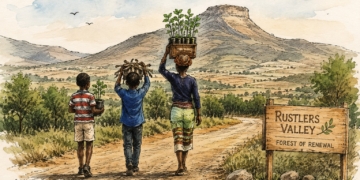
The Forest of Renewal at Rustlers Valley celebrates the intertwined legacies of Frik Grobbelaar, Anton Chaka and Riky Rick, inviting South Africans to restore the land while cultivating hope, belonging and community. Illustration: ChatGPT
Food for Thought

Rustlers Valley offers a blueprint for South Africa’s renewal

by Ivor Price
18th July 2026

As the Rustlers Valley Memorial Forest is launched in the eastern Free State this weekend, Ivor Price reflects on why...

Read moreDetails
Grain SA appoints Mabuza to lead farmer development

Rising stars: 2026 PGP finalists redefining SA grain farming

18th July 2026
Rooibos heads to space in groundbreaking Mzansi experiment

Rooibos heads to space in groundbreaking Mzansi experiment

18th July 2026

Seriti Institute CEO wins prestigious Best Woman 2026 CSI award

17th July 2026
Farmers and brewers call for budget that builds, not breaks

Minister details Land Bank’s success in boosting black farmers

17th July 2026

Seriti Institute CEO wins prestigious Best Woman 2026 CSI award

Climate change: SA’s food processors are feeling the heat

Drought and heatwaves force SA maize farmers to adapt or switch

Farmers urged to embrace uncertainty and build resilience

Minister details Land Bank’s success in boosting black farmers

Join Food For Mzansi's WhatsApp channel for the latest updates!

JOIN NOW!
Next Post
Moments before Dr Patrice Motsepe, the founder and executive chairman of African Rainbow Minerals, announced a multi-billion rand fund for black farmers. He is pictured with the late AFASA president Dr Vuyo Mahlati and chairperson Neo Masithela. Photo: Food For Mzansi

Motsepe announces multi-billion rand fund for black farmers

THE NEW FACE OF SOUTH AFRICAN AGRICULTURE

With 21 global awards in the first six years of its existence, Food For Mzansi is much more than an agriculture publication. It is a movement, unashamedly saluting the unsung heroes of South African agriculture. We believe in the power of agriculture to promote nation building and social cohesion by telling stories that are often overlooked by broader society.

Smart vineyard irrigation starts below the ground

Treat food processing as essential national infrastructure – Khoury

Farmers urged to embrace uncertainty and build resilience

SA poultry industry calls for urgent bird flu vaccine rollout

Mother’s legacy, neighbour’s grace: Venessa Simelane’s farm story

Deadline looms: Register water use by 23 July or risk penalties

  • Awards & Global Impact
  • Our Story
  • Contact Us
  • Cookie Policy
  • Privacy Policy
  • Copyright

Contact us
Office: +27 21 879 1824
News: info@foodformzansi.co.za
Advertising: sales@foodformzansi.co.za

Contact us
Office: +27 21 879 1824
News: info@foodformzansi.co.za
Advertising: sales@foodformzansi.co.za

  • Awards & Global Impact
  • Our Story
  • Contact Us
  • Cookie Policy
  • Privacy Policy
  • Copyright

Chat Options

I'm Lerato, your AI assistant!
No Result
View All Result
  • News
  • Changemakers
  • Lifestyle
  • Farmer’s Inside Track
  • Food for Thought

Copyright © 2024 Food for Mzansi

This website uses cookies. By continuing to use this website you are giving consent to cookies being used. Visit our Privacy and Cookie Policy.