Monday, July 20, 2026
SUBSCRIBE
22 GLOBAL MEDIA AWARDS
Food For Mzansi
  • News
  • Changemakers
  • Lifestyle
  • Farmer’s Inside Track
  • Food for Thought
No Result
View All Result
  • News
  • Changemakers
  • Lifestyle
  • Farmer’s Inside Track
  • Food for Thought
No Result
View All Result
Food For Mzansi
No Result
View All Result
in News

Drought and heatwaves force SA maize farmers to adapt or switch

As rising temperatures and erratic rainfall turn maize farming into a risky gamble, South African producers face tough choices. Some are replanting failed fields, while others are switching to drought-tolerant crops like sunflower and soya

by Lisakanya Venna
17th July 2026
Making the right choice between open-pollinated and hybrid maize seeds is key to maximising yields and ensuring sustainable crop production.

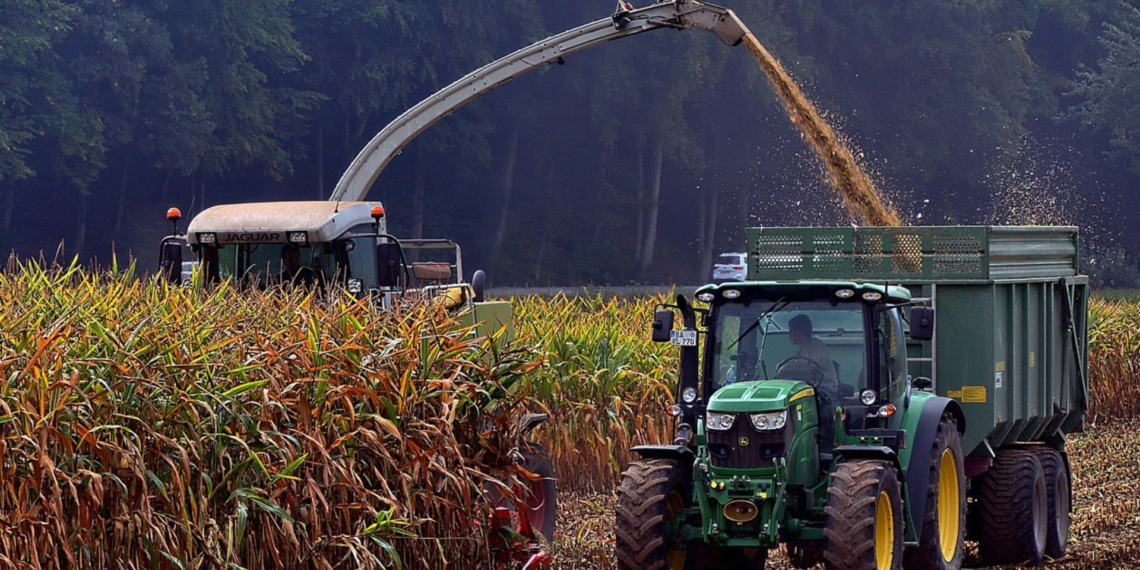
Severe droughts and soaring temperatures are pushing South Africa's staple crop to its limits, leaving fields parched and forcing farmers to rethink traditional planting habits. Photo: Pixabay

Share on FacebookShare on TwitterShare on WhatsApp

For generations, maize has been the backbone of South Africa’s food system. But as hotter temperatures, prolonged droughts, and increasingly erratic rainfall reshape the country’s agricultural heartlands, many producers say growing the staple crop has become an increasingly risky gamble.

Some are replanting fields after seeds fail to germinate in heat-baked soils. Others are planting fewer hectares of maize or switching part of their land to more drought-tolerant crops such as sunflower and soya in an effort to reduce climate-related losses.

Their experiences mirror projections from local climate scientists. Climatologist Francois Engelbrecht has identified southern Africa as one of the world’s climate-change hotspots, warning that the region is warming faster than the global average. 

Under high-emissions scenarios, rising temperatures, more frequent heatwaves and prolonged droughts could severely reduce the viability of rain-fed maize production unless farmers adapt.


Related stories
  • Maize farmers tighten defences as Goss’s wilt spreads
  • White maize hybrid leads Croplan’s South African debut
  • White maize prices rise, food costs to go up
  • Africa’s seed industry faces pressure amid global uncertainty

Rotting seeds and empty fields

For Mpumalanga maize farmer Motshidisi Modise, those changes are already unfolding. “The past five years have definitely been difficult, especially when it comes to drought and poor rainfall, where it has affected yield.

“Without large irrigation to assist with drought, if the drought persists, it will result in loss if we are unable to save the crops,” she said.

Mpumalanga maize farmer Motshidisi Modise has been forced to replant entire fields after extreme ground temperatures caused seeds to rot underground. Photo: Supplied/ Food For Mzansi

Another maize farmer in the Free State, Setjhaba Ramabenyane, echoed these frustrations, noting that unpredictable weather forced him to abandon consistent maize planting a decade ago. 

Ramabenyane highlighted a devastating drought two seasons ago. Because he caps his maize planting to under 100 hectares, he managed to avoid a catastrophic financial crash. Still, the volatility has fundamentally altered his passion for the crop. 

“I am not really a passionate maize producer, so for me, it has not become a headache as yet. I prefer sunflower, soya, and wheat,” he said.

Free State producer Setjhaba Ramabenyane has intentionally capped his maize planting to mitigate financial risk, shifting his focus to water-efficient sunflowers and soya. Photo: Photo/ Food For Mzansi

Direct threat to SA’s food prices 

The local threat is deeply rooted in plant biology. According to agronomist and soil scientist Dr Hendrik Smith, localised temperature increases of just 1.5°C to 2.0°C are projected to trigger South African maize yield declines ranging from 15% to more than 40%. 

“Harvest unpredictability could spike by up to 25%, a volatility that will directly drive up local grocery store food prices. Rising temperatures pose a severe threat to South Africa’s maize production. Higher heat causes the crop’s growth stages to shorten and dramatically increases evaporation,” Smith explained.

Maize is highly sensitive to heat stress during its flowering, pollination and early grain-filling stages. When temperatures climb above 30°C during these critical windows, the plant’s reproductive systems break down, damaging pollen viability and halting fertilisation altogether. 

A prolonged heatwave at this stage can instantly wipe out 80% to 90% of a farmer’s expected yield.

How maize farmers can mitigate and adapt

In 2020, a groundbreaking study by the National Aeronautics and Space Administration (NASA) revealed that human-caused greenhouse gas emissions, rising temperatures and shifting rainfall patterns could cause global maize yields to plummet by 24% by the end of the century, with declines becoming apparent as early as 2030. 

To protect the future of food security, farmers can no longer rely on traditional habits. Smith outlined several critical adaptation strategies: focus on adjusted planting times, adapted cultivars, healthy soil and applying regenerative conservation agriculture practices to mitigate the damage. 

According to Smith’s research on conservation agriculture, building resilience to climate change begins with improving soil health. Practices such as minimum or no-tillage and maintaining permanent soil cover increase soil organic matter, enabling soils to retain more moisture during prolonged dry spells and heatwaves.

Smith also advocates more diverse crop rotations and the use of drought-tolerant crops to spread climate risk. 

Technology is becoming another important adaptation tool. Farmers are increasingly using more accurate weather forecasting and exploring heat-tolerant seed cultivars to improve their chances of maintaining yields in an increasingly unpredictable climate.

READ NEXT: The countdown is on for Nampo Cape 2026 in Bredasdorp

Sign-up for the latest agricultural news delivered straight to your inbox every day with Mzansi Today!

Lisakanya Venna

Lisakanya Venna is a junior journalist and content coordinator with varied multimedia experience. As a CPUT journalism alumni, she finds fulfilment in sharing impactful stories and serving as a reliable source of information.

Tags: Climate changeCommercialised farmerConservation agricultureInform meMaize
Farmers and brewers call for budget that builds, not breaks
News

Minister details Land Bank’s success in boosting black farmers

by Staff Reporter
17th July 2026

Over the past three financial years, Land Bank’s blended finance scheme has successfully transitioned 76 small-scale farmers into commercial operations,...

Read moreDetails
Wits students step up to fight campus hunger

Wits students step up to fight campus hunger

17th July 2026
Making the right choice between open-pollinated and hybrid maize seeds is key to maximising yields and ensuring sustainable crop production.

Drought and heatwaves force SA maize farmers to adapt or switch

17th July 2026
Early harvest and larger crops mark unusual 2026 lemon season

Early harvest and larger crops mark unusual 2026 lemon season

17th July 2026
How this KZN agricultural advisor is bringing tech to rural fields

How this KZN agricultural advisor is bringing tech to rural fields

16th July 2026

Dune spinach: A climate-hardy green transforming coastal farming

Drought and heatwaves force SA maize farmers to adapt or switch

Rustlers Valley offers a blueprint for South Africa’s renewal

Early harvest and larger crops mark unusual 2026 lemon season

Rooibos industry targets global growth while protecting local roots

Join Food For Mzansi's WhatsApp channel for the latest updates!

JOIN NOW!
Next Post
Wits students step up to fight campus hunger

Wits students step up to fight campus hunger

THE NEW FACE OF SOUTH AFRICAN AGRICULTURE

With 21 global awards in the first six years of its existence, Food For Mzansi is much more than an agriculture publication. It is a movement, unashamedly saluting the unsung heroes of South African agriculture. We believe in the power of agriculture to promote nation building and social cohesion by telling stories that are often overlooked by broader society.

Mother’s legacy, neighbour’s grace: Venessa Simelane’s farm story

Deadline looms: Register water use by 23 July or risk penalties

This week’s agri events: 20 – 24 July

Climate change: SA’s food processors are feeling the heat

Rustlers Valley offers a blueprint for South Africa’s renewal

Rising stars: 2026 PGP finalists redefining SA grain farming

  • Awards & Global Impact
  • Our Story
  • Contact Us
  • Cookie Policy
  • Privacy Policy
  • Copyright

Contact us
Office: +27 21 879 1824
News: info@foodformzansi.co.za
Advertising: sales@foodformzansi.co.za

Contact us
Office: +27 21 879 1824
News: info@foodformzansi.co.za
Advertising: sales@foodformzansi.co.za

  • Awards & Global Impact
  • Our Story
  • Contact Us
  • Cookie Policy
  • Privacy Policy
  • Copyright

Chat Options

I'm Lerato, your AI assistant!
No Result
View All Result
  • News
  • Changemakers
  • Lifestyle
  • Farmer’s Inside Track
  • Food for Thought

Copyright © 2024 Food for Mzansi

This website uses cookies. By continuing to use this website you are giving consent to cookies being used. Visit our Privacy and Cookie Policy.