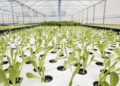
Netafim Southern & East Africa is continuing on its mission to make precision irrigation accessible and effective for every farmer, from large commercial producers to smallholders working a few hectares, across all crops and conditions.
Netafim managing director Michael Esmeraldo notes that the company’s focus remains clear: enabling farmers to grow more with less water through innovation, education, and long-term support.
“The water is not going to become more anytime soon. There are only two things that we really can do: we can build more water infrastructure across the region, and we can use water more efficiently. This is where adoption of precision irrigation technologies comes into play,” Esmeraldo explains.
Esmeraldo encourages farmers to optimise existing farmland before expanding into new areas. “Africa deforests 3.2 million hectares a year for agriculture. I often wonder, is it really necessary? Are we producing optimally on the arable land that we already have? If we can improve on the hectares that we’re currently farming on, we can stop cutting down new land.”
Through technologies such as drip irrigation and real-time monitoring systems, Netafim enables farmers to achieve higher yields with minimal waste. “Let’s just start using the land that we’re already farming on a little bit better,” Esmeraldo urges.
SA’s leadership in smart irrigation
According to Esmeraldo, globally, only 4-5% of farmers use drip irrigation, yet South Africa’s adoption rate stands at around 19%. He attributes this progress to the country’s long-standing experience with water scarcity and Netafim’s active role in introducing sustainable irrigation systems over the past decades.
“We’re a semi-arid country, and water has never been in abundance,” he says. “We’ve always had to make a plan with the water that we have. We are ahead globally. We’re not perfect, but we’re moving in the right direction.”
Netafim continues to lead regional efforts through collaborations, pilot projects, and partnerships across Zimbabwe, Zambia, Kenya, Malawi and many other countries in Southern and East Africa, driving the adoption of precision irrigation practices across the region.
Enabling compliance and market access
Esmeraldo believes Netafim’s technologies position farmers for future global market compliance, as international buyers increasingly demand evidence of sustainable production.
“I’ve been saying for years that water efficiency compliance is coming. Pretty soon, farmers will have to comply with some kind of water use efficiency regulation, just as they already do with pesticides, herbicides, and labour standards.”
By using Netafim’s precision systems, farmers can easily measure and control their water use, helping them prepare for possible water regulations.
Related stories
- Netafim celebrates 60 years of driving precision irrigation
- Netafim: The future of tree crop irrigation is already here
Making drip irrigation accessible to all farmers
Esmeraldo emphasises that the company is continuously working to make irrigation systems scalable and cost-effective. “Nowadays, we’re manufacturing drip irrigation with prices ranging from below one Rand per metre to over ten Rand per metre, suitable for a wide range of applications. It’s not like it was 10 or 15 years ago when it was only accessible to the top 10% of farmers.”
Solutions exist that allow farmers to begin with simple, seasonal systems and expand as their farms grow. “You can use it to start generating cash flow and go from step to step,” Esmeraldo adds.
Despite advances in accessibility, the lack of financing remains one of the biggest barriers to precision irrigation adoption. He challenges banks and development financiers to recognise drip irrigation as a key environmental, social, and governance (ESG) investment.
“If they can finance solar panels, why not drip irrigation. When the first bank jumps on this, it’s going to be a snowball effect, boosting food security, saving water, and strengthening the economy,” Esmeraldo says.
Educating farmers through agronomic support
According to Esmeraldo, Netafim is the only irrigation company in South Africa with a dedicated team of agronomists. Their role is to provide hands-on guidance, training, and soil-water education to farmers who may lack a technical background.
“Our agronomists help farmers understand, in a practical way, how water moves in the soil, the optimal management of drip irrigation and how precision transforms production,” Esmeraldo says.
Beyond one-on-one support, Netafim also partners with local industry bodies to deliver collective training sessions and demonstrations.
Precision irrigation as a risk management tool
Esmeraldo describes drip irrigation as a powerful risk management strategy in a changing climate: “It’s about efficiency. Drip irrigation is sitting at 95% efficiency, which means for every 100 litres of water applied, 95 litres reach the plant. If you only have limited water, at least 95% of it will be applied efficiently,” he explains.
He adds that low-flow drip irrigation systems further allow farmers to irrigate larger areas simultaneously, ensuring resilience during droughts.
Powering sustainable farming with renewable energy
Drip irrigation solutions are also compatible with solar energy, a major advantage in regions facing an unstable power supply.
“You can only use solar effectively with drip irrigation because it uses less electricity. In some parts of Africa, we’re already seeing large-scale farms combining solar energy with drip irrigation, a model that’s spreading,” Esmeraldo shares.
Looking ahead, Esmeraldo expresses confidence in Netafim’s growing contribution to transforming African agriculture, noting that the region already leads globally in several areas. He points to the citrus industry as a strong example of how advanced irrigation technologies can enhance yields, improve quality, and strengthen market access, setting a benchmark for other sectors to follow.
He concludes with a challenge to accelerate progress: “The convincing has been done. The score is on the board. Now it’s about pushing the rate of adoption of precision irrigation. We all need to use water more sparingly, and that starts with smarter irrigation.”
READ NEXT: Precision irrigation unlocks superior crop quality & exports