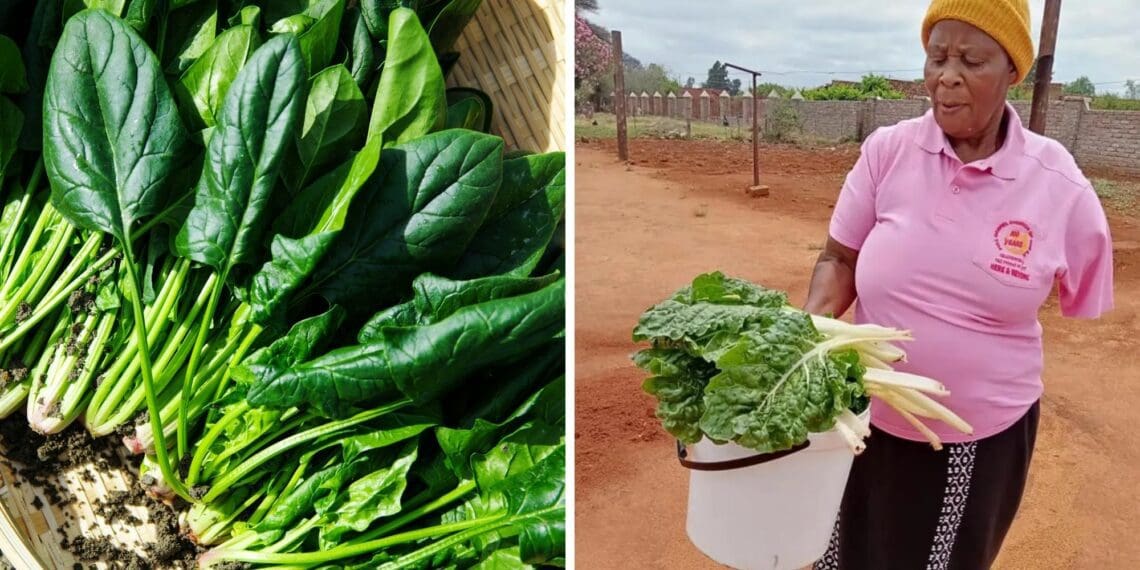
Having lived with her disability for over 30 years, Dolly Modisagaarekwe is determined to build a better life for her family and community through farming. The 66-year-old has taken up farming post-retirement despite having lost a hand in a car crash.
Modisagaarekwe, from Taung in North West, had many other jobs over the years, but it has always been farming that kept her going. When she retired in April 2021, she knew exactly what do next.
“I saw how older people in my area complained about having to go long distances just to buy vegetables. Most of them live alone, so I decided to start farming in my yard since the space is very big,” she tells Food For Mzansi.
In an effort to assist a care centre for the elderly, Modisagaarekwe started farming – a dream she was postponing for many years. “I started with spinach, cabbages, tomatoes and onions as these are the everyday basics that people need,” she explains.
Modisagaarekwe donated her first harvest to all her neighbours and pensioners. “I could not charge them because I felt this was my starting point. [I] wanted them to let me know how the produce from my garden [tasted]. From the produce that I planted, spinach was the one that came out a lot [in the feedback.] Many people in my area loved it also.”
A challenge to the disabled
Despite her disability, she started farming on a greater level. The accident that claimed her hand is now a distant memory and she is proof that disability does not have to be a prison sentence.
“I was involved in an accident with my husband and my hand got cut off from being involved in that,” she reminisces. “I knew from that time that my life was about to change. The saddest part was that my husband left me citing that he cannot be in a marriage with a disabled person, so he left me with the children.”
Modisagaarekwe urges other disabled people in disadvantaged communities to explore new opportunities in farming. She says, “If God has given you another chance and the mind is still functioning well, there is absolutely nothing that should stop them from working.
“I started by watering my backyard farm with a bucket using my one hand, but that did not deter me to continue working extra hard and have as many produce as possible. We need to move away from the mindset of disabled persons not being able to work. If we have the ability to work, let us get down and work.”

It takes a village
Meanwhile, Modisagaarekwe has high praise for the people who helped her on her journey. She singles out members of her church as well as a neighbour, Phemelo Manankong, who also works for the Northern Cape department of agriculture and land reform.
“He motivated me a lot and encouraged me to go the extra mile in my farming journey. He saw how challenging watering my produce was and bought me a hosepipe which eased the burden of having to water my garden with a bucket which was starting to have an impact on my back.”
Of course, farming comes with many challenges. Modisagaarekwe struggled when some of her vegetables didn’t mature because of a lack of water.
“I must say, these recent rains brought so much joy to me. Even the maize that I had planted started showing life after weeks of having little water.”
She looks forward to a great new year. Her goal is to provide early childhood development centres with her produce, especially her much-loved spinach.
“In the following year, I am increasing my crops and want to add other things. My yard is big enough to add other crops. I intend to approach creches and other care centres to purchase my produce.”
Her ultimate farming dream includes more equipment to ease the farming process, as well as her very own storeroom. Currently, this is stored in her two-room house which isn’t ideal for a mother of three. “I am very much excited about [the new] year and the plans I have. Disability cannot stand in my way to make my life and those of my community better.”