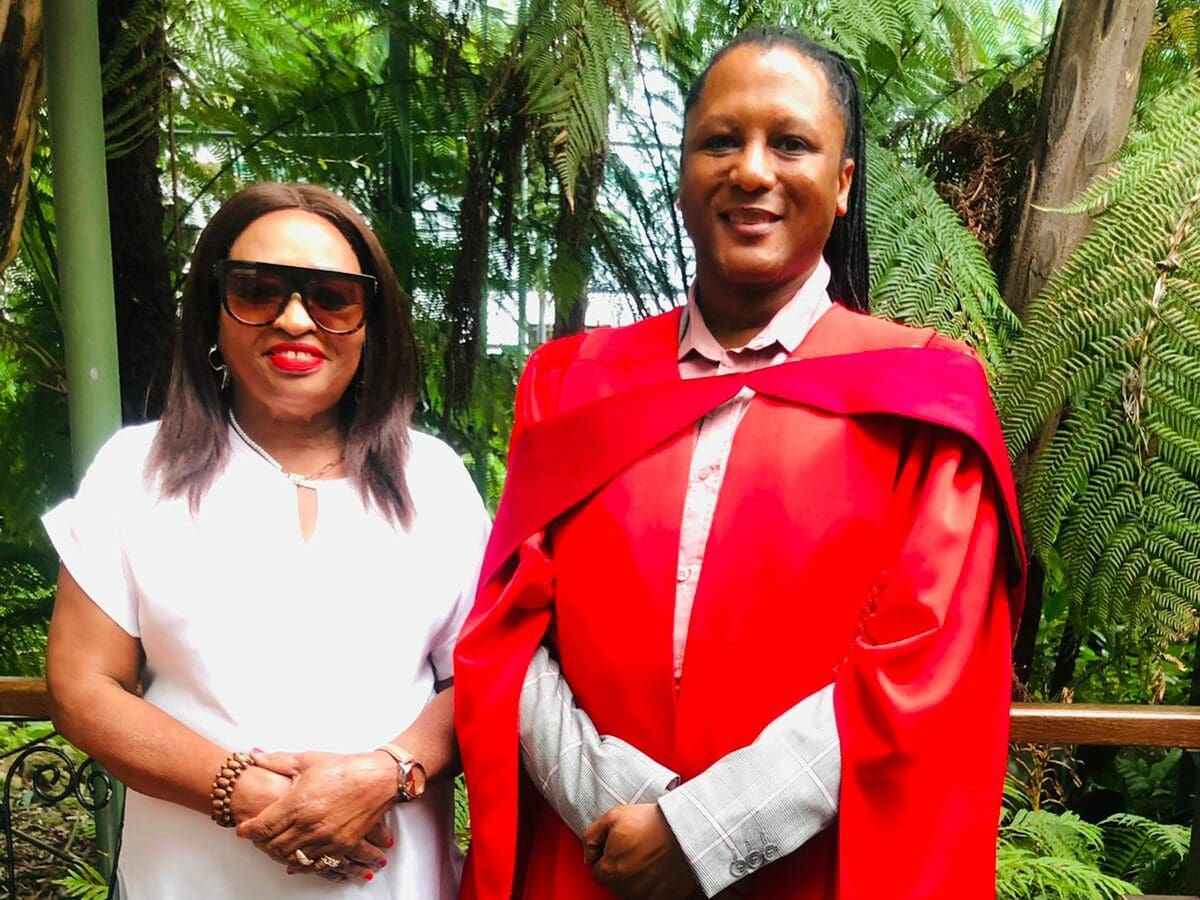
Medicine’s loss was agriculture’s gain. And, in the end, Andries Daniels (40) gets to be called “doctor”, anyway, after he recently became the first black South African male to receive a PhD in viticulture.
The senior researcher at the Agricultural Research Council Infruitec-Nietvoorbi initially had his eye set on healthcare. None of the Mother City’s universities, however, accepted his application because his matric results just weren’t good enough.
Then, after re-writing the exams to improve his marks he was eventually accepted to study medicine, but a South African Curators Board bursary to study agriculture changed his life course. He ended up studying for a BSc degree in viticulture and oenology instead.
Today, he is a force to be reckoned with and he is passionate about driving change in the agriculture sector. In an interview with Food For Mzansi, shortly after receiving his doctorate from Stellenbosch University, Daniels said, “I don’t want to regard my PhD as just another book on the shelf, but as a symbol for a solution that I offered to the table.”
A solutions driven viticulturist
Throughout his studies, Daniels has always been solutions-driven. In 2008 he received an honours degree in viticulture. His Master’s degree followed five years later. This, while delivering presentations at many local and international conferences and having four peer-reviewed articles published.
Not many people know, though, that Daniels had to work himself up from night watchman at the ARC to grape master.
His childhood was tough, too, and in the absence of his own father he had to provide for his family. “I’ve always worked hard. I had to grow up quickly because I saw my mother was unemployed and my siblings needed things that no one could truly give [them] but me.”
He remains most grateful to his mother, Agnes, for taking him to the local library to read so he could be knowledgeable. This provided not only a welcome escape but opened a whole new world.
Throughout his life, Daniels was influenced by inspirational people. After all, it takes a village to get a PhD. He referenced the saying, “You are the people you spend your time with.” These people encouraged him to reach for greater heights.
“I have always had these amazing friends – all unique in their own way. They have been in my life for almost 20 years now. My supervisors, Professor Umezuruike Opara and Dr Hélène Nieuwoudt, also played pivotal roles in my journey to become Dr Andries Jerrick Daniels.”
According to Daniels there is, however, one friend that stands out in terms of supporting him throughout his academic journey. This is Dr Denver van Schalkwyk.
“He got his PhD when he was 27. He has really been that overachiever in the group [of friends] and always was an inspiration due the way he thinks and tackles things. He also was the one who was always there, calling me, encouraging me to push on.”

ALSO READ: From ink to wine: How Zinaschke got top winemaker job
Mzansi raisin grape cultivar
In a media release, the ARC said Daniels’ PhD work focused on different technologies. This includes near infrared (NIR) spectroscopy that can be used to determine the quality of whole table grape berries and bunches in the vineyard and the packing shed before packing.
Daniels is also proud of his work on Sundowner, the very first uniquely South African-bred raisin grape cultivar. Sundowner was developed in collaboration with his ARC team leader, plant breeder Phyllis Burger, RaisinsSA and Culdevco.
Being a self-starter has always been his greatest strength, and he considered himself lucky to work in an environment that allows him creative flexibility.
“My supervisor, Phyllis [Burger], is aware that I am hands-on, and she occasionally reminds me of all I have done when I forget.”
He explained, “Sundowner was inspired by the sensation you get when you had a difficult day and you need to let some steam off, sitting by the patio and staring at the balance of yellow, tangerine and orange hues with a glass of great wine ready to be savored.”
Furthermore, his study with raisin cultivars has led him to work with so-called second-economy farmers, who were previously disadvantaged and do not currently have the same opportunities as many commercial white farmers.
“It has given me the chance to begin training farmers from the ground up, beginning with the planting of vines and grafting of the new cultivator. The training I provide them with, inspires and encourages me because I know that all of the information, I’ve gained over the years can be put to use in a practical way.”
Daniels has high hopes for the future. He aims to do further research and develop new models to aid in the improvement of grape varietals in South Africa. “My aim is to deliver sustainable and effective solutions to South African grape farmers,” he says.
He believes this would not only help the grape sector to grow to new heights, but it will also reduce imports, which have been costly for Mzansi producers. “I am convinced that if I continue my efforts, the grape farming business will not suffer any longer, and the economy will improve.”